
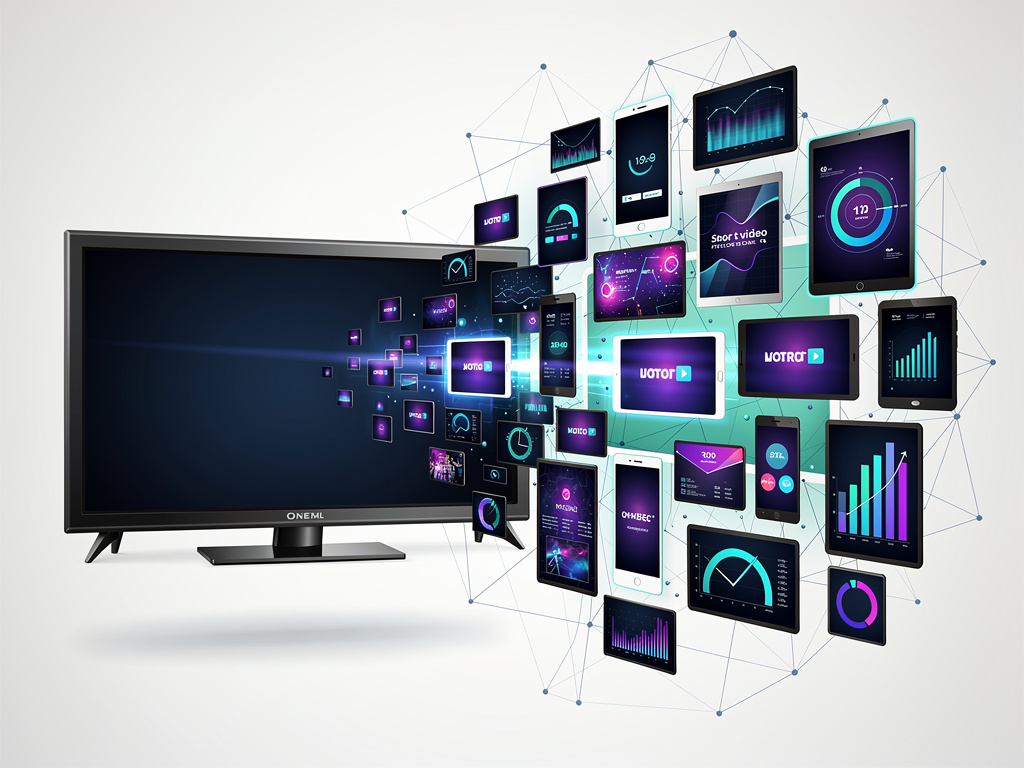
The 30-second television commercial didn’t die so much as it shattered into fragments, each piece finding a new home across platforms that didn’t exist when Madison Avenue first perfected the format. What replaced it isn’t a single heir but a sprawling collection of advertising units, each with its own rules, metrics, and creative demands.
Advertisers spent $68.3 billion on television in 2023, according to eMarketer. That’s down from $70.6 billion in 2021. The money didn’t vanish. It scattered.
Digital video advertising reached $63.1 billion in 2023, with social media claiming another $72.3 billion. But these numbers obscure a more fundamental transformation. The 30-second spot assumed a captive audience, a shared cultural moment, and a clear boundary between content and commerce. All three assumptions have collapsed.
“We’re not replacing 30-second spots with another standardized unit,” says Jessica Liu, senior vice president of creative strategy at Dentsu. “We’re creating hundreds of different formats, each optimized for a specific platform, audience state, and conversion goal.”
The six-second bumper ad on YouTube represents one extreme. Launched in 2016, these unskippable units force advertisers to compress their message into what amounts to a brand flash. Google reported that bumper ads drove a 90% lift in ad recall when used alongside longer formats. But they work only when viewers already know the brand.
TikTok invented something different entirely. The platform’s native ads blend into the feed with the same vertical format and interaction patterns as organic content. TopView ads, which appear when users open the app, last up to 60 seconds but rarely run their full length. TikTok’s internal research found that ads under 21 seconds generate the highest engagement rates.
These aren’t modified TV spots. They’re designed for thumbs, not remote controls.
Instagram offers five distinct ad formats within Stories alone, each with different duration limits, interaction options, and performance characteristics. Reels ads mirror the platform’s short-form video feed. Feed ads look like posts. Shopping ads turn the entire interface into a storefront. No single format dominates because user behavior shifts depending on how they entered the app and what they came to do.
“The idea that you could create one piece of creative and distribute it everywhere is dead,” says Marcus Chen, chief creative officer at Wieden+Kennedy. “We’re now creating 40 to 50 variations of a campaign, each tailored to a specific platform, placement, and audience segment.”
Television itself has fragmented. Connected TV advertising grew to $25.1 billion in 2023, according to IAB, but CTV ads come in wildly different forms. Hulu shows traditional 30-second spots but also offers pause ads, L-bar banners, and interactive overlays. Roku places video ads in its home screen and screensavers. YouTube operates on its own logic entirely, mixing skippable and non-skippable units of varying lengths.
The fragmentation extends to measurement. Television relied on Nielsen ratings, an imperfect but shared currency. Digital platforms each provide their own metrics, often incompatible with competitors. Impressions, viewable impressions, completed views, view-through rates, and engagement rates all measure different things. The Association of National Advertisers found that 15% of programmatic ad impressions go to sites with made-for-advertising content that delivers little value.
So advertisers now plan campaigns across a matrix of formats, platforms, and objectives. Awareness. Consideration. Conversion. Each stage demands different creative approaches and success metrics.
Amazon changed the calculation further by tying advertising directly to commerce. Sponsored product ads appear in search results and product pages, looking nearly identical to organic listings. Video ads on Prime Video now interrupt content, but they link directly to product pages. The entire advertising experience collapses into a single transaction. Amazon’s advertising revenue reached $46.9 billion in 2023, making it the third-largest digital ad platform behind Google and Meta.
Streaming services adopted different strategies. Netflix resisted advertising for years before launching an ad-supported tier in November 2022. The company initially offered only 15 and 30-second spots, deliberately mimicking traditional television. But Netflix reported that its ad tier reached 40 million monthly active users by May 2024, and the company began experimenting with interactive formats and deeper audience targeting.
Disney+ took a different approach, offering three ad formats at launch: 15, 30, and 60 seconds. The company emphasized its first-party data and brand safety. “We know exactly who’s watching and can match that to household data,” Rita Ferro, Disney’s president of advertising, told AdWeek. The pitch focuses on precision rather than reach.
Podcast advertising invented yet another format. Host-read ads, often 60 to 90 seconds long, embed the sales message in the host’s voice and style. These ads perform better than produced spots because they sound like content. Industry data shows that host-read ads generate conversion rates two to three times higher than standard digital audio ads.
The creative implications run deep. Television commercials developed a grammar over decades—the problem-solution structure, the celebrity endorsement, the emotional vignette with product reveal. Digital formats demand different storytelling approaches.
TikTok ads work best when they don’t look like ads. Brands hire creators to produce content that matches the platform’s aesthetic—quick cuts, trending sounds, authentic presentation. TikTok found that branded content from creators drives 27% higher engagement than standard ads.
Instagram prioritizes visual polish. High-quality photography and clean design signal credibility. The platform’s shopping features blur the line between content and commerce, allowing users to purchase products without leaving the app.
YouTube occupies a middle ground. The platform hosts everything from six-second bumpers to 20-minute product demonstrations. Successful YouTube advertising often provides value—tutorials, entertainment, or information—rather than interrupting it. Brands increasingly create content that viewers choose to watch rather than ads they’re forced to see.
And then there’s influencer marketing, which dispenses with traditional advertising formats altogether. Creators integrate products into their content, sometimes with clear sponsorship disclosures, sometimes more ambiguously. The Federal Trade Commission issued updated guidance on disclosure requirements, but enforcement remains inconsistent.
Programmatic advertising automates the buying process but adds another layer of complexity. Advertisers bid on individual impressions in real-time auctions, targeting specific audiences across thousands of websites and apps. The system theoretically improves efficiency but creates transparency problems. Ads appear on sites advertisers never approved. Bots generate fake impressions. Measurement grows murky.
The Interactive Advertising Bureau established standards for digital video ads, but platforms often ignore them. Pre-roll, mid-roll, and post-roll placements follow different rules on different services. Auto-play policies vary. Sound defaults to on or off depending on the platform. Advertisers must master each platform’s specific requirements.
Television’s simplicity looks almost quaint in comparison. Buy spots during specific programs. Create a 30-second commercial. Measure reach and frequency. The system had flaws—waste, imprecision, high costs—but everyone understood how it worked.
The new environment offers precision that television never could. Advertisers can target 25-year-old women in Denver who searched for running shoes in the past week. They can serve different ads to different households watching the same streaming program. They can measure not just impressions but clicks, conversions, and lifetime value.
But precision comes with costs. Creative production expenses multiply when every platform requires custom formats. Media planning grows exponentially more complex. Attribution—determining which ad drove which sale—becomes a statistical exercise rather than a clear answer.
Privacy regulations complicate everything further. Apple’s App Tracking Transparency framework, implemented in 2021, requires apps to ask permission before tracking users across other apps and websites. Flurry Analytics reported that only 25% of users opt in to tracking globally. Google plans to phase out third-party cookies in Chrome, though the timeline keeps shifting. The infrastructure that enabled precise digital targeting is crumbling.
Advertisers respond by investing in first-party data—information collected directly from customers. Retail media networks, where brands advertise on retailer websites and apps, exploded in growth. Walmart, Target, CVS, and dozens of other retailers launched advertising businesses, offering brands access to purchase data. eMarketer projects retail media ad spending will reach $56.1 billion in 2024, up from $45.2 billion in 2023.
The fragmentation creates winners and losers. Large brands with substantial budgets can afford to create dozens of ad variations and test them across platforms. Small businesses struggle with the complexity. Agencies expand their production capabilities or partner with specialized studios. Creative talent must understand platform algorithms as well as storytelling principles.
Television commercials employed directors, cinematographers, and production crews. Digital formats often require different skills—motion graphics, user interface design, data analysis. The career paths that led to creative director roles in traditional advertising no longer apply.
What’s emerging isn’t chaos, exactly, but a new order with different organizing principles. Reach matters less than relevance. Production value matters less than platform fit. The campaign concept matters less than the ability to execute hundreds of variations.
Some advertisers still produce 30-second spots. Major brands buy time during the Super Bowl and other live events. But these commercials now serve as anchors for broader campaigns that spin out into dozens of formats. The TV spot becomes source material—a 30-second version, a 15-second version, a six-second version, a vertical version for Stories, a version with captions for sound-off viewing, a version optimized for mobile, a version for connected TV.
The advertising industry adapted by building new infrastructure. Creative management platforms store assets and generate variations automatically. Dynamic creative optimization systems assemble ads in real-time based on viewer data. Attention measurement companies use eye-tracking and facial coding to determine what actually gets noticed.
But the fundamental challenge remains: capturing attention in an environment where audiences control what they see. Television forced viewers to watch ads or change the channel. Digital platforms let users scroll past, skip, or block ads entirely. Advertisers must earn attention rather than demand it.
This transforms the creative brief. Instead of asking “What’s our 30-second spot?” brands ask “What will people choose to engage with?” The answer varies by platform, audience, and context. A luxury car brand might run cinematic spots on streaming services, carousel ads on Instagram, and search ads on Google. Each format tells a different part of the story.
Performance marketing—advertising designed to generate immediate actions—now accounts for the majority of digital spend. Brand advertising—designed to shape perceptions over time—struggles to justify its budget in platforms built for direct response. The tools measure clicks and conversions easily but struggle with harder questions about brand health and long-term value.
The 30-second spot thrived because it balanced brand building and persuasion in a single unit. You had time to tell a story, create an emotion, and deliver a message. The format’s constraints forced discipline. Today’s fragments often optimize for a single objective—awareness or conversion, emotion or information—but rarely both.
Television advertising also created shared cultural moments. Entire offices discussed the previous night’s commercials. Super Bowl ads became events unto themselves. Digital advertising targets individuals, not audiences. The campaigns that break through socially now do so because they spread organically, not because everyone saw them simultaneously.
The advertising fragment replaced the 30-second spot not because it works better but because audiences scattered and platforms multiplied. Advertisers followed viewers wherever they went, adapting to each platform’s formats and rules. What looks like progress—precision, measurement, efficiency—comes with losses in creativity, cultural impact, and clarity.
No one expects the 30-second spot to return as the dominant format. But its death revealed something the industry is still processing: perhaps advertising’s golden age depended less on creative excellence than on captive audiences with limited choices. Now that audiences can avoid, skip, or ignore ads, advertisers must work harder for attention they once commanded by default. The fragments that replaced the 30-second spot reflect this new reality—smaller, faster, more targeted, and far more numerous. Whether they’re better remains an open question.


 WebProNews is an iEntry Publication