
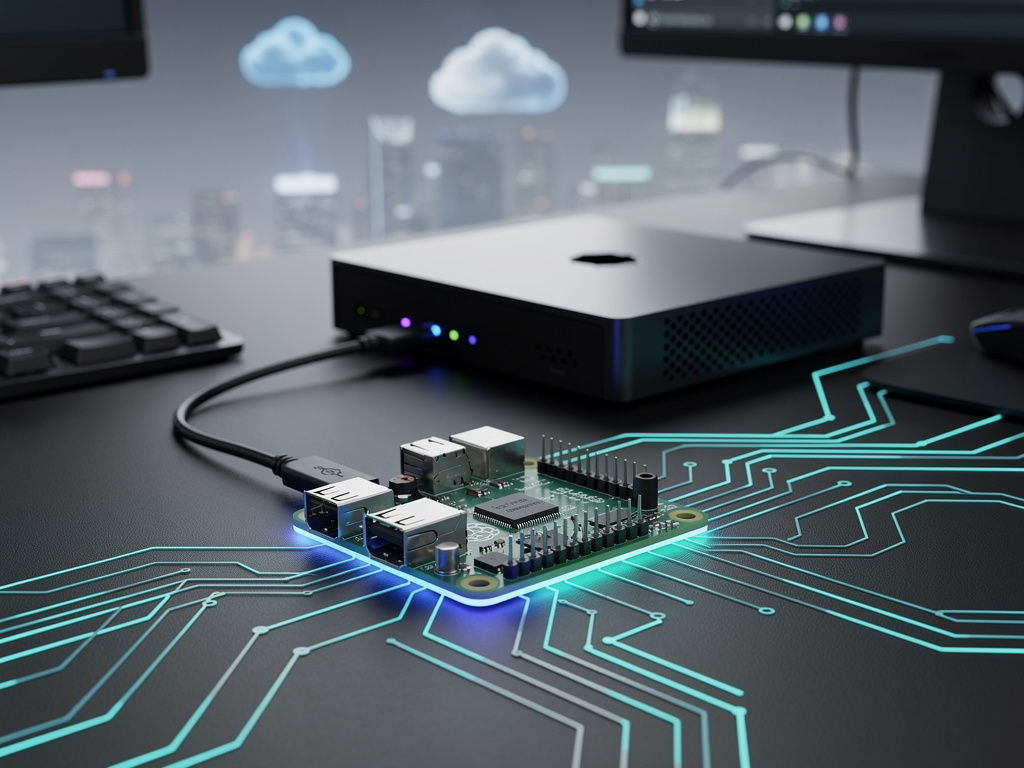
In an era where artificial intelligence development seems locked in an arms race toward ever-larger models requiring massive cloud infrastructure, one developer has taken the opposite approach. Mario Zechner, a software engineer and independent researcher, has successfully created a fully functional AI coding assistant that runs locally on a Raspberry Pi 5—a $60 single-board computer roughly the size of a credit card. The project, which he detailed in a comprehensive technical writeup on his personal blog, represents a significant milestone in demonstrating that practical AI applications don’t necessarily require enterprise-grade hardware or cloud dependencies.
Zechner’s experiment challenges the prevailing narrative that useful AI coding assistants must rely on massive language models hosted in data centers. His implementation uses DeepSeek Coder V2 Lite, a 16-billion-parameter model that has been quantized to run efficiently on consumer hardware. The entire system operates within the constraints of the Raspberry Pi 5’s 8GB of RAM, processing code suggestions and completions without any internet connection. For developers concerned about code privacy, intellectual property protection, or simply wanting to avoid subscription fees, this represents a compelling alternative to cloud-based solutions like GitHub Copilot or Amazon CodeWhisperer.
The technical architecture Zechner developed is remarkably sophisticated despite its modest hardware foundation. He built the system using llama.cpp, an open-source inference engine optimized for running large language models on consumer hardware. The coding agent integrates with Visual Studio Code through a custom extension, providing real-time code completion, bug detection, and refactoring suggestions. Response times average between 2-8 seconds depending on query complexity—slower than cloud-based alternatives but entirely acceptable for many development workflows, particularly when weighed against the benefits of complete data sovereignty and zero ongoing costs.
Engineering Constraints and Optimization Strategies
The journey to fitting a capable coding assistant onto a Raspberry Pi required numerous technical compromises and clever optimizations. Zechner employed 4-bit quantization on the DeepSeek Coder model, a technique that reduces the precision of the model’s numerical weights to decrease memory requirements. This quantization process typically results in some degradation of model performance, but Zechner’s testing revealed that for coding tasks, the impact was minimal—the quantized model retained approximately 95% of its original capabilities while reducing its memory footprint by roughly 75%.
Memory management proved to be the most significant technical challenge. The Raspberry Pi 5’s 8GB of RAM must accommodate not only the AI model itself but also the operating system, the inference engine, and the development environment. Zechner implemented aggressive context window management, limiting the amount of surrounding code the model considers when generating suggestions. He also developed a custom caching system that keeps frequently accessed model components in memory while swapping less-used portions to the Pi’s microSD card storage. These optimizations allowed the system to maintain stable operation even during extended coding sessions.
The performance characteristics of this local setup reveal interesting trade-offs compared to cloud-based alternatives. While response latency is higher—typically 3-5 seconds for simple completions versus sub-second responses from GitHub Copilot—the system exhibits no network-related delays or failures. For developers working in environments with unreliable internet connectivity or on projects with strict data residency requirements, this reliability advantage can outweigh the speed differential. Additionally, the system’s throughput remains consistent regardless of how many developers might be using cloud services simultaneously, eliminating the occasional slowdowns that affect shared infrastructure.
Privacy and Security Implications for Enterprise Development
The privacy implications of Zechner’s approach extend far beyond individual developer preferences. Major technology companies and financial institutions face increasingly stringent data protection regulations that complicate the use of cloud-based AI coding assistants. When developers use services like GitHub Copilot, code snippets are transmitted to external servers for processing—a practice that can violate corporate security policies or regulatory requirements in industries like healthcare, finance, and defense. A fully local solution eliminates this entire category of risk, ensuring that proprietary code never leaves the developer’s machine.
Several high-profile incidents have heightened corporate sensitivity around code leakage through AI assistants. In 2023, Samsung banned employee use of ChatGPT after engineers accidentally leaked sensitive semiconductor design information by pasting code into the system for optimization suggestions. Similar concerns have led numerous enterprises to restrict or prohibit cloud-based AI coding tools. Zechner’s Raspberry Pi implementation offers these organizations a potential path forward—they can provide developers with AI-assisted coding capabilities while maintaining complete control over their intellectual property.
The economic model also deserves scrutiny. GitHub Copilot costs $10 per user per month for individuals and $19 per user per month for businesses. For a development team of 50 engineers, this represents $11,400 annually at the business tier. By contrast, equipping each developer with a Raspberry Pi 5 and the necessary peripherals costs roughly $150 per workstation—a one-time expense of $7,500 that pays for itself in less than eight months. For larger organizations or those in cost-sensitive markets, this economic advantage becomes increasingly compelling, particularly when combined with the privacy and security benefits.
Technical Limitations and Real-World Performance
Despite its impressive capabilities, Zechner’s system has clear limitations that prevent it from being a drop-in replacement for cloud-based alternatives in all scenarios. The 16-billion-parameter DeepSeek Coder model, even when running optimally, cannot match the sophistication of the much larger models powering services like GitHub Copilot, which reportedly uses OpenAI’s GPT-4 architecture with hundreds of billions of parameters. This size differential manifests in the quality of code suggestions, particularly for complex algorithmic problems or when working with less common programming languages and frameworks.
Zechner’s testing revealed that the local system excels at routine coding tasks—autocompletion, generating boilerplate code, simple refactoring, and identifying common bug patterns. However, it struggles with more abstract reasoning tasks, such as architectural design suggestions or optimizing complex algorithms. The model’s smaller context window, limited by the Pi’s memory constraints, means it can only consider a few hundred lines of surrounding code when making suggestions, whereas cloud-based systems can analyze thousands of lines or even entire codebases. For large-scale enterprise applications with millions of lines of code, this contextual limitation represents a significant disadvantage.
The inference speed, while acceptable for many workflows, can disrupt the flow state that developers prize. Modern cloud-based AI assistants have trained developers to expect near-instantaneous suggestions that appear as they type. The 3-5 second delay of the Raspberry Pi system requires a mental adjustment—developers must pause and wait for suggestions rather than having them appear seamlessly. Zechner acknowledges this limitation in his writeup, noting that the system works best for developers who adopt a more deliberate coding style, thinking through their approach before requesting AI assistance rather than relying on the AI to guide their exploration.
Open Source Ecosystem and Community Response
The broader implications of Zechner’s work extend into the ongoing debate about AI democratization and the concentration of AI capabilities in the hands of a few large technology companies. By demonstrating that useful AI coding assistance can run on commodity hardware costing less than $100, he has provided a proof of concept for a more decentralized approach to AI tooling. The entire project relies on open-source components—the DeepSeek Coder model is freely available, llama.cpp is open source, and Zechner has released his integration code under a permissive license.
This open-source foundation has already sparked community interest and derivative projects. Developers on GitHub and Hacker News have begun experimenting with variations of Zechner’s approach, testing different model architectures, exploring alternative quantization strategies, and adapting the system for other single-board computers. Some have reported success running similar setups on the more powerful Nvidia Jetson boards, which offer better GPU acceleration and can handle larger models with shorter inference times. Others have focused on optimizing the system for specific programming languages or development environments.
The project also highlights the rapid pace of improvement in small language models. Just two years ago, running a capable coding assistant on a Raspberry Pi would have been impossible—the available models were either too large to fit in memory or too unsophisticated to provide useful suggestions. The DeepSeek Coder V2 Lite model that Zechner uses was released in 2024 and represents a new generation of efficient models specifically designed for resource-constrained environments. As this trend continues, the performance gap between local and cloud-based AI assistants will likely narrow further.
Future Directions and Industry Impact
Zechner’s experiment arrives at a pivotal moment in the evolution of development tools. The initial excitement around AI coding assistants has given way to more nuanced discussions about their practical utility, cost-effectiveness, and security implications. While cloud-based solutions will likely remain the default choice for many developers and organizations, the viability of local alternatives opens new possibilities for specific use cases and markets. Government agencies with strict air-gapped network requirements, startups operating on tight budgets, and developers in regions with limited internet infrastructure all represent potential audiences for local AI coding assistants.
The technical approach Zechner pioneered could also inform hybrid architectures that balance local and cloud capabilities. Imagine a development environment that handles routine completions and simple queries locally on a Raspberry Pi or similar device, only reaching out to cloud-based services for complex reasoning tasks that exceed local capabilities. This hybrid model would minimize data exposure while still providing access to more sophisticated AI assistance when needed. Several startups in the AI infrastructure space are already exploring similar architectures, though none have yet delivered production-ready implementations.
Looking forward, the continued improvement in model efficiency and hardware capabilities suggests that local AI coding assistants will become increasingly viable. Apple’s M-series chips, AMD’s Ryzen AI processors, and Qualcomm’s Snapdragon X Elite all include dedicated neural processing units designed to accelerate AI workloads on consumer devices. As these technologies mature and become more widespread, the performance gap between local and cloud-based AI assistants will continue to narrow. Zechner’s Raspberry Pi implementation may eventually be viewed as an early proof of concept for a broader shift toward edge-based AI computing in software development.
The project also raises important questions about the future business models for AI coding assistance. If capable local alternatives become widely available at minimal cost, how will companies like GitHub, Microsoft, and Google justify their subscription fees? The answer likely lies in the additional services and integrations that cloud platforms can provide—seamless collaboration features, integration with project management tools, and access to the absolute cutting edge of model capabilities. However, the existence of viable free alternatives will inevitably apply downward pressure on pricing and force cloud providers to more clearly articulate their value proposition beyond raw AI capabilities.
For now, Zechner’s Raspberry Pi coding agent remains primarily a technical curiosity and a powerful demonstration of what’s possible with careful engineering and open-source tools. Its practical utility is limited to specific scenarios where privacy, cost, or connectivity constraints outweigh the need for maximum performance. Yet in demonstrating that useful AI coding assistance can escape the data center and run on a device that fits in your pocket, Zechner has expanded the boundaries of what developers can reasonably expect from their tools. In an industry often characterized by ever-escalating hardware requirements and cloud dependencies, that expansion represents a refreshing counterpoint—and perhaps a glimpse of a more decentralized AI future.


 WebProNews is an iEntry Publication