
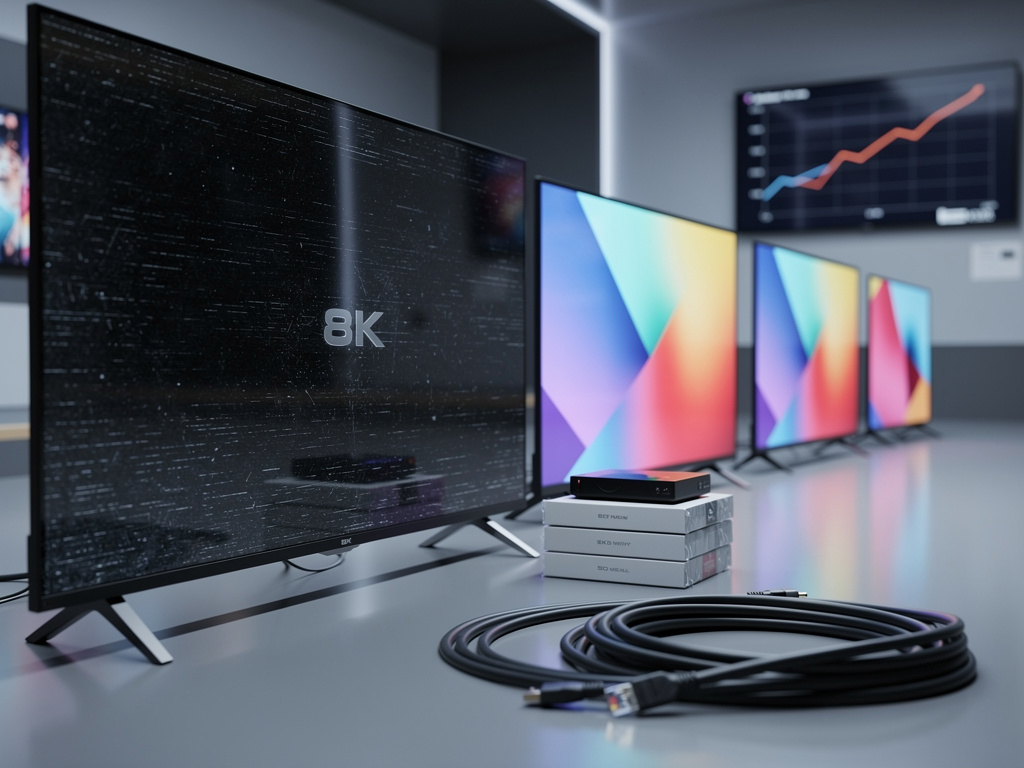
The television industry’s grand vision of 8K resolution dominating living rooms worldwide is quietly unraveling, as manufacturers, content creators, and streaming platforms collectively acknowledge what many consumers suspected all along: the emperor of ultra-high-definition may have no clothes. After years of aggressive marketing and premium pricing for 8K displays, the sector is experiencing a sobering reality check that reveals the chasm between technological capability and practical consumer demand.
According to Slashdot, the television industry is finally confronting the possibility that 8K may never achieve mainstream adoption. This admission represents a significant departure from the optimistic projections that dominated industry conferences and product launches over the past five years. The technology, which offers 7680 x 4320 pixels—four times the resolution of 4K and sixteen times that of 1080p HD—promised to revolutionize home entertainment with unprecedented clarity and detail.
The reality, however, has proven far more complex than the marketing materials suggested. Multiple factors have conspired to create what industry analysts now describe as a perfect storm of obstacles preventing 8K from gaining traction. These include the scarcity of native 8K content, the astronomical bandwidth requirements for streaming such content, the limited human ability to perceive differences between 4K and 8K at typical viewing distances, and the premium pricing that has kept 8K displays out of reach for most consumers.
The Content Conundrum: A Resolution Without Programming
The most fundamental challenge facing 8K adoption remains the near-complete absence of native content. Major streaming platforms including Netflix, Amazon Prime Video, Disney+, and HBO Max have shown little interest in producing or distributing 8K programming. The economics simply don’t support the massive investment required for 8K production when 4K adoption itself remains incomplete. Film studios face similar calculations: shooting, storing, and distributing 8K content requires exponentially more storage capacity and processing power than 4K workflows.
Broadcast television has proven even less hospitable to 8K ambitions. While Japan’s NHK launched experimental 8K broadcasts for the 2020 Tokyo Olympics, the initiative failed to spark widespread adoption or inspire similar efforts in other markets. The infrastructure investments required to support 8K broadcasting—from cameras and production equipment to transmission systems and satellite capacity—represent billions of dollars in capital expenditure with uncertain return on investment. Traditional broadcasters, already struggling with cord-cutting and declining advertising revenue, have shown no appetite for such risky ventures.
The gaming industry, often an early adopter of cutting-edge display technology, has similarly declined to embrace 8K. Current generation gaming consoles from Sony and Microsoft prioritize frame rates and ray tracing over resolution, with most titles targeting 4K at 60 or 120 frames per second rather than 8K at lower frame rates. The computational demands of rendering games at 8K resolution would require hardware far beyond current console capabilities, and even high-end gaming PCs struggle to maintain playable frame rates at 8K in graphically demanding titles.
The Physics of Perception: When More Pixels Don’t Matter
Perhaps the most damning evidence against 8K’s necessity comes from human physiology itself. Vision scientists have long understood that the human eye has finite resolving power, and at typical television viewing distances, most people cannot distinguish between 4K and 8K resolution. For a 65-inch television—among the most popular large-screen sizes—viewers would need to sit approximately five feet away to perceive any difference between 4K and 8K, a distance closer than most living room configurations allow.
This biological limitation fundamentally undermines the value proposition of 8K displays for home use. While 8K resolution might prove beneficial for enormous screens exceeding 85 inches, or for commercial applications like digital signage and cinema projection, the mass consumer market operates within physical constraints that make the additional resolution imperceptible. Industry researchers have conducted numerous double-blind tests where viewers consistently fail to identify 8K content when shown side-by-side with high-quality 4K material at realistic viewing distances.
The bandwidth requirements for streaming 8K content present another insurmountable obstacle for mass adoption. An 8K stream requires approximately 50-100 Mbps of sustained bandwidth, depending on compression efficiency—far exceeding the capabilities of typical home internet connections in most markets. Even in countries with advanced broadband infrastructure, internet service providers have expressed concern about the network congestion that widespread 8K streaming would create. The data caps imposed by many ISPs would make regular 8K viewing prohibitively expensive for consumers, adding another barrier to adoption.
Manufacturing Realities and Market Dynamics
Television manufacturers themselves have begun quietly retreating from their 8K commitments. Samsung, once the most vocal proponent of 8K technology, has significantly reduced its 8K model lineup and shifted marketing emphasis back to premium 4K displays with enhanced features like mini-LED backlighting, quantum dot color, and high refresh rates. LG has followed a similar trajectory, focusing innovation on OLED panel improvements and gaming-specific features rather than resolution increases. Sony’s 8K offerings remain limited to a handful of flagship models positioned as prestige products rather than volume sellers.
Sales data confirms the market’s indifference to 8K. Industry tracking shows 8K televisions accounting for less than one percent of global TV sales, with no indication of accelerating adoption curves. The premium pricing required to offset the higher manufacturing costs of 8K panels—typically two to three times the cost of comparable 4K models—has created a value proposition that consumers overwhelmingly reject. In an era when excellent 65-inch 4K televisions sell for under $500, asking consumers to pay $3,000 or more for imperceptible resolution improvements has proven a non-starter.
The production economics further complicate 8K’s viability. Manufacturing 8K panels requires more sophisticated equipment and tighter tolerances than 4K production, resulting in lower yields and higher per-unit costs. As panel makers have invested billions in expanding 4K production capacity, the financial incentive to maintain parallel 8K manufacturing lines has diminished. Several major panel manufacturers have reportedly scaled back or suspended 8K panel production, redirecting resources toward improving 4K panel quality and reducing costs.
The Streaming Wars and Resolution Reality
The competitive dynamics of the streaming industry have effectively sealed 8K’s fate. As platforms compete for subscribers, they’ve concluded that investment in content quality, catalog depth, and user experience delivers far better returns than resolution increases. Netflix’s decision to focus on improving HDR implementation, color accuracy, and audio quality rather than pursuing 8K reflects a data-driven understanding of what actually enhances viewer satisfaction and retention.
Bandwidth economics play a crucial role in streaming platforms’ calculus. Delivering 4K content already strains network infrastructure and drives significant costs for content delivery networks. Quadrupling the data requirements for 8K would proportionally increase delivery costs while serving a negligible audience of 8K display owners. The business case simply doesn’t exist when platforms can improve the viewing experience for their entire user base through other enhancements that require far less bandwidth and infrastructure investment.
The professional production community has also grown skeptical of 8K’s necessity for consumer delivery. While some cinematographers appreciate 8K cameras for the flexibility they provide in post-production—allowing for reframing, digital zooming, and visual effects work—they recognize that the final delivery format for the vast majority of viewers will be 4K or lower. The workflow complications and storage costs associated with 8K production are increasingly difficult to justify when the end product will be downsampled for distribution.
What Comes After the 8K Dream
The industry’s pivot away from 8K represents a maturation of the television market, where incremental resolution increases no longer drive consumer upgrade cycles. Instead, manufacturers are focusing on improvements that deliver tangible benefits: better contrast through mini-LED and OLED technology, wider color gamuts, higher peak brightness for HDR content, faster refresh rates for gaming and sports, and improved smart TV interfaces. These enhancements provide demonstrable value that consumers can perceive and appreciate, unlike the theoretical benefits of 8K resolution.
The 8K experience offers valuable lessons for technology industries prone to specification-driven marketing. The assumption that more is always better—more pixels, more megahertz, more megapixels—ignores the complex relationship between technical specifications and actual user experience. As the television industry discovered, crossing the threshold of human perceptual ability renders further increases meaningless for practical purposes, regardless of how impressive the numbers appear in marketing materials.
Some industry observers suggest that 8K technology may eventually find its place in niche applications rather than mass consumer adoption. Medical imaging, professional video production, digital signage, and specialized commercial installations could benefit from 8K resolution in ways that home television viewing does not. This trajectory would mirror other technologies that failed to achieve predicted consumer adoption but found sustainable markets in professional and commercial sectors.
The Future of Television Innovation
Looking forward, the television industry appears to be redirecting innovation toward areas with clearer consumer benefits and more sustainable business models. Micro-LED technology promises OLED-like picture quality with improved brightness and longevity. Advanced AI processing can enhance lower-resolution content, potentially delivering better results than simply increasing native resolution. Improved gaming features, including variable refresh rates and low-latency modes, address the needs of the growing gaming demographic.
The environmental implications of the 8K retreat also deserve consideration. The energy consumption of 8K displays significantly exceeds that of 4K models, both during operation and in the manufacturing process. As sustainability concerns increasingly influence consumer electronics design and regulation, the industry’s shift away from unnecessary resolution increases aligns with broader efforts to reduce the environmental impact of technology products.
The 8K story ultimately illustrates the importance of aligning technological capability with genuine market needs. While the engineering achievement of 8K displays deserves recognition, the technology’s failure to gain traction demonstrates that innovation must solve real problems or deliver perceivable benefits to succeed commercially. The television industry’s quiet acknowledgment of 8K’s limited future represents a pragmatic recalibration that should result in more focused innovation and better products for consumers who never needed 33 million pixels in the first place.


 WebProNews is an iEntry Publication