
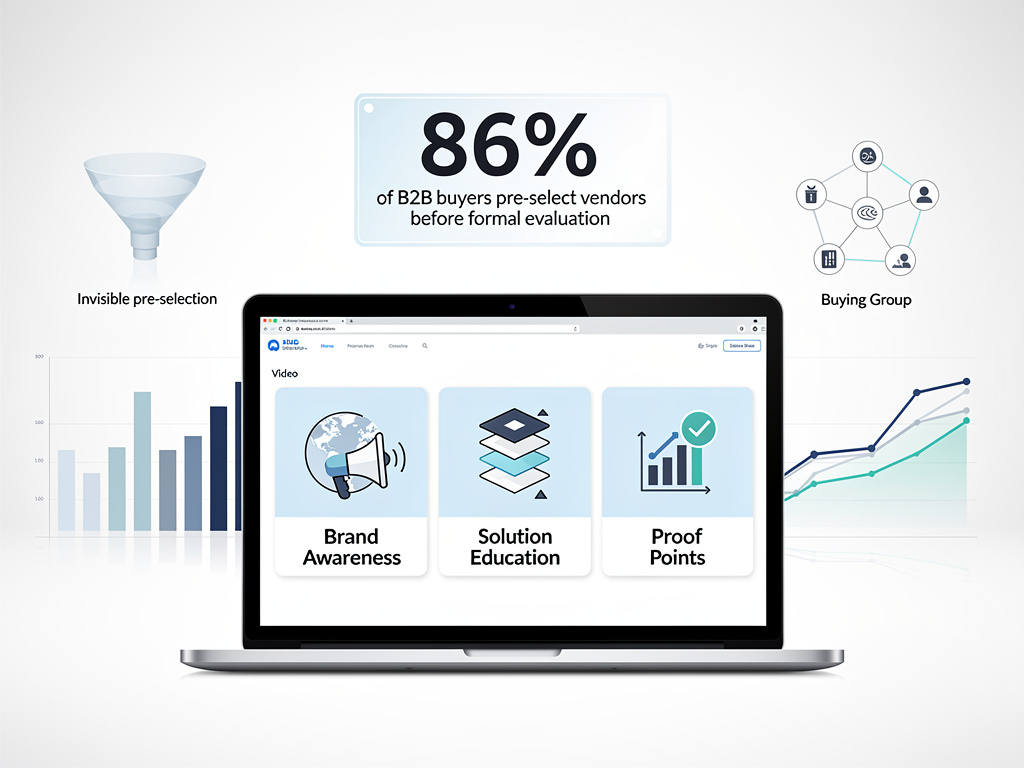
In the corridors of enterprise sales organizations, a quiet crisis is unfolding. The vast majority of B2B buying decisions are effectively made before a vendor’s sales representative ever gets the chance to deliver a pitch. According to research highlighted by MarTech.org, a staggering 86% of buyers have already pre-selected their vendor on Day 1 of the formal buying process. For sales and marketing leaders who have spent decades refining their outbound playbooks and demo scripts, this statistic represents nothing short of a paradigm shift — one that demands a fundamental rethinking of how pipeline is built and deals are won.
The implications are profound. If buyers are arriving at the table with their minds largely made up, then the traditional model of generating leads, nurturing them through a funnel, and converting them via sales conversations is increasingly obsolete. The real battle for revenue is being fought upstream, in the months and quarters before a prospect ever fills out a contact form. And the weapon of choice for the smartest B2B teams? Video — deployed strategically across three distinct plays that together form a comprehensive demand generation engine.
The Pre-Selection Era: How Buying Groups Operate in the Shadows
To understand why video has become so critical, one must first grasp the mechanics of modern B2B buying. Today’s purchase decisions are rarely made by a single individual. Instead, they are driven by buying groups — committees of six to ten stakeholders, each with different priorities, risk tolerances, and information needs. These groups conduct extensive independent research long before engaging with any vendor’s sales team. They consume analyst reports, peer reviews, social media commentary, and — increasingly — video content that helps them understand not just what a product does, but how it fits into their strategic objectives.
As MarTech.org reports, the concept of “Day 1” in the buying process is misleading. By the time a formal evaluation begins, the buying group has already built a shortlist. They have consumed content, formed opinions, and developed preferences. The 86% pre-selection figure means that for most vendors, the opportunity to influence a deal has passed before they even know the deal exists. This reality forces a fundamental question: How do you win a deal that starts without you?
Video as the Great Equalizer: Why Moving Pictures Move Buying Committees
The answer, according to leading B2B strategists, lies in a three-play video strategy designed to reach buying groups at every stage of their covert research process. Video has unique properties that make it ideally suited for this mission. It conveys emotion, builds trust, and communicates complex ideas faster than any white paper or blog post. In an era where attention is the scarcest resource in business, video commands it more effectively than any other medium. Research from multiple industry sources consistently shows that video content generates higher engagement rates, longer time-on-page metrics, and stronger recall than text-based alternatives.
But not all video is created equal, and the mistake many B2B organizations make is treating video as a monolithic tactic rather than a strategic framework. The most effective teams, as detailed in the MarTech.org analysis, deploy video across three carefully orchestrated plays, each targeting a different phase of the buyer’s hidden journey and a different member of the buying group. This three-play approach transforms video from a content format into a demand generation system.
Play One: Brand Video That Builds Mental Availability Before the Search Begins
The first play is what might be called the “air war” — brand-level video content designed to build awareness and mental availability long before a buying cycle initiates. This is not product demo content or feature comparison material. Instead, it is thought leadership video that positions a company and its executives as authoritative voices on the problems that matter to their target audience. The goal is deceptively simple: when a buying group begins to coalesce around a need, your brand should already occupy a position of trust and familiarity in their collective consciousness.
This first play targets the earliest, most diffuse stage of demand — what some marketers call “pre-intent.” The buying group members are not yet searching for solutions. They are reading about industry trends, attending virtual events, and scrolling through LinkedIn feeds. Brand video that addresses their strategic challenges — not your product’s features — earns attention at this stage. It is the digital equivalent of the relationships that enterprise sales teams once built over years of golf outings and conference dinners, compressed into scalable, repeatable content assets. According to the framework outlined by MarTech.org, this play is essential because it ensures your brand is on the shortlist before the shortlist is formally created.
Play Two: Solution-Level Video That Educates the Full Buying Group
The second play shifts from brand awareness to solution education. Once a buying group has identified a problem and begun actively researching approaches, they need content that helps them understand the category of solutions available and the criteria they should use to evaluate them. This is where solution-level video content becomes invaluable. These are not product demos — they are educational assets that frame the problem, outline the evaluation framework, and subtly position your approach as the logical choice.
The sophistication of this second play lies in its recognition that different members of the buying group need different information. A chief financial officer evaluating total cost of ownership needs different content than a technical architect assessing integration complexity or an end user worried about workflow disruption. The smartest B2B teams create video content tailored to each of these personas, ensuring that every member of the buying committee encounters material that speaks directly to their concerns. This multi-persona approach is critical because, as the MarTech.org analysis emphasizes, deals are won not by convincing one champion but by satisfying the information needs of an entire committee operating with different mandates and different definitions of success.
Play Three: Proof-Point Video That Closes the Trust Gap
The third and final play in the video strategy addresses what is perhaps the most decisive factor in B2B purchasing: trust. Even after a buying group has developed awareness of your brand and educated themselves on your solution category, they face a fundamental risk calculus. Enterprise purchases carry career risk for the individuals who champion them. A failed implementation can derail a project, a department, or a career. Proof-point video — customer testimonials, case studies, and results-driven narratives — provides the social proof that closes this trust gap.
What distinguishes high-performing B2B teams is the specificity and authenticity of their proof-point video. Generic customer quotes and vague success metrics no longer suffice. The most compelling proof-point videos feature named customers from recognizable organizations, discussing specific challenges, quantified results, and candid assessments of the implementation experience. These videos function as peer references at scale — allowing buying group members to hear from people like them, in companies like theirs, who faced problems like theirs and achieved outcomes they aspire to replicate. As detailed by MarTech.org, this third play is the linchpin that converts passive interest into active preference and, ultimately, into a signed contract.
The Operational Challenge: Building a Video Engine That Scales
Executing a three-play video strategy is conceptually straightforward but operationally demanding. It requires alignment between marketing, sales, and customer success teams. Marketing must produce a steady cadence of brand and solution video content. Sales must be equipped to deploy proof-point videos at precisely the right moment in the buying process. Customer success must identify and cultivate the customer advocates willing to appear on camera and share their stories. The entire organization must be oriented around a single insight: the deal is won or lost before the first sales call.
The production requirements are significant but not insurmountable. Modern video tools and platforms have dramatically reduced the cost and complexity of creating professional-quality content. What was once the exclusive domain of companies with six-figure production budgets is now accessible to mid-market organizations with modest resources and clear strategic intent. The barrier to entry is not budget — it is organizational will and strategic clarity. Teams that treat video as an afterthought or a checkbox will continue to lose deals to competitors who treat it as the centerpiece of their go-to-market strategy.
Measuring What Matters: Attribution in a Pre-Selection World
One of the thorniest challenges in executing this strategy is measurement. Traditional marketing attribution models are poorly suited to capturing the impact of content consumed during the pre-selection phase. If a buyer watches your brand video six months before entering a formal evaluation, how do you attribute that influence? If three members of a buying group independently consume your solution-level content on different platforms, how do you connect those interactions to the eventual deal?
Leading B2B organizations are investing in intent data platforms, account-based analytics, and video engagement metrics that provide visibility into these previously opaque interactions. They are tracking not just views and clicks, but watch-through rates, repeat viewership, and cross-stakeholder engagement within target accounts. These signals, while imperfect, offer a far richer picture of demand than traditional lead scoring models. The organizations that master this measurement challenge will have a decisive advantage, because they will be able to see — and influence — the buying process in its earliest, most consequential stages.
The Strategic Imperative for 2025 and Beyond
The 86% pre-selection statistic is not a curiosity — it is a strategic imperative. It tells us that the traditional sales funnel is an increasingly poor model for how enterprise deals actually unfold. The real funnel is invisible, operating in the research behaviors and content consumption patterns of buying groups that may never appear in your CRM until the decision is nearly final. Video, deployed across the three-play framework described by MarTech.org, offers the most powerful tool available for reaching these buyers where they are, when they are making the decisions that matter most.
For B2B leaders, the message is clear: the organizations that invest in video as a strategic demand generation system — not a tactical content format — will disproportionately capture the deals that are being decided in the shadows. Those that continue to rely on outbound cadences and demo-driven selling will find themselves competing for the 14% of deals where the outcome is still genuinely open. In an era where buyers hold all the cards, the only winning move is to play the game before it officially begins.


 WebProNews is an iEntry Publication