
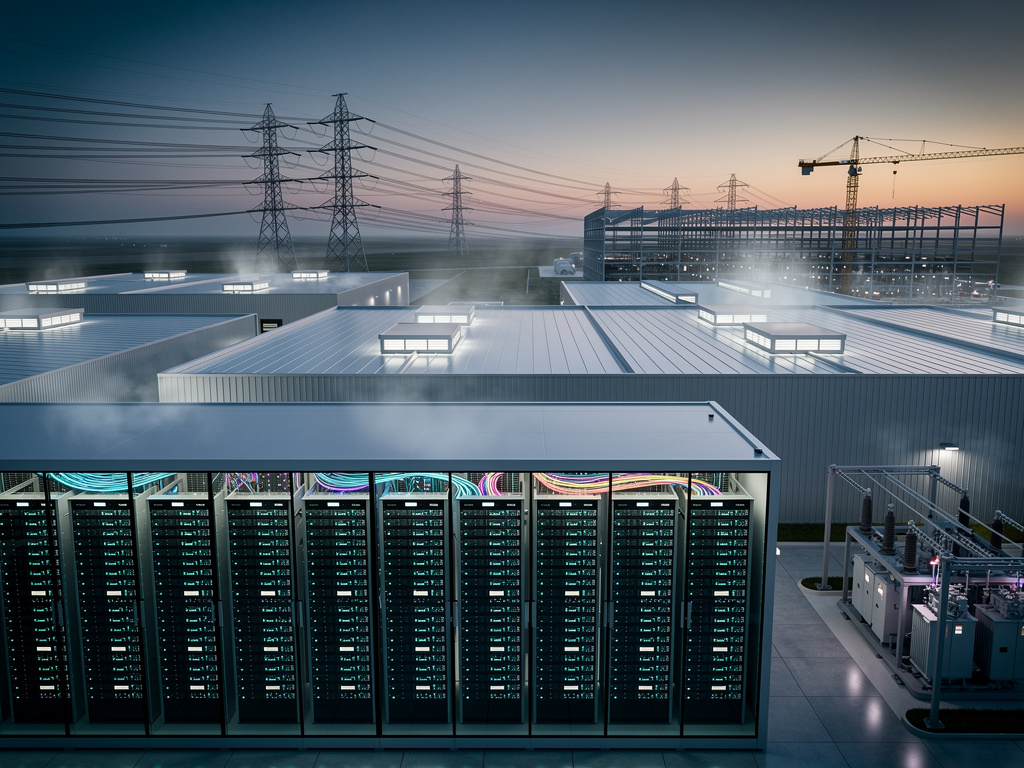
In the annals of American corporate history, there have been great capital expenditure cycles — the railroad boom of the 19th century, the telecom fiber buildout of the late 1990s, the shale oil revolution of the 2010s. None of them come close to what is now unfolding across the technology sector. Alphabet, Amazon, Meta, and Microsoft have collectively forecast approximately $650 billion in capital expenditures for 2026, a staggering 60% year-over-year increase driven almost entirely by the construction of data centers to power artificial intelligence workloads. The figure is so large that it exceeds the GDP of entire nations, dwarfs the annual defense budgets of most countries, and represents a concentration of corporate investment that has no modern precedent.
The numbers crystallized over a breathtaking 48-hour stretch in early February 2026, as three of the four companies reported quarterly earnings and issued forward guidance that stunned even the most bullish analysts. Amazon led the charge, projecting $200 billion in capital spending for the year — a figure so enormous that it momentarily silenced the earnings call. Microsoft reaffirmed its trajectory of accelerating investment. Alphabet disclosed plans for $75 billion in capex, a number that, while the smallest of the four, still represents a dramatic escalation from prior years. Meta, which had already telegraphed its intentions, rounded out the group with its own massive commitments. As Bloomberg reported, the combined total approaches $650 billion, a figure that would have been dismissed as fantasy just three years ago.
Amazon’s $200 Billion Moonshot Sets the Pace
Amazon’s announcement was the headline event of the earnings season. The company projected $200 billion in capital expenditures for 2026, a figure that includes spending on data centers, AI infrastructure, and the physical logistics network that underpins its retail empire, though the overwhelming majority is earmarked for computing infrastructure. As The New York Times detailed, the $200 billion plan represents a breathtaking acceleration — roughly double what the company spent in 2024 and a clear signal that CEO Andy Jassy views AI infrastructure as the defining investment opportunity of the decade. The spending will fund new data centers across North America, Europe, and Asia, equipped with the latest Nvidia and custom-designed chips.
Jassy, speaking on Amazon’s earnings call, framed the investment as both a competitive necessity and a once-in-a-generation opportunity. As CNBC reported, Jassy told analysts that demand for AI computing through Amazon Web Services was growing faster than the company’s ability to deploy capacity, and that every dollar spent on infrastructure was being matched by customer commitments. “The demand signals we are seeing are unlike anything in our history,” Jassy said, according to the CNBC report. “We are not building speculatively. We are building to meet demand that is already contracted or in advanced stages of negotiation.” The confidence was notable given the scale of the commitment — $200 billion is more than the entire market capitalization of most S&P 500 companies.
Alphabet’s $75 Billion Gamble Meets Wall Street Skepticism
If Amazon’s announcement was met with a mix of awe and cautious optimism, Alphabet’s disclosure of $75 billion in planned capex for 2026 triggered a more complicated reaction. The company reported strong quarterly results, with Google Cloud revenue growing at an impressive clip, but investors fixated on the sheer magnitude of the spending plan and what it implied for near-term profitability. As MarketWatch reported, Alphabet’s stock fell in after-hours trading despite the cloud growth, with analysts questioning whether the returns on such massive investment could materialize quickly enough to justify the outlay. The stock decline underscored a growing tension in the market: investors broadly believe in the AI thesis but are increasingly nervous about the timeline to profitability.
Alphabet CEO Sundar Pichai pushed back against the skepticism, arguing that the company’s AI investments were already generating measurable returns through Google Cloud, Search enhancements, and a growing portfolio of AI-powered enterprise products. The $75 billion figure, while lower than Amazon’s or Microsoft’s commitments, still represents a dramatic increase for a company that historically ran a relatively capital-light business model. Much of the spending will go toward constructing new data center campuses and purchasing the specialized chips — both Nvidia’s latest GPUs and Google’s own Tensor Processing Units — needed to train and serve increasingly large AI models. The investment also reflects the intensifying competition for power and real estate, as data center sites with access to reliable electricity have become among the most sought-after assets in corporate America.
The AI Arms Race: Competition, Conviction, and the Cloud
The combined $650 billion figure is not merely a sum of individual corporate strategies — it reflects a self-reinforcing competitive dynamic that has taken hold across the technology sector. Each company’s spending announcement effectively raises the stakes for its rivals, creating a cycle of escalation that shows no signs of abating. As TechCrunch observed, Amazon and Google are leading the AI capex race, but the ultimate prize — dominance in cloud-based AI services — remains uncertain and fiercely contested. Microsoft, buoyed by its partnership with OpenAI and the rapid growth of Azure, has been spending at a comparable pace. Meta, pursuing a different strategy centered on open-source AI models and consumer applications, has nonetheless committed tens of billions to its own infrastructure buildout.
The competitive logic is straightforward, even if the numbers are not. AI model training requires enormous quantities of computing power, and the companies that control the most infrastructure will be best positioned to serve enterprise customers, develop proprietary AI capabilities, and attract the talent needed to push the technology forward. But the sheer scale of the spending raises legitimate questions about returns. As The Financial Times noted, the capital intensity of the AI buildout is beginning to rival that of the oil and gas industry, with the crucial difference that technology assets depreciate far more quickly than physical wells and pipelines. A cutting-edge GPU purchased today may be obsolete within three to four years, meaning that the companies are not just making large bets — they are making bets that must pay off quickly.
Power, Real Estate, and the Physical Constraints of Digital Ambition
Behind the headline spending figures lies a complex web of physical infrastructure challenges that threaten to constrain even the most ambitious buildout plans. Data centers are voracious consumers of electricity, and the simultaneous expansion by four of the world’s largest companies is placing unprecedented strain on power grids across the United States and beyond. In Virginia’s Loudoun County, long the epicenter of American data center development, available power capacity has been effectively exhausted, forcing companies to look to less traditional locations — rural Georgia, the Texas panhandle, nuclear-adjacent sites in the Midwest. The competition for power purchase agreements with utilities has become as fierce as the competition for AI talent, with companies signing multi-billion-dollar, multi-decade contracts to secure reliable electricity supplies.
The physical buildout also requires staggering quantities of concrete, steel, copper, and specialized cooling equipment. Supply chains for these materials, already strained by broader construction demand, are being pushed to their limits. Several major data center projects have experienced delays due to transformer shortages, with lead times for high-voltage electrical equipment stretching to three years or more in some cases. The labor market for skilled construction workers, electricians, and mechanical engineers has tightened dramatically in regions with heavy data center activity. These constraints suggest that even $650 billion in planned spending may not translate into $650 billion in deployed capacity within the calendar year — a reality that could create both bottlenecks and opportunities for the companies and their suppliers.
Wall Street’s Divided Verdict on the Spending Surge
The investor reaction to the combined spending plans has been notably bifurcated. On one hand, the stocks of companies in the AI supply chain — Nvidia, most prominently, but also firms like Vertiv, Eaton, and Quanta Services — have surged on the expectation that the spending will flow directly to their bottom lines. On the other hand, the stocks of the spenders themselves have shown more mixed performance. As MarketWatch reported regarding Alphabet, investors are grappling with the tension between long-term AI optimism and near-term margin compression. Amazon’s stock, despite the eye-popping capex figure, held up better, in part because Jassy’s commentary about contracted demand provided a degree of visibility that Alphabet’s guidance lacked.
Analysts across Wall Street have scrambled to update their models, with many acknowledging that traditional valuation frameworks struggle to accommodate spending of this magnitude. The bull case rests on the assumption that AI will prove to be a general-purpose technology on the order of electricity or the internet — a transformation so profound that early infrastructure investment will generate outsized returns for decades. The bear case, articulated with increasing frequency, warns of a classic overinvestment cycle: too much capacity built too quickly, leading to falling utilization rates, margin pressure, and eventual write-downs. The truth, as is often the case, likely lies somewhere in between, but the stakes are high enough that being wrong in either direction carries enormous consequences.
The Broader Economic Implications of a $650 Billion Buildout
The macroeconomic implications of $650 billion in annual capital spending by just four companies are difficult to overstate. To put the figure in context, total U.S. nonresidential fixed investment — encompassing all corporate spending on structures, equipment, and intellectual property across every industry — was approximately $3.5 trillion in 2025. The Big Four tech companies alone now account for a meaningful and rapidly growing share of that total. Their spending is influencing everything from regional employment patterns to electricity pricing to the trajectory of interest rates, as the demand for capital to fund these projects ripples through financial markets.
The spending is also reshaping the geography of American economic activity. Towns and counties that were previously agricultural backwaters are being transformed by data center construction, bringing jobs, tax revenue, and infrastructure upgrades — but also strains on water resources, local power grids, and community character. As Reuters reported, Amazon’s $200 billion spending plan alone will fund construction across dozens of sites in multiple countries, making the company one of the largest single sources of construction demand in the world. The ripple effects extend to semiconductor manufacturing, where the insatiable demand for AI chips has helped justify the massive new fabrication plants being built by TSMC, Samsung, and Intel in the United States, partly underwritten by federal subsidies from the CHIPS Act.
What Happens If the Music Stops
For all the confidence expressed by CEOs on earnings calls, the history of technology investment cycles offers sobering lessons. The late-1990s telecom buildout, which saw companies lay millions of miles of fiber-optic cable in anticipation of exponential internet traffic growth, ended in a spectacular bust that destroyed hundreds of billions of dollars in shareholder value. The demand eventually materialized — it just took a decade longer than the investors who funded the buildout had anticipated. The parallel is imperfect: today’s AI spending is being driven by companies with vastly stronger balance sheets and more diversified revenue streams than the telecom startups of the dot-com era. But the underlying dynamic — massive capital deployment predicated on demand forecasts that may or may not prove accurate — is uncomfortably similar.
The key variable is whether AI revenue growth can keep pace with the infrastructure buildout. So far, the evidence is encouraging but incomplete. Cloud revenue at Amazon, Google, and Microsoft is growing rapidly, and enterprise adoption of AI tools is accelerating. But the bulk of the revenue is still concentrated among a relatively small number of large customers, and the broader diffusion of AI across the economy — the scenario that would justify $650 billion in annual spending — remains a work in progress. If demand growth slows or plateaus before the infrastructure is fully utilized, the financial consequences could be severe, not just for the companies themselves but for the vast ecosystem of suppliers, contractors, and communities that have become dependent on the buildout. For now, Big Tech is betting that the AI revolution is real, that it is early, and that the winners will be those who build the most, the fastest. It is a $650 billion wager — and the world is watching.


 WebProNews is an iEntry Publication