
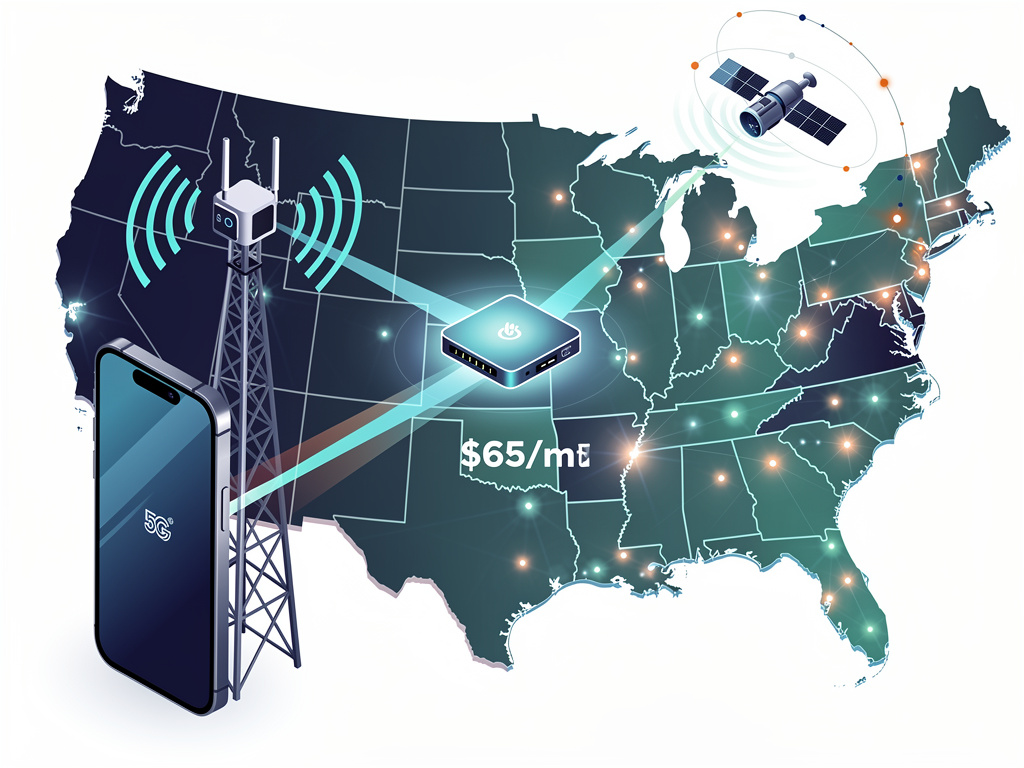
A small wireless carrier most Americans have never heard of just made one of the most aggressive moves in the telecom industry this year. US Mobile, the Verizon-backed MVNO known for its mix-and-match flexibility, is now bundling Starlink satellite internet with its wireless plans — offering both services starting at $65 a month. That’s not a typo.
The deal, first reported by CNET, pairs US Mobile’s unlimited talk, text, and data with Starlink’s residential satellite internet at a combined price that undercuts what many Americans pay for either service alone. The Starlink Residential plan typically runs $120 per month on its own. US Mobile’s unlimited premium plan costs $44. Bundled together, the two come in at $65 — a discount so steep it demands scrutiny.
Here’s how it works. US Mobile subscribers who sign up for the bundle get Starlink Residential service at a reduced rate of $21 per month when paired with the carrier’s top-tier wireless plan. The savings amount to roughly $99 per month compared to purchasing each service separately. There’s a catch, though. Starlink still requires its proprietary hardware kit, which runs $299 upfront — a cost that hasn’t changed and isn’t included in the bundle discount.
Still. Sixty-five dollars a month for satellite broadband and a premium wireless plan on Verizon’s network is a number that should make the big three carriers uncomfortable.
US Mobile has operated in relative obscurity for years, serving as one of dozens of mobile virtual network operators that lease capacity from major networks. But it’s been making increasingly bold plays to differentiate itself. The company, founded by Ahmed Khattak in 2015, has positioned itself as a tech-forward alternative to the bloated plans offered by AT&T, T-Mobile, and Verizon directly. It runs on both Verizon’s and T-Mobile’s networks, giving subscribers a choice of coverage footprint. And now it’s tying itself to the most talked-about satellite internet provider on Earth.
The timing is deliberate. SpaceX’s Starlink division has been aggressively expanding its consumer base, recently surpassing 4 million subscribers globally. But growth in the United States has slowed as the service saturates its core market of rural and underserved households. Bundling with a wireless carrier — even a smaller one — opens a new distribution channel. For Starlink, the economics of discounting through a partner likely make sense if it drives volume and reduces churn.
For US Mobile, the calculus is simpler: attention. The wireless market in the U.S. is brutally competitive, with T-Mobile, AT&T, and Verizon collectively controlling more than 95% of postpaid subscribers. MVNOs survive on margins thinner than a SIM card. A headline-grabbing bundle with Starlink gives US Mobile something money can’t easily buy — relevance in a conversation dominated by companies with hundred-billion-dollar market caps.
What This Means for the Bigger Players
The major carriers have been circling satellite connectivity for years. T-Mobile struck a deal with SpaceX in 2022 to bring direct-to-cell satellite service to T-Mobile phones, a program that has slowly rolled out in beta form for text messaging. AT&T has explored similar arrangements. Verizon, for its part, hasn’t announced a comparable satellite partnership, which makes the US Mobile–Starlink bundle all the more interesting given that US Mobile rides on Verizon’s infrastructure.
None of the big three, however, have offered a consumer bundle pairing traditional wireless service with satellite home internet at a fixed monthly rate. That’s the gap US Mobile is exploiting. It’s a flanking maneuver — attacking not from a position of network strength, but from pricing creativity and partnership agility.
The question is whether this forces a response. T-Mobile already bundles its wireless plans with its fixed wireless 5G home internet product, offering discounts for customers who take both. Comcast and Charter have pushed their own wireless-broadband bundles through Xfinity Mobile and Spectrum Mobile, respectively. The convergence of wireless and home internet has been a defining competitive trend for the past three years. But satellite internet bundled with cellular service? That’s a different proposition entirely — one aimed squarely at the roughly 20 million American households that lack access to reliable wired broadband.
And that’s where this gets interesting from a policy perspective. The Federal Communications Commission has spent billions through programs like the Broadband Equity, Access, and Deployment (BEAD) initiative to close the digital divide. Satellite internet has been a contentious part of that conversation, with Starlink initially winning — and then losing — nearly $900 million in FCC subsidies after failing to meet speed benchmarks during an auction review. A low-cost bundle that brings both mobile and home internet to underserved areas could accomplish through market forces what government programs have struggled to deliver through bureaucratic allocation.
Could. The operative word.
Starlink’s performance, while impressive for satellite technology, remains inconsistent. Median download speeds in the U.S. have fluctuated between 40 and 100 Mbps depending on congestion, time of day, and location, according to data tracked by Ookla. Latency has improved but still hovers around 30 to 50 milliseconds in most areas — fine for streaming and video calls, less ideal for competitive gaming or latency-sensitive applications. As more subscribers pile onto the network, the physics of shared satellite capacity become harder to manage.
US Mobile’s plan also raises questions about long-term sustainability. A $21 monthly rate for Starlink service is dramatically below SpaceX’s standard pricing. Whether that’s subsidized by SpaceX, absorbed by US Mobile, or structured as a limited-time promotional rate isn’t entirely clear from the public details available. Promotional pricing in telecom has a long and inglorious history of hooking customers before reverting to standard rates. Anyone who’s ever signed up for a cable bundle knows the drill.
But the initial economics are hard to argue with. For a household in rural Montana or a small-town family in Iowa — places I know well, having grown up in the Midwest where broadband options ranged from DSL to nothing — $65 a month for a phone plan and home internet isn’t just competitive. It’s potentially transformative.
The broader satellite-to-phone market is heating up simultaneously. AST SpaceMobile, a company developing its own direct-to-cell satellite network, recently began commercial service through AT&T. Lynk Global has signed agreements with carriers in multiple countries. Apple’s Emergency SOS via satellite feature, built into iPhones since the iPhone 14, demonstrated that consumer demand for satellite connectivity extends well beyond rural broadband. The infrastructure above our heads is becoming as important as the towers on the ground.
US Mobile’s move won’t topple any giants overnight. It’s a small carrier making a smart, asymmetric bet. But the bundle represents something the wireless industry has been slow to deliver: a single bill, a simple price, and a service combination that actually makes sense for people who’ve been left behind by traditional providers. Whether the big carriers respond with their own satellite bundles or dismiss this as a niche play will say a lot about where American telecom is headed.
For now, $65 buys you a phone plan and the internet from space. The future showed up, and it’s cheaper than your current cable bill.


 WebProNews is an iEntry Publication