
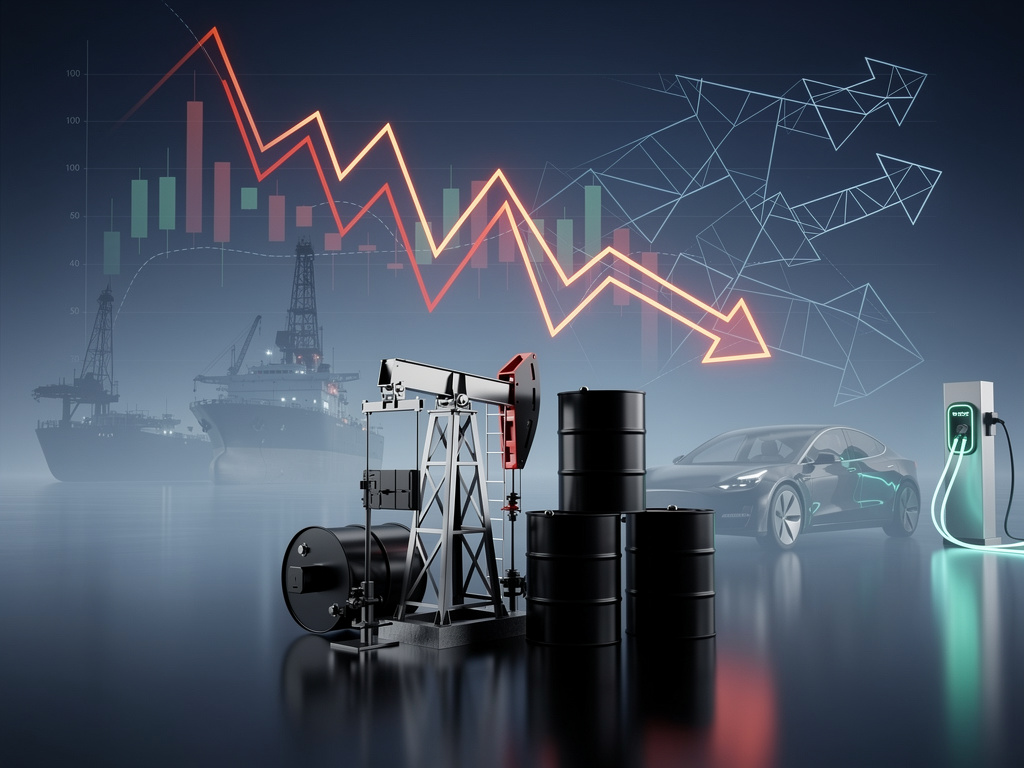
Morgan Stanley just told its clients to brace for oil in the mid-$50s by the end of next year. Not a temporary dip. Not a fleeting correction. A structural repricing of crude that, if it materializes, would redraw the economics of American shale, strain OPEC’s already fractured unity, and force energy investors to rethink nearly every assumption they’ve carried since the post-pandemic recovery.
The call, issued in a note to clients this week, projects Brent crude averaging $62.50 a barrel in the fourth quarter of 2025 before sliding to $55 by the second half of 2026. That’s a significant markdown from the bank’s prior forecast of $67.50 for Q4 2025 and a jarring figure for an industry that has spent the last three years enjoying prices well above $70. As Business Insider reported, the revision stems from a convergence of bearish forces: rising OPEC+ supply, weakening global demand forecasts, and the growing specter of an Iran nuclear deal that could unleash additional barrels onto an already softening market.
The timing is brutal.
Oil prices have already been under pressure for weeks. Brent traded near $66 in late April, down roughly 15% from its January highs. West Texas Intermediate has tracked a similar decline. And the forward curve — the market’s best guess at where prices are headed — has flattened in a way that suggests traders see little reason for optimism in the near term. Morgan Stanley’s analysts, led by Martijn Rats, pointed to a fundamental shift in OPEC+ strategy as the primary catalyst. The cartel announced in early April that it would accelerate the unwinding of its voluntary production cuts, adding more than 400,000 barrels per day to the market starting in May — roughly three times what most analysts had expected.
That decision didn’t happen in a vacuum. Saudi Arabia, the group’s de facto leader, has grown increasingly frustrated with members like Kazakhstan and Iraq that have consistently overproduced their quotas. The accelerated supply increase reads less like careful market management and more like a warning shot: comply or face a price war. Morgan Stanley’s team described it as a “significant shift in OPEC+ strategy” and noted that the group appears willing to tolerate lower prices to enforce discipline within its own ranks, according to the Business Insider report.
Then there’s Iran. Negotiations between Tehran and Washington over a potential nuclear deal have accelerated in recent weeks, with multiple rounds of indirect talks producing what both sides have characterized as progress. If sanctions on Iranian oil exports are eased — even partially — the market could absorb another 1 to 1.5 million barrels per day of supply. That’s not a hypothetical. Iranian production has already crept higher in recent months as enforcement of existing sanctions has loosened, and a formal deal would remove the last meaningful barrier to full-capacity output.
Morgan Stanley’s analysts estimate that an Iran deal alone could push Brent below $60 faster than their base case suggests. The bank’s bear case — which it describes as unlikely but plausible — envisions crude in the low $50s by early 2026. At those levels, a significant portion of U.S. shale production becomes uneconomic. Breakeven costs in the Permian Basin, America’s most prolific oil region, average around $55 to $60 per barrel for new wells, according to the Dallas Federal Reserve’s most recent energy survey. Marginal operators in less productive basins face breakevens closer to $65.
So what does $55 oil actually mean for the American energy industry?
It means pain. Not the existential, bankruptcy-wave kind of pain that characterized the 2014-2016 downturn or the COVID-era crash. But a grinding, slow-motion squeeze on capital budgets, drilling activity, and employment. Producers have spent the last two years preaching capital discipline — returning cash to shareholders through buybacks and dividends rather than chasing growth. That discipline would be tested severely at $55. Companies would likely slash drilling programs, defer completions, and hunker down. The rig count, already below its 2022 peak, would fall further.
Energy stocks have already begun to reflect this anxiety. The S&P 500 Energy Index has underperformed the broader market by nearly 10 percentage points year-to-date. Shares of major producers like ExxonMobil and Chevron are down modestly, while smaller E&P companies — the ones most exposed to commodity price swings — have fared worse. ConocoPhillips, Devon Energy, and Pioneer Natural Resources (now part of Exxon) have all seen their valuations compress as forward earnings estimates get revised lower.
Morgan Stanley’s note specifically flagged the risk to oilfield services companies, which face a double whammy of lower activity and pricing pressure. Halliburton, Schlumberger (now SLB), and Baker Hughes all depend on healthy drilling budgets from their producer clients. A sustained move below $60 would hit them hard.
But here’s the counterargument, and it’s one that several Wall Street firms have advanced in recent days. Goldman Sachs, while also lowering its oil forecasts, maintains a more constructive view than Morgan Stanley. Goldman’s commodity team sees Brent averaging $68 in Q4 2025 and staying near $65 through 2026, arguing that OPEC+ retains the ability — and ultimately the willingness — to reverse course if prices fall too far. The logic: Saudi Arabia needs roughly $80 oil to balance its fiscal budget, and Crown Prince Mohammed bin Salman’s ambitious economic transformation plan, Vision 2030, depends on sustained revenue. A prolonged period of $55 oil would be as damaging to Riyadh as it would be to Houston.
There’s also the demand side of the equation, which remains genuinely uncertain. The International Energy Agency’s latest monthly report, published in mid-April, trimmed its 2025 global oil demand growth forecast to 1.0 million barrels per day, down from 1.1 million previously. China — the engine of marginal demand growth for the past two decades — is showing signs of structural deceleration. Its economy grew 5.4% in the first quarter, beating expectations, but much of that growth came from sectors with lower energy intensity. Electric vehicle adoption continues to accelerate, with NEVs (new energy vehicles) accounting for more than 50% of new car sales in China for the first time in March 2025, according to data from the China Passenger Car Association.
That EV penetration number is staggering. And it’s not just a China story. Europe’s EV market share continues to climb, and even the U.S. — where the transition has been slower and more politically contentious — saw plug-in vehicles capture roughly 10% of new car sales in Q1 2025. The structural demand destruction from electrification is no longer theoretical. It’s measurable. It’s accelerating. And it’s a factor that virtually every major forecasting body, from the IEA to OPEC itself, has been forced to incorporate into its projections.
OPEC’s own demand outlook remains far more optimistic, projecting 1.3 million barrels per day of growth in 2025. But the cartel has consistently overestimated demand in recent years, and its forecasts are widely viewed as aspirational rather than analytical. The gap between the IEA’s numbers and OPEC’s numbers has become a running joke among commodity traders — and a serious problem for anyone trying to model supply-demand balances with precision.
Against this backdrop, the geopolitical wildcards multiply. The Iran deal is the most immediate and quantifiable risk, but it’s far from the only one. U.S. tariff policy under the Trump administration has introduced a new layer of uncertainty into global trade flows, and by extension, energy demand. The administration’s aggressive tariff posture toward China — including levies on a broad range of industrial goods — threatens to slow both economies, reducing oil consumption in the world’s two largest markets simultaneously. Morgan Stanley’s analysts explicitly cited trade policy as a headwind in their revised forecast.
Russia remains a factor too, though a diminishing one. Russian crude exports have proven remarkably resilient despite Western sanctions, finding willing buyers in India, China, and Turkey at discounted prices. The so-called “shadow fleet” of tankers carrying Russian oil has grown to several hundred vessels, and enforcement of the G7’s $60 price cap has been inconsistent at best. If anything, Russian supply has been more stable than expected — adding to the global surplus that Morgan Stanley sees building through 2026.
For investors, the practical question is whether energy stocks are cheap enough to buy or still too expensive given the deteriorating commodity outlook. The answer depends entirely on your time horizon and your conviction about where oil settles. At $55 Brent, the S&P 500 Energy Index is probably still overvalued relative to the cash flows producers would generate. At $65, current valuations look more reasonable. At $75 — a level many bulls still consider achievable if OPEC+ reverses course and the Iran deal collapses — energy stocks would be outright cheap.
Morgan Stanley’s recommendation? Underweight energy. The bank downgraded U.S. oil and gas stocks to underweight in its latest strategy note, arguing that the risk-reward skew is unfavorable even after the recent selloff. It specifically recommended investors reduce exposure to exploration and production companies and oilfield services firms, while maintaining selective positions in integrated majors with strong balance sheets and diversified revenue streams.
Not everyone agrees. Bank of America’s energy team published a note in late April arguing that the pessimism is overdone. Their analysts pointed out that global oil inventories remain near five-year lows, that OPEC+ has a track record of cutting production when prices threaten fiscal stability, and that geopolitical supply disruptions — from the Middle East to West Africa — remain an underpriced risk. BofA’s Brent target for Q4 2025 is $70, meaningfully above Morgan Stanley’s $62.50.
The divergence between these forecasts tells you something important about the current state of oil markets: nobody really knows. The range of plausible outcomes is unusually wide, driven by an unusual confluence of supply-side uncertainty (OPEC+ discipline, Iran, Russia), demand-side uncertainty (China, EVs, trade wars), and policy uncertainty (tariffs, sanctions enforcement, energy regulation). In that kind of environment, conviction trades in either direction carry substantial risk.
What seems most likely is something messy. A market that chops sideways in the $60-$70 range for the balance of 2025, with periodic spikes on geopolitical headlines and periodic dips on bearish inventory data. The real test comes in 2026, when the full impact of OPEC+’s supply additions, any Iran deal, and the ongoing EV-driven demand erosion would converge. That’s when Morgan Stanley’s $55 call gets its reckoning.
If they’re right, the consequences extend well beyond stock prices. A sustained period of sub-$60 oil would reshape capital allocation across the global energy industry, accelerate consolidation among U.S. shale producers, strain the finances of petrostate governments from Riyadh to Abuja, and — paradoxically — potentially slow the energy transition by making fossil fuels cheap enough to compete with renewables on price alone. Cheap oil has always been the energy transition’s most dangerous adversary.
And that might be the most important thing Morgan Stanley is really saying. Not just that oil is going lower. But that the industry’s comfortable equilibrium — the one where $75 oil funded generous dividends, healthy drilling programs, and Vision 2030 simultaneously — is breaking apart. What replaces it won’t be comfortable for anyone.


 WebProNews is an iEntry Publication