
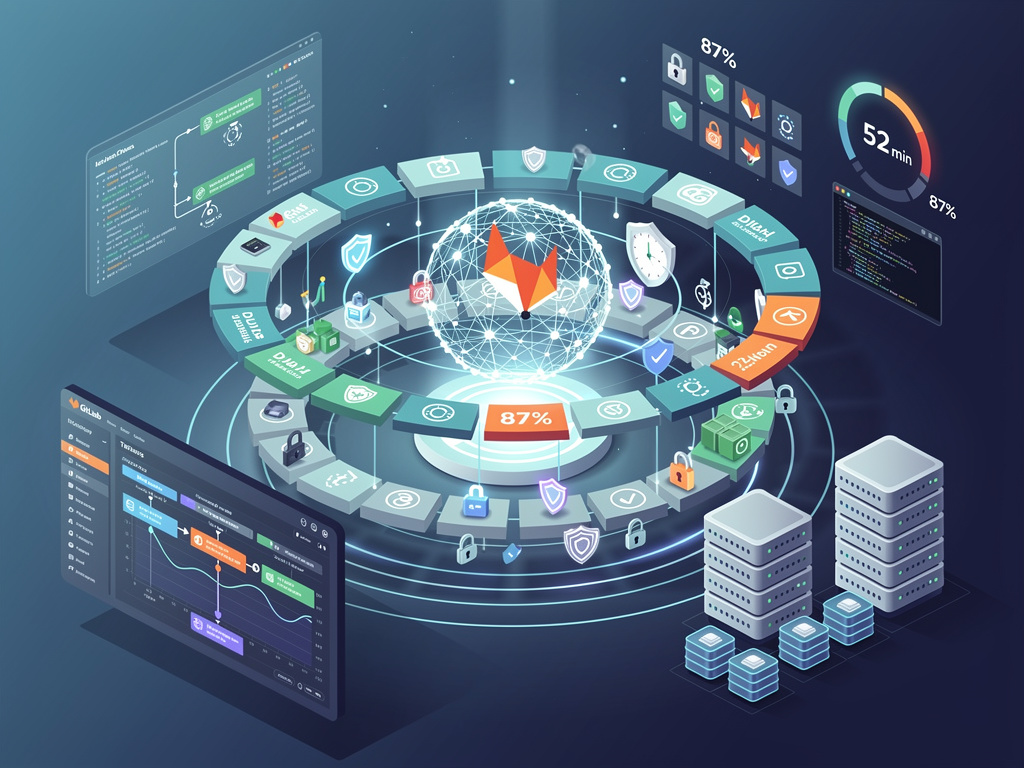
Software developers now spend just 52 minutes per day actually writing code — a startling figure that has become the centerpiece of GitLab’s latest strategic pivot. Despite artificial intelligence making the act of coding up to ten times faster, the overwhelming majority of a developer’s workday is consumed by everything around the code: security reviews, compliance checks, pipeline management, and cross-team coordination. GitLab’s answer, unveiled at its Transcend customer event, is a sweeping vision called Intelligent Orchestration — an AI-driven system designed to automate the sprawling, unglamorous machinery of modern software delivery.
The announcement, made during GitLab’s Transcend event, represents the company’s most aggressive bet yet that the future of developer productivity lies not in faster code generation but in eliminating the bureaucratic overhead that surrounds it. With new AI capabilities, a revamped assessment program, and tighter security integrations, GitLab is positioning itself as the platform that can turn software development from a fragmented, tool-heavy slog into a streamlined, policy-governed pipeline — all without requiring developers to leave a single interface.
Why 52 Minutes Matters More Than 10x Speed
The statistic that developers spend only 52 minutes per day coding has circulated in industry discussions for some time, but GitLab is now wielding it as a foundational argument for its product strategy. According to Stock Titan’s coverage of the Transcend event, GitLab CEO Sid Sijbrandij and the company’s leadership team framed the problem bluntly: making code generation faster through AI copilots is valuable, but it addresses only a fraction of the developer’s actual day. The remaining seven-plus hours are spent navigating security gates, waiting for pipeline approvals, managing dependencies, and handling the operational complexity that modern DevSecOps demands.
This framing is a direct challenge to competitors like GitHub, whose Copilot product has focused heavily on AI-assisted code completion. GitLab is essentially arguing that the industry’s obsession with code generation speed is misplaced — or at least incomplete. If a developer’s coding time is already compressed to under an hour, then even a 10x improvement in that narrow window yields diminishing returns compared to optimizing the other 87% of their workday. It’s a provocative thesis, and one that GitLab is backing with significant product investment.
Intelligent Orchestration: GitLab’s Bet on AI Beyond the Editor
At the heart of GitLab’s Transcend announcements is Intelligent Orchestration, a system designed to use AI to automate and coordinate tasks across the entire software development lifecycle. As detailed by Stock Titan, Intelligent Orchestration goes beyond simple code suggestions. It aims to automatically trigger security scans, enforce compliance policies, manage merge request workflows, and route tasks to the appropriate teams — all governed by organizational policies that administrators can define and update centrally.
The system leverages GitLab Duo, the company’s AI suite, which has been expanding rapidly over the past year. GitLab Duo already includes features like code suggestions, vulnerability explanations, and root cause analysis for pipeline failures. With Intelligent Orchestration, these capabilities are being woven into a broader fabric that can make decisions about what happens next in a development workflow, not just assist with the task at hand. For example, when a developer submits a merge request, the system can automatically determine which security scans are required based on the nature of the code change, run those scans, flag issues, and even suggest remediations — all before a human reviewer needs to intervene.
Security as a First-Class Citizen, Not an Afterthought
One of the most significant dimensions of the Transcend announcements is the deep integration of security controls into the orchestration layer. GitLab has long marketed itself as a DevSecOps platform — one that embeds security into the development process rather than bolting it on at the end. But the Intelligent Orchestration framework takes this a step further by making security policies programmable and enforceable at the platform level. According to Stock Titan’s reporting, organizations can now define granular security requirements that are automatically applied based on project type, risk level, regulatory environment, or other criteria.
This is a direct response to a growing concern among enterprise software teams: as AI accelerates code production, the volume of code that needs to be reviewed, tested, and secured is increasing dramatically. If developers are generating code faster than security teams can review it, the result is either a bottleneck that negates the productivity gains or a dangerous accumulation of unreviewed vulnerabilities. GitLab’s approach attempts to solve this by automating the security review process itself, using AI to triage and prioritize vulnerabilities while ensuring that organizational policies are consistently enforced.
A New Assessment Program for Enterprise Readiness
Alongside Intelligent Orchestration, GitLab also introduced a new assessment program at Transcend, designed to help organizations evaluate their DevSecOps maturity and identify areas where automation can deliver the greatest impact. The program provides structured evaluations that benchmark an organization’s current practices against industry best practices and GitLab’s own framework for AI-driven development. For enterprise buyers — often navigating complex procurement and compliance requirements — this kind of structured assessment can be a critical tool for building internal business cases and securing executive buy-in.
The assessment program also serves a strategic purpose for GitLab: it creates a structured on-ramp for organizations that may be using only a subset of GitLab’s capabilities. By identifying gaps in a customer’s current workflow, GitLab can demonstrate the value of deeper platform adoption — a classic land-and-expand motion that has been central to the company’s growth strategy since its IPO. The timing is deliberate; as enterprises grapple with how to govern and scale their use of AI in software development, a vendor that can offer both the tools and the roadmap has a significant competitive advantage.
The Competitive Stakes: GitLab vs. GitHub and the AI Arms Race
GitLab’s Transcend announcements arrive at a moment of intense competition in the developer tools market. Microsoft-owned GitHub has been aggressively expanding its Copilot platform, recently introducing Copilot Workspace and agent-based coding features that aim to handle multi-file, multi-step development tasks autonomously. Atlassian, JetBrains, and a growing roster of startups are also pouring resources into AI-powered development tools. The race is no longer just about who has the best code completion model — it’s about who can orchestrate the entire software delivery process most effectively.
GitLab’s differentiation has always been its single-platform approach: source code management, CI/CD, security scanning, project management, and now AI orchestration, all within one application. This architectural choice gives GitLab a structural advantage when it comes to cross-cutting automation, because all the data and workflows live in one system. Competitors that rely on integrations between separate tools face inherent friction when trying to build the kind of end-to-end orchestration that GitLab is describing. Whether that architectural advantage translates into market share gains will depend on execution — and on whether enterprises are willing to consolidate their toolchains onto a single vendor.
What Industry Insiders Should Watch Next
For CTOs, engineering leaders, and DevOps practitioners, the key question raised by GitLab’s Transcend announcements is not whether AI will transform software development — that is already happening — but where the transformation will deliver the most value. GitLab is making a clear argument that the highest-leverage opportunity is in the orchestration and governance layer, not in code generation alone. If the 52-minute statistic is even directionally correct, then the companies that figure out how to automate the other seven hours of a developer’s day will capture an outsized share of the productivity gains that AI promises.
The implications extend beyond tooling. As AI-driven orchestration systems take on more decision-making authority — determining which security scans to run, which compliance checks to enforce, and how to route work across teams — organizations will need to develop new governance frameworks for the automation itself. Who is accountable when an AI system greenlights a merge request that introduces a vulnerability? How do audit trails work when decisions are made by algorithms rather than humans? These are the questions that GitLab’s Intelligent Orchestration surfaces, and they are questions that every enterprise software organization will need to answer in the months and years ahead.
GitLab’s stock (NASDAQ: GTLB) has been closely watched by investors seeking exposure to the AI-in-development theme, and the Transcend announcements are likely to be parsed for signals about the company’s ability to monetize its AI investments. With the broader market increasingly focused on whether AI spending is translating into real productivity gains, GitLab’s emphasis on measurable workflow automation — rather than abstract AI capabilities — may resonate with both customers and shareholders. The 52-minute paradox, it turns out, is not just a product marketing talking point. It may be the most important metric in the future of software engineering.


 WebProNews is an iEntry Publication