
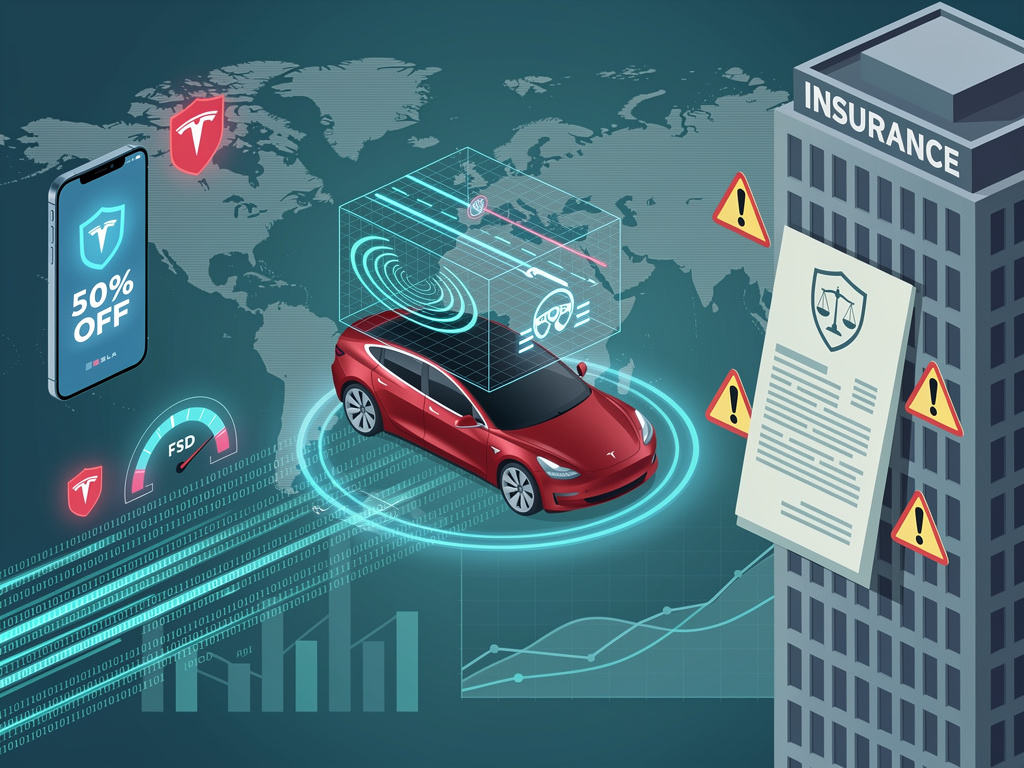
A tantalizing proposition recently rippled through the technology and insurance sectors: a potential 50% rate cut for Tesla owners using the vehicle’s Full Self-Driving (FSD) software. While the specific offer, highlighted in a discussion on Slashdot, represents more of a directional signal than a current market-wide product from insurer Lemonade, it crystallizes a multibillion-dollar question facing the entire auto industry: When will the promised safety benefits of autonomous-driving technology translate into tangible, dramatic savings for consumers?
The answer is proving far more complex than a simple software update. It involves a high-stakes battle over data, a fundamental disagreement on how to measure risk, and a cautious actuarial world hesitant to underwrite Silicon Valley’s bold promises. For industry insiders, this isn’t just about one company’s discount; it’s about the impending collision between data-rich automakers, agile insurtech startups, and the established giants of the insurance world. The outcome will redefine the very nature of auto insurance for decades to come.
The Insurtech Playbook: Data as the New Deductible
Lemonade, a company built on a foundation of artificial intelligence and behavioral economics, has already laid the groundwork for such a future. Its entry into the auto insurance market was predicated on a telematics-first approach, using a smartphone app to monitor driving behavior. As detailed by TechCrunch at the time of its launch, Lemonade Car uses sensors in the driver’s phone to measure metrics like mileage, braking force, and speed to generate a personalized safety score. This model of usage-based insurance (UBI) is the sector’s clear trajectory, shifting pricing from static proxies for risk—like age, credit score, and zip code—to dynamic, real-world driver performance.
This philosophy positions companies like Lemonade to theoretically reward drivers for using safety-enhancing technology like Tesla’s FSD. If the data proves that an FSD-engaged vehicle is demonstrably safer—resulting in fewer accidents, less severe collisions, and ultimately, lower claim payouts—then offering a steep discount is not a gimmick but a logical, data-driven business decision. The core challenge, however, lies in obtaining and trusting that data. While a smartphone app can track a driver’s habits, it cannot fully see or verify the complex interplay between a human operator and an advanced driver-assistance system.
Tesla’s Vertical Integration: From Factory Floor to Insurance Premium
This is precisely where Tesla has thrown down the gauntlet to the entire insurance industry. The electric vehicle maker isn’t waiting for third parties to validate its technology; it’s becoming an insurer itself. Tesla Insurance leverages the vehicle’s vast sensor suite to collect granular, real-time driving data, creating a proprietary “Safety Score.” This score, which measures everything from hard braking to aggressive turning and tailgating, directly determines a driver’s monthly premium. As Reuters reports, Tesla’s stated goal is to use its data advantage to offer rates 20% to 30% lower than competitors.
This move is a profound threat to traditional carriers. Tesla possesses the ultimate ground-truth data, recording not just how the driver behaves but how the car’s own systems, like Autopilot and FSD, are performing. The company argues that it alone can accurately price the risk of a Tesla vehicle because it understands the technology from the inside out. For legacy insurers, this creates an existential dilemma: how can they compete when the manufacturer itself becomes a vertically integrated insurer with an insurmountable data advantage? They are left to price the risk of a technology they cannot fully access or independently audit.
The Great Divide: ‘Driver-Assist’ Reality vs. ‘Self-Driving’ Hype
The crux of the insurance industry’s hesitation lies in the significant gap between the marketing of “Full Self-Driving” and its current technological reality. Despite its name, Tesla’s FSD is classified as a Level 2 driver-assistance system by the Society of Automotive Engineers. This designation means the driver must remain fully engaged, with hands on the wheel and eyes on the road, ready to take control at any moment. The legal and financial liability for the vehicle’s operation rests squarely on the human driver, not on Tesla.
This distinction is critical for underwriters. The system’s capabilities have drawn intense scrutiny from federal regulators, with the National Highway Traffic Safety Administration (NHTSA) launching numerous investigations into crashes involving Tesla’s automated systems. A major recall was issued, as reported by The Associated Press, to implement stronger controls to prevent driver misuse. For an insurer, this regulatory environment signals not reduced risk, but a new and unpredictable form of it, where driver inattentiveness, lulled by a false sense of security, can lead to catastrophic failure.
Actuarial Prudence in an Age of Unproven Algorithms
For centuries, the insurance business has been built on the law of large numbers and vast pools of historical claims data. Actuaries price risk based on decades of proven outcomes. Advanced driver-assistance systems (ADAS) and FSD, by contrast, are new, constantly evolving via over-the-air software updates, and lack the longitudinal data required for confident risk modeling. An FSD update pushed to the fleet overnight could, in theory, alter the risk profile of hundreds of thousands of vehicles simultaneously, a prospect that is unsettling for a traditionally cautious industry.
Furthermore, initial data on the real-world impact of ADAS has been mixed. A study from the Insurance Institute for Highway Safety (IIHS), cited by Forbes, found that while features like automatic emergency braking have reduced crashes, the higher repair costs for vehicles equipped with sophisticated sensors can sometimes offset the savings from fewer claims. Insurers are therefore unwilling to grant massive discounts based on a manufacturer’s safety report alone; they require their own validated claims data to justify such a dramatic reduction in premiums.
The Shifting Landscape of Liability
Looking ahead, the entire model of personal auto insurance is poised for a radical transformation as the technology matures from Level 2 assistance to true Level 4 or 5 autonomy, where the vehicle is responsible for the driving task under specific conditions. In that future, a crash may not be the driver’s fault but rather a failure of the vehicle’s hardware or software. Liability would likely shift from the individual owner to the automaker, the software developer, or the component manufacturer. The insurance product would morph from a personal auto policy into a form of product liability coverage purchased by the manufacturer.
This future would demand a complete re-engineering of the insurance market. Policies would need to cover new risks, such as cybersecurity threats and algorithm failures. As McKinsey & Company notes in its analysis of the industry’s future, insurers must evolve from their current roles to become risk managers in a connected ecosystem. The companies that thrive will be those that can effectively model, price, and mitigate these complex new technological risks.
A Market on the Brink of Reinvention
While a 50% discount for FSD may be premature, the pressure it represents is very real. The convergence of telematics, AI, and increasingly autonomous vehicles is forcing a reckoning in the auto insurance industry. Tesla’s direct-to-consumer insurance model, fueled by unparalleled vehicle data, serves as a stark warning to legacy carriers that their most profitable business line is under threat.
The ultimate winners will be the organizations that can master the data. Whether it is an insurtech like Lemonade making a bold, calculated bet on a new technology, an established player that successfully partners to gain data access, or an automaker that decides to own the entire value chain, the race is on. The road ahead is uncertain, but it is clear that the simple act of calculating a car insurance premium is becoming one of the most complex and competitive data science problems in the world.


 WebProNews is an iEntry Publication