
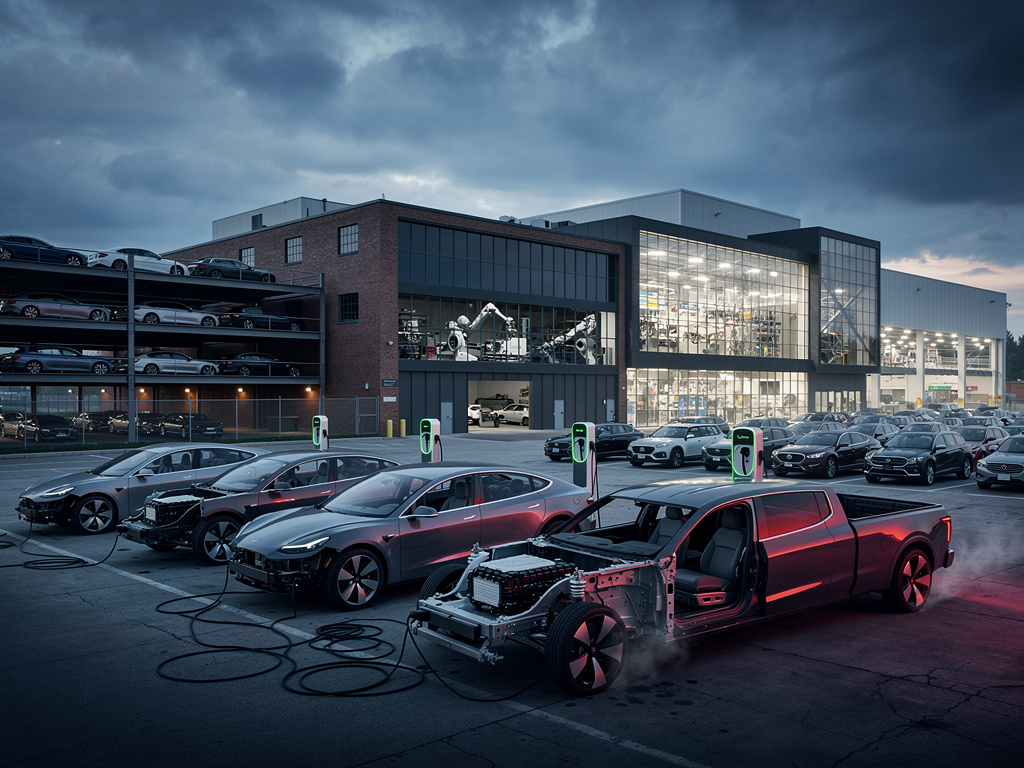
For the better part of a decade, Detroit’s Big Three automakers placed enormous bets that the future of the automobile was electric. They retooled factories, forged billion-dollar battery partnerships, and launched splashy marketing campaigns promising a new era of zero-emission driving. Now, the bill for that collective wager has come due—and it is staggering.
General Motors, Ford Motor, and Stellantis have together announced more than $50 billion in combined write-downs related to their electric-vehicle businesses, according to The Wall Street Journal. The figure represents one of the most dramatic financial retreats in modern automotive history, a sobering acknowledgment that the industry’s rush toward electrification outpaced consumer appetite, economic reality, and political durability.
A Tax Credit Vanishes, and Demand Craters
The most immediate catalyst for the downturn was the elimination of the $7,500 federal EV tax credit, which Republican lawmakers abolished last fall alongside federal fuel-efficiency mandates. That credit had served as a powerful demand lever, effectively subsidizing the purchase price of electric vehicles and making them more competitive with their gasoline-powered counterparts. When it disappeared in September, the market response was swift and punishing.
EV sales fell more than 30% in the fourth quarter following the credit’s expiration, as reported by The Wall Street Journal. Demand collapsed across the board, hitting even the most high-profile models. Tesla’s Cybertruck, which had generated years of anticipation and a massive reservation list, saw sales plummet. Ford’s much-hyped electric F-150 Lightning pickup—once positioned as the vehicle that would bring middle America into the EV fold—suffered a similar fate. Automakers now expect demand to remain muted for the foreseeable future, a stark departure from the exponential growth curves that had underpinned their investment theses.
Ford Pivots Away From a Strategy That ‘Will Never Make Money’
Of the three Detroit automakers, Ford has executed perhaps the most dramatic strategic reversal. The company had invested heavily in electrifying its most iconic nameplates, including the Mustang Mach-E crossover and the Lightning pickup. But the economics never worked. Ford’s EV division, known internally as Model e, reported billions in operating losses, and the path to profitability remained elusive even under the most optimistic projections.
Ford CEO Jim Farley has been blunt about the rationale for the change in direction. “Instead of plowing billions into the future knowing these large EVs will never make money, we are pivoting,” Farley said, as quoted by The Wall Street Journal. Ford now says it will focus on producing a single low-cost EV pickup by 2027, a far cry from the sweeping electrification roadmap it had laid out just a few years earlier. The company has also dissolved a joint venture with South Korean conglomerate SK On that was intended to produce EV batteries domestically—a partnership that had been heralded as a cornerstone of America’s battery manufacturing ambitions.
GM Trims the Sails but Stays the Course—Mostly
General Motors has taken a somewhat different approach, choosing to scale back rather than abandon its EV strategy entirely. The company still aims to build large electric trucks, a segment where it believes it can eventually compete. But the scope of its ambitions has been significantly reduced. GM has laid off thousands of workers at plants across Michigan, Ohio, and Tennessee, dismantling plans for factories that were supposed to produce EV trucks and electric motors. In their place, those facilities will now build gas-powered trucks and V-8 engines—a return to the products that have historically generated the company’s strongest margins.
Because GM had not committed as aggressively to a single electrification timeline, it had less to cancel and write down than some of its peers. Still, the human cost has been significant. The layoffs represent not just a financial adjustment but a fundamental reshuffling of the workforce that Detroit had been training for an electric future. Workers who had been retrained for EV assembly are now being reassigned—or let go entirely—as the industry recalibrates.
Stellantis Books the Biggest Charge of All
Stellantis, the parent company of Jeep, Ram, Chrysler, and several European brands, has recorded the single largest write-down among the three automakers related to its electric-vehicle investments. The company is in the process of unloading its stake in a battery-making business, effectively unwinding one of the key pillars of its electrification strategy. The charge reflects not just sunk costs in manufacturing capacity but also the diminished value of technology partnerships and supply agreements that were negotiated during a period of peak EV optimism.
Stellantis CEO Antonio Filosa offered a candid assessment of what went wrong. “The pace of the energy transition had been overestimated,” Filosa said, adding that the industry’s aggressive push “distanced us from many car buyers’ real-world needs, means and desires.” It was a remarkable admission from the head of one of the world’s largest automakers—an acknowledgment that the industry had, in its enthusiasm, lost touch with the customers it was trying to serve.
A $20 Billion Hole in America’s Clean-Energy Manufacturing Base
The ripple effects of Detroit’s retreat extend far beyond the automakers’ own balance sheets. More than $20 billion in previously announced investments in EV and battery manufacturing facilities were wiped out last year, according to Atlas Public Policy, which tracks clean-economy investments. That contraction drove the first net annual decrease in announced clean-energy investments in years, reversing a trend that had been accelerating since the passage of the Inflation Reduction Act in 2022.
The implications are profound for communities across the industrial Midwest and Southeast that had been counting on EV-related construction projects to deliver jobs and economic revitalization. Factory towns that had been promised a second act in the electric age are now watching those promises evaporate. Battery plants that were supposed to anchor new supply chains are being downsized, delayed, or canceled outright. The political and economic fallout is only beginning to be felt, and it is likely to shape debates over industrial policy and energy transition strategy for years to come.
China’s BYD Surges While Detroit Retreats
While American automakers pull back, the global EV market tells a more complex story. Outside the United States, electric-vehicle adoption continues to grow, driven in large part by China’s dominant position in the sector. BYD, the Shenzhen-based automaker backed by Warren Buffett’s Berkshire Hathaway, recently surpassed Tesla as the world’s largest EV seller by volume. The company delivered more than one million vehicles outside of China last year—double its international deliveries in 2024, according to the The Wall Street Journal.
BYD’s rise has not been without its own challenges. At home in China, the company’s sales growth has slowed amid intensifying competition from domestic rivals and a reduction in state subsidies for affordable vehicles. Internationally, BYD faces a growing wall of tariffs, as countries from the European Union to Canada and Brazil have imposed duties on Chinese-made EVs in an effort to protect their own automotive industries. Yet BYD’s scale, vertical integration, and cost advantages continue to make it a formidable competitor—one that Detroit’s automakers are increasingly unable to match on price.
The Uncomfortable Truth About the EV Transition
The $50 billion in write-downs forces an uncomfortable reckoning with the assumptions that drove Detroit’s electrification push. For years, automakers operated under the belief that EV adoption would follow a predictable S-curve—slow at first, then accelerating rapidly as battery costs fell, charging infrastructure expanded, and consumer preferences shifted. Government policy, particularly the Biden administration’s aggressive emissions standards and generous tax credits, reinforced that belief and gave companies the confidence to commit tens of billions in capital.
But the transition proved far more fragile than anticipated. Consumer demand, it turned out, was heavily dependent on subsidies. Without the $7,500 credit, many buyers simply could not justify the price premium of an electric vehicle over a comparable gas-powered model. Charging infrastructure, while expanding, remained uneven and unreliable in many parts of the country. And the political winds shifted faster than anyone in Detroit had planned for, with the Republican-led rollback of EV incentives and emissions standards pulling the regulatory rug out from under the industry’s feet.
What Comes Next for Detroit’s Electric Ambitions
The question now facing Detroit is not whether electric vehicles have a future—they almost certainly do—but what that future looks like in a post-subsidy, post-mandate environment. The automakers that survive this shakeout will likely be those that can build EVs profitably at lower price points, without relying on government support to close the gap with internal combustion engines. Ford’s pivot toward a single affordable EV pickup by 2027 may prove prescient if the company can execute on cost. GM’s decision to maintain a presence in electric trucks, albeit at reduced scale, could pay off if battery costs continue their long-term decline.
But for now, the dominant narrative is one of retrenchment. The factories being converted back to gasoline-vehicle production, the battery partnerships being dissolved, the workers being laid off—these are the tangible consequences of an industry that moved too fast, spent too freely, and assumed that the political and economic conditions supporting electrification would hold. The $50 billion reckoning is not just a financial event. It is a cautionary tale about the dangers of building a corporate strategy on the assumption that government policy is permanent and that consumer demand will follow investment rather than the other way around.


 WebProNews is an iEntry Publication