
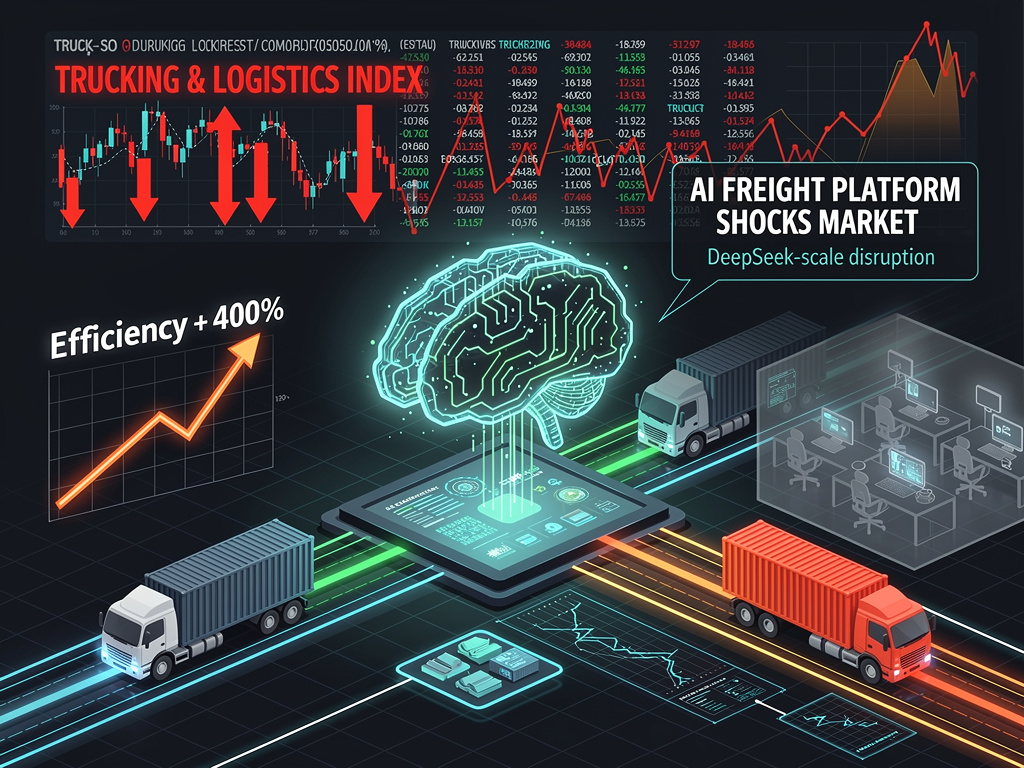
On a single Wednesday in February 2026, billions of dollars in market capitalization evaporated from the trucking and logistics sector — not because of a recession, a fuel crisis, or a regulatory crackdown, but because of a software demonstration. SemiCab, a relatively obscure freight technology company, unveiled an artificial intelligence platform that it claimed could handle 400% more freight volume without adding a single employee. Wall Street’s reaction was swift, merciless, and, for industry veterans, deeply unsettling.
The selloff that began on February 12 and accelerated into February 13 wiped out significant value across publicly traded trucking carriers, freight brokerages, and third-party logistics providers. As reported by CNBC, major logistics stocks tumbled in heavy trading volume, with some names falling by double-digit percentages in a matter of hours. The carnage drew immediate comparisons to the January 2025 DeepSeek moment that rattled AI infrastructure stocks — only this time, the disruption was pointed squarely at the $900 billion American freight industry.
A Platform That Promises to Rewrite the Rules of Freight Brokerage
At the center of the storm is SemiCab’s AI-powered collaborative shipping platform, which the company says uses advanced machine learning algorithms to optimize freight matching, load consolidation, and route planning at a scale previously unimaginable without massive human workforces. According to a press release distributed via GlobeNewsWire, the platform demonstrated the ability to handle 400% more freight volume without requiring additional staff — a claim that, if validated at scale, would fundamentally alter the economics of freight brokerage and logistics coordination.
The technology works by aggregating shipping demand across multiple shippers, using AI to identify consolidation opportunities and match loads with carriers in real time. What traditionally requires teams of freight brokers making phone calls, negotiating rates, and manually coordinating pickups and deliveries can now, according to SemiCab, be executed algorithmically. The company’s platform, branded in some industry circles as “Algorhythm,” reportedly processes vast datasets — weather patterns, traffic conditions, carrier availability, warehouse capacity, and historical pricing — to make routing and pricing decisions in milliseconds. As Stock Titan detailed, the demonstration showed the system operating with a skeleton crew managing freight volumes that would typically require a workforce several times larger.
Wall Street’s Brutal Verdict on Legacy Logistics
The market’s response was immediate and punishing. Bloomberg reported that logistics stocks plunged as the sector became the latest victim of what analysts are calling the “AI disruption trade” — a pattern in which investors rapidly reprice entire industries based on demonstrations of AI capability that threaten incumbent business models. Shares of major freight brokerages and asset-light logistics providers were hit hardest, as their business models rely most heavily on the human-intensive freight matching and coordination processes that SemiCab’s tool aims to automate.
According to The Guardian, shares in some of the industry’s largest publicly traded firms fell sharply in the trading sessions following the announcement. The selloff was not limited to pure-play brokerages; asset-heavy carriers also saw declines as investors recalculated the pricing power dynamics in a market where AI-driven platforms could theoretically compress margins across the entire supply chain. The Guardian noted that the speed and severity of the decline caught many industry participants off guard, particularly given that SemiCab is not yet a household name even within logistics circles.
The Freight Brokerage Model Under Existential Scrutiny
To understand why the market reacted so violently, one must appreciate the structure of American freight brokerage. The industry employs hundreds of thousands of people whose primary function is to serve as intermediaries between shippers who need goods moved and carriers who have truck capacity available. These brokers earn their margins — typically between 12% and 20% of the total freight cost — by leveraging relationships, market knowledge, and negotiating skill to match supply with demand. It is, at its core, an information arbitrage business.
Artificial intelligence threatens to collapse that arbitrage. If a platform can perform the matching function faster, cheaper, and at dramatically higher volumes than human brokers, the value proposition of traditional brokerage erodes rapidly. As CNBC reported, analysts at several major investment banks issued notes within hours of the SemiCab demonstration warning that the technology represented a “category-defining” moment for the industry. Some drew parallels to the impact of electronic trading on Wall Street’s own floor-trading operations decades earlier — a comparison that resonated uncomfortably with investors who remembered how quickly that transition unfolded once it began.
Skeptics Urge Caution Amid the Panic
Not everyone is convinced that the sky is falling. Several industry veterans and analysts have pushed back on the most apocalyptic interpretations of SemiCab’s demonstration, arguing that there is a significant gap between a controlled technology demo and real-world deployment at scale across America’s fragmented and complex freight network. Trucking involves physical assets — trucks, trailers, warehouses, loading docks — that cannot be digitized away. Weather disrupts routes. Drivers call in sick. Receivers reject loads. The messy reality of moving physical goods across a continent, these skeptics argue, will prove far more resistant to AI disruption than the stock market’s knee-jerk reaction suggests.
Moreover, as The Guardian pointed out, the freight industry has seen waves of technological disruption before — from electronic logging devices to digital freight marketplaces — and while each has reshaped aspects of the business, none has delivered the wholesale transformation that early hype suggested. The incumbents, some analysts noted, have significant advantages in customer relationships, carrier networks, and institutional knowledge that cannot be easily replicated by a technology startup, however impressive its AI capabilities may be. Several large brokerages have also been investing heavily in their own proprietary technology platforms for years, potentially blunting SemiCab’s competitive edge.
The Labor Question Looms Large
Perhaps the most sensitive dimension of the SemiCab announcement is its implications for employment. The freight brokerage and logistics coordination sector employs a vast workforce, and the explicit claim that the platform can handle 400% more volume “without additional staff” is, in effect, a statement about labor displacement. As detailed by GlobeNewsWire, the efficiency gains demonstrated by SemiCab suggest that a small team augmented by AI could perform work that currently requires large operations centers staffed with dozens or hundreds of brokers and coordinators.
This raises profound questions for an industry that has long served as a pathway to middle-class employment for workers without advanced degrees. Freight brokerage positions often pay well relative to educational requirements, and the sector has been a significant employer in regions across the United States. If AI platforms can genuinely replicate and exceed the productivity of human brokers, the employment implications could extend well beyond the stock prices of publicly traded companies. Labor advocates and some members of Congress have already begun raising concerns about the pace of AI-driven workforce displacement across multiple sectors, and the trucking industry — with its political visibility and economic importance — is likely to become a focal point of that debate.
Echoes of the DeepSeek Shock and the Broader AI Disruption Cycle
Bloomberg explicitly framed the logistics selloff as part of a broader pattern that has been playing out across industries since 2024. The “AI disruption trade” has become a recurring feature of equity markets: a startup or research lab demonstrates a capability that appears to threaten an established industry, investors rapidly reprice the incumbents, and then a period of more nuanced assessment follows. In some cases — such as AI-driven coding tools’ impact on IT services firms — the initial selloff proved prescient. In others, the panic was overdone and stocks recovered as the limitations of the new technology became apparent.
The SemiCab episode also carries echoes of the DeepSeek moment in January 2025, when a Chinese AI lab demonstrated capabilities that called into question the massive capital expenditures being made by American tech giants. That event temporarily wiped nearly a trillion dollars from the market capitalizations of companies like Nvidia and Microsoft before a partial recovery. The logistics selloff, while smaller in absolute dollar terms, follows the same psychological template: a sudden demonstration of capability that forces a rapid reassessment of an industry’s fundamental economics.
What Comes Next for Trucking and Freight Technology
The coming weeks and months will be critical in determining whether the February 2026 selloff marks the beginning of a genuine structural shift in logistics or proves to be another episode of AI-fueled market overreaction. Several factors will shape the outcome. First, industry observers will be watching closely to see whether SemiCab can translate its demonstration into commercial deployments with major shippers. A technology that works in a controlled environment is very different from one that can handle the chaos and complexity of real-world freight operations across tens of thousands of lanes and hundreds of thousands of carriers.
Second, the response of incumbent players will matter enormously. Companies like C.H. Robinson, XPO Logistics, and Echo Global Logistics have not been standing still on technology investment. If they can integrate similar AI capabilities into their existing platforms — leveraging their massive datasets and carrier relationships — they may be able to defend their market positions more effectively than the stock market currently assumes. As Stock Titan noted, the demonstration has already accelerated conversations within major logistics firms about their own AI roadmaps.
An Industry at an Inflection Point
Third, regulatory and political dynamics could play a significant role. The trucking industry is heavily regulated, and any technology that threatens widespread job displacement is likely to attract scrutiny from lawmakers and regulators. The Federal Motor Carrier Safety Administration, the Department of Transportation, and Congressional committees with jurisdiction over surface transportation are all potential venues for oversight activity that could slow or shape the adoption of AI-driven freight platforms.
What is clear is that February 12, 2026, will be remembered as a watershed moment for the freight industry — the day that artificial intelligence went from being a theoretical threat to a tangible one in the eyes of Wall Street. Whether SemiCab’s platform ultimately delivers on its extraordinary promises or falls short of its billing, the demonstration has permanently altered the conversation about the future of freight. For the hundreds of thousands of workers, the thousands of companies, and the investors with billions at stake, the question is no longer whether AI will reshape trucking and logistics, but how fast, how deeply, and who will be left standing when the transformation is complete.


 WebProNews is an iEntry Publication