
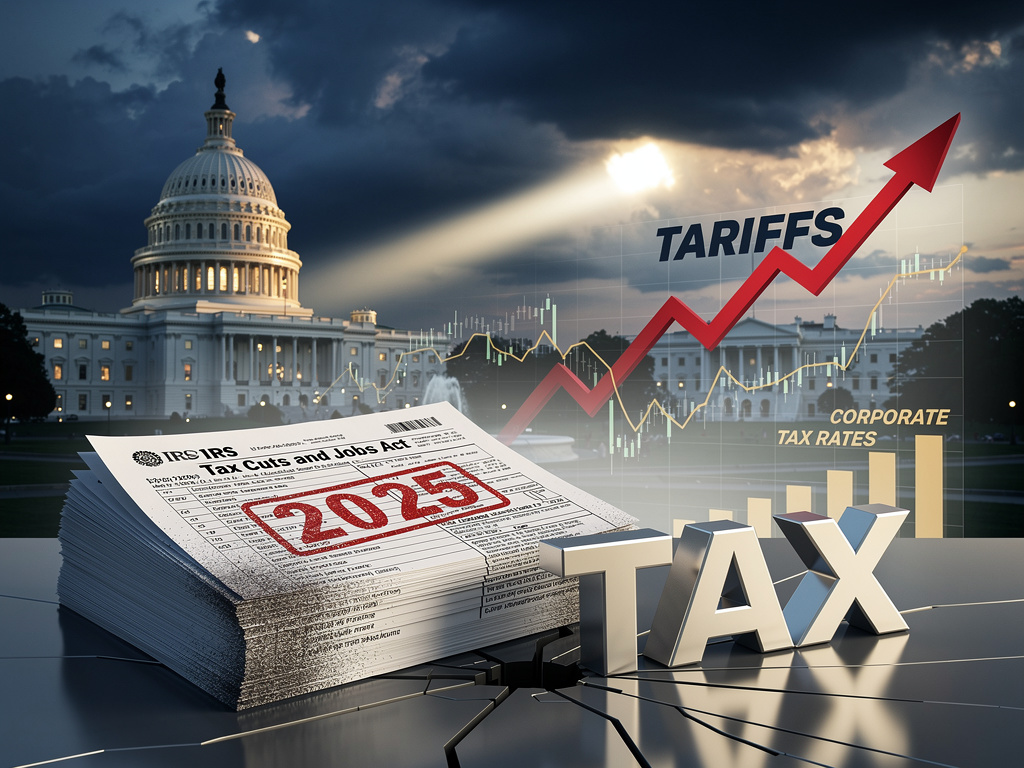
WASHINGTON—As 2025 looms, a fiscal cliff of monumental proportions is coming into view, set to become the defining economic battleground for the next administration. At its center is the Tax Cuts and Jobs Act (TCJA) of 2017, former President Donald J. Trump’s signature legislative achievement, whose provisions for individuals are set to expire at the end of next year. The ensuing policy collision will not merely determine tax rates; it will reshape household finances, dictate corporate investment strategy, and set the nation’s fiscal trajectory for the next decade.
The upcoming presidential election presents two starkly different futures for American taxpayers and businesses. President Biden has pledged to let the cuts expire for those earning over $400,000 while seeking to expand credits for families. Conversely, a second Trump administration would not only aim to make the individual cuts permanent but is also reportedly contemplating a more profound restructuring of the federal revenue system. This divergence has left Wall Street, corporate boardrooms, and family financial planners in a state of high-stakes suspense, waiting to see which economic reality will emerge from the political fray.
A Push for Permanence Meets a Sobering Price Tag
The core of the debate begins with the TCJA’s sunsetting provisions. Without legislative action, 2026 will bring a sharp reversion to pre-2018 tax law. That means higher marginal income tax rates across most brackets, a standard deduction cut nearly in half, a smaller Child Tax Credit, and the return of personal exemptions and certain itemized deductions. For millions of American households that have grown accustomed to the current system, the change would be abrupt and, for many, costly. The central pillar of Mr. Trump’s tax platform is a full and permanent extension of these individual cuts, a move he argues is essential for continued economic prosperity.
This pledge, however, carries a formidable fiscal weight. According to an analysis by the Committee for a Responsible Federal Budget, making the expiring TCJA provisions permanent would add a staggering $4 trillion to the national debt over the next decade, including interest costs. This figure complicates the political calculus, even for fiscal conservatives, as it would exacerbate a national debt already on an unsustainable path. The tension between the populist appeal of permanent tax cuts and the growing pressure for fiscal discipline will be a central conflict in any 2025 tax negotiation, forcing a Republican-led government to confront difficult trade-offs.
A New Economic Paradigm: Tariffs as a Tax-Cut Funding Mechanism
Beyond simply extending his first-term policies, Mr. Trump has floated a far more disruptive idea: using broad-based tariffs as a primary tool of fiscal policy. He has discussed imposing a universal baseline tariff of 10% on all imports, with even higher rates on goods from China. More recently, reports have emerged of him workshopping an idea to use sweeping new tariffs as a mechanism to fund significant cuts to, or even replace, the American income tax, according to a report from Axios. This represents a fundamental shift, viewing tariffs not just as a tool for trade negotiation but as a primary source of federal revenue to offset domestic tax reductions.
This proposal has been met with deep skepticism by many mainstream economists, who warn that such a high tariff would act as a massive tax on American consumers, raising prices on a vast array of goods and risking retaliatory actions that could cripple U.S. exports. Furthermore, the plan extends to corporate taxes. After successfully lowering the top corporate rate from 35% to 21%, Mr. Trump has told top U.S. CEOs he is now considering a further cut to 20% or even as low as 15%, as reported by Bloomberg. Such a move would aim to make the U.S. an even more attractive destination for business but would add hundreds of billions more to the deficit unless offset by tariff revenue or steep spending cuts—a feat that has proven politically elusive.
The SALT Cap Conundrum and Shifting Political Alliances
One of the most politically contentious elements of the TCJA is its $10,000 cap on the deduction for state and local taxes (SALT). This provision disproportionately impacted higher-income households in high-tax, predominantly Democratic states like New York, New Jersey, and California. The cap has created unusual political alliances, with a bipartisan group of lawmakers from these states vehemently advocating for its full repeal. A repeal would primarily benefit the wealthiest taxpayers, creating an ideological puzzle for both parties.
Mr. Trump has historically shown little interest in repealing the SALT cap, viewing it as a justifiable levy on high-tax states. However, the narrow margins likely to exist in the next Congress could give a small group of pro-SALT Republicans from states like New York significant leverage in any tax debate. While a full repeal remains unlikely, a potential compromise could involve raising the cap—for instance, to $20,000 for individuals and $40,000 for joint filers—as a way to placate these key lawmakers without completely abandoning the provision. The outcome of the SALT debate will be a critical bellwether for the art of the deal in a new Washington.
Navigating Profound Uncertainty: Planning for a Bifurcated Future
This policy divergence creates a profound planning challenge. As noted by Business Insider, headlines suggesting “bigger refunds” under a Trump plan are shorthand for what would simply be a continuation of current law, whereas a failure to act would result in a tax increase for most filers in 2026. This cliff forces businesses and individuals to plan for two wildly different scenarios. Key decisions on capital investment, retirement contributions, and estate planning now hang in the balance, contingent entirely on the outcome of the November election.
The conversation in Mr. Trump’s camp is not limited to extending the TCJA. His economic advisors, a group that includes familiar names like Stephen Moore and Larry Kudlow, are reportedly exploring a “Tax Reform 2.0.” This could involve simplifying the tax code further, indexing capital gains to inflation, or introducing new tax-favored savings accounts. According to The Wall Street Journal, the overarching goal is to use the tax code to spur a higher rate of economic growth, with a target of 3% annually. This ambition ensures that the 2025 tax debate will be less about a simple extension and more about a wholesale reimagining of America’s fiscal architecture.
The Coming Legislative Showdown
Ultimately, no tax plan can be enacted by presidential decree. The composition of the House and Senate following the 2024 elections will be just as crucial as who occupies the Oval Office. A victory by either party without control of both chambers of Congress would likely lead to legislative gridlock and a potential scenario where all TCJA provisions expire, triggering a sudden, multitrillion-dollar tax hike on the American economy—a shock few in either party desire. The most plausible path for any major tax legislation would be through the budget reconciliation process, which allows certain bills to pass the Senate with a simple majority, bypassing the 60-vote filibuster.
The stage is therefore set for a legislative showdown in 2025 that will be among the most consequential in recent memory. The outcome will hinge on razor-thin congressional margins, intense lobbying from every sector of the economy, and the dealmaking abilities of the next president. As detailed by the Tax Foundation, the sheer number of expiring provisions creates a complex, interlocking puzzle for lawmakers. For industry insiders and financial professionals, the coming year will demand vigilant monitoring of the political winds from Washington, as the resolution of this $4 trillion question will reverberate through every corner of the U.S. economy for years to come.


 WebProNews is an iEntry Publication