
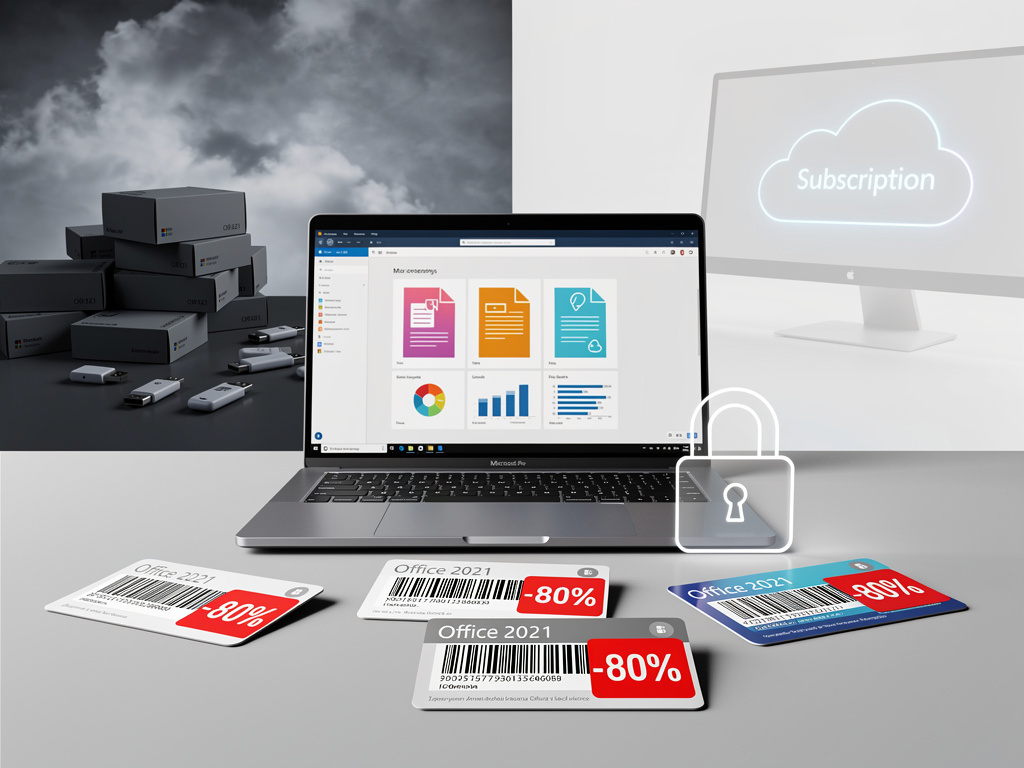
In an era dominated by the relentless march toward subscription services, a curious anomaly persists in the software market, one that directly challenges the recurring-revenue model championed by titans like Microsoft Corp. A recent promotion surfaced offering a lifetime license for Microsoft Office Professional 2021 for Windows for just under $30, a staggering 91% discount from its typical list price. As highlighted by Mashable, the deal provides access to the full suite of iconic applications—Word, Excel, PowerPoint, Outlook, and more—for a one-time fee that is less than half the cost of a single year of Microsoft’s flagship 365 Personal subscription.
This is not an isolated incident but a signal from a resilient corner of the market that prizes ownership over access. For Microsoft, it represents a significant point of friction. The company’s financial trajectory has been overwhelmingly powered by its pivot to the cloud and subscription services. In its second-quarter fiscal results for 2024, Microsoft reported that its Office Commercial products and cloud services revenue increased by 15%, driven by a 17% growth in Office 365 Commercial revenue. This strategy, centered on predictable, recurring income and deeper customer integration through cloud services, is the company’s undisputed future. Yet, the allure of a single, permanent purchase remains a powerful counter-narrative for a significant user base, from students and freelancers to small businesses wary of accumulating monthly operational expenses.
The Strategic Divide Between Perpetual and Subscription Models
The value proposition of a perpetual license like Office 2021 is its simplicity and predictability. A user pays once and owns the software for the life of the device it is installed on. This model eliminates the mental overhead and financial drain of another monthly bill, a phenomenon increasingly known as “subscription fatigue.” For businesses operating on tight margins, a one-time software expenditure is a capital expense that can be budgeted for, rather than a recurring operational cost that compounds over time. This approach appeals particularly to users with static needs, who require the core functionality of Office applications without the constant evolution of cloud-integrated features.
Conversely, Microsoft’s strategic focus is squarely on the Microsoft 365 ecosystem. The subscription offers a fundamentally different, and from the company’s perspective, superior, value proposition. It includes not just the core applications but also 1TB of OneDrive cloud storage, robust multi-device access across PCs, Macs, and mobile devices, and, most critically, a continuous stream of feature updates and security patches. Subscribers are the first to receive new tools, such as the AI-powered Copilot assistant, which is being deeply integrated into the 365 suite. This a key differentiator, as Office 2021 is a feature-frozen product; it will receive security updates but no new functionalities for the duration of its lifecycle.
Navigating the Murky Waters of the Digital Grey Market
The existence of such deeply discounted licenses raises an immediate and critical question for any discerning buyer: are they legitimate? The answer resides in the complex and often opaque world of the software grey market. These product keys are typically not counterfeit, but they are often sold outside of Microsoft’s intended distribution channels. According to a detailed investigation by PCMag on the similar market for Windows keys, these licenses often originate from several sources. They can be OEM (Original Equipment Manufacturer) keys that were meant to be bundled with new hardware, volume licenses purchased by large corporations that are then illicitly broken up and resold, or keys acquired through regional price arbitrage, where they are bought cheaply in one country and resold in another.
While the key will often activate the software successfully, the practice occupies a legal grey area and violates Microsoft’s terms of service. The primary risk for the consumer or business is that Microsoft could, at any time, identify the key as improperly sold and deactivate it, leaving the user with non-functional software and little recourse. Furthermore, purchasing from unauthorized resellers carries an inherent security risk, as there is no guarantee the download links provided are for untampered software. For any business where software integrity and compliance are paramount, these risks often outweigh the initial cost savings.
A Built-In Expiration Date for One-Time Buyers
Beyond the risks of deactivation, there is a more definitive ticking clock on the value of these perpetual licenses. Microsoft has a clear and public lifecycle policy for its products. According to the company’s official documentation, mainstream support for Office 2021 is scheduled to end on October 13, 2026. After this date, the software will no longer receive security updates, bug fixes, or technical support, as detailed by Microsoft on its official lifecycle page. In an environment of ever-evolving cybersecurity threats, running unsupported software on a network-connected machine is a significant gamble, making the “lifetime” license a misnomer in a practical business context.
This planned obsolescence is a core part of the strategy to nudge users toward the evergreen Microsoft 365 platform. However, Microsoft has not entirely abandoned the perpetual model, acknowledging its necessity for specific niche markets. The company has announced a commercial preview for Office LTSC (Long-Term Servicing Channel) 2024. As reported by The Verge, this version is targeted at specialized commercial and government use cases, such as devices on a manufacturing floor or medical equipment that cannot accept frequent feature updates for regulatory or stability reasons. This targeted release underscores that while the perpetual license is not dead, its role has been relegated from a mainstream option to a specialized tool, further cementing Microsoft 365’s position as the default choice for the vast majority of users.
The Calculation for Modern IT Decision-Makers
For IT managers and small business owners, the choice is not merely about a one-time cost versus a subscription. It is a strategic decision about total cost of ownership (TCO), security posture, and future-proofing. A $30 license may seem appealing for a secondary, non-critical workstation or for an organization with absolutely no need for collaborative or cloud-based features. However, for a primary business environment, the lack of ongoing feature updates, integrated cloud storage, and collaborative tools like real-time co-authoring can quickly become a competitive disadvantage.
When security is factored in, the calculation becomes even clearer. The cost of a single security breach resulting from an unpatched vulnerability in an unsupported software package would far exceed the cumulative cost of a Microsoft 365 subscription. The subscription model effectively outsources a portion of the security and update management burden to Microsoft, a value proposition that resonates strongly with overburdened IT departments. The persistent availability of these low-cost licenses serves as a constant temptation, but one that requires a rigorous risk-benefit analysis before any purchase is made.
An Enduring Demand for Ownership in a Rented World
Ultimately, the deep discounts on Office 2021 are more than just a bargain; they are a reflection of a fundamental tension in the modern digital economy. They represent the lingering demand for a sense of ownership and control in a world that is increasingly shifting to a model of temporary, service-based access. While Microsoft’s subscription empire is in no danger of crumbling, the vibrant grey market for its perpetual licenses demonstrates that a segment of the customer base remains unconvinced or unserved by the all-in subscription future.
This persistent undercurrent will continue to challenge software companies to justify the value of their subscriptions and to consider the needs of users who, for reasons of budget, philosophy, or specific use-case, prefer to buy and to own. The $30 Office license is a paradox: a product Microsoft is strategically moving away from, yet one that continues to find willing buyers, serving as a constant reminder that in the software industry, the past is never entirely left behind.


 WebProNews is an iEntry Publication