
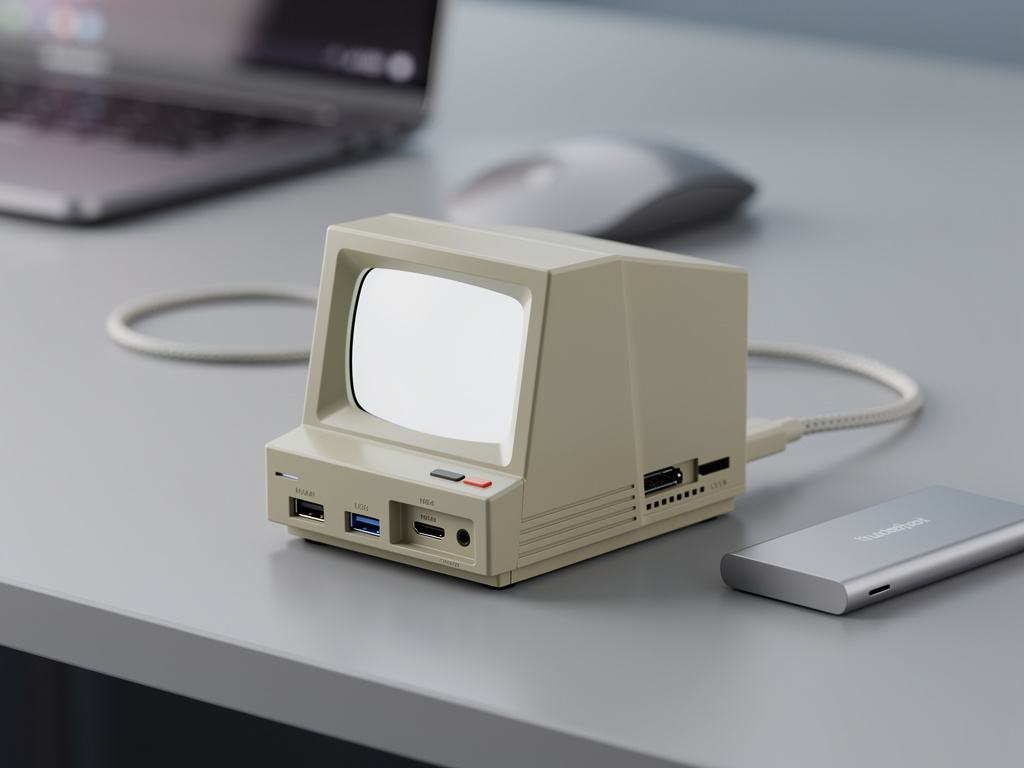
It’s shaped like the original 1984 Macintosh. It has a working display where the CRT used to be. And it connects to your modern Mac via a single Thunderbolt cable, adding ports, storage expansion, and a second screen — all inside a case smaller than a coffee mug.
The Retro Dock, designed by accessory maker Shargeek, is the latest product to capitalize on Apple nostalgia while solving a genuinely practical problem: the chronic port shortage on modern MacBooks. 9to5Mac first reported on the dock’s full specifications and availability, and the device has since generated significant attention among Mac enthusiasts and professionals who want both form and function on their desks.
At $249, it’s not cheap for a dock. But it’s not just a dock.
The Retro Dock packs a 3.5-inch IPS display into the front panel — right where the Macintosh 128K’s 9-inch monochrome screen once sat. That display functions as a secondary monitor, capable of showing system stats, a clock, custom images, or even acting as a tiny usable screen for widgets and monitoring tools. The resolution is 320×480, which won’t replace anyone’s Studio Display, but Shargeek has designed a companion app that lets users configure what appears on the screen. Think CPU usage, memory pressure, network throughput, or a rotating gallery of pixel art. It’s a novelty, sure. But it’s a novelty that people seem to genuinely want.
Behind the nostalgia, the hardware specifications are serious. The dock provides two USB-C ports (one Thunderbolt 4 passthrough), two USB-A 3.2 ports, an HDMI 2.1 output supporting up to 4K at 120Hz, a MicroSD card slot, a full-size SD card slot, and an NVMe SSD bay that accepts M.2 2230 and 2242 drives. That last feature is the one that matters most. Apple’s internal storage remains expensive — the jump from 512GB to 1TB on a MacBook Pro still costs $200 — and the ability to slot in a fast NVMe drive inside the dock effectively gives users expandable storage without dangling external enclosures.
Power delivery hits 100W, enough to charge a 16-inch MacBook Pro at full speed.
The design references are unmistakable and intentional. The case is molded in “Platinum” beige plastic, matching the color Apple used on its computers from 1984 through the mid-1990s. There’s a faux floppy disk slot on the front that serves as the SD card reader. The rear venting mimics the original Macintosh’s battery compartment lines. Shargeek even included a tiny rainbow Apple-style logo, though they’ve been careful enough to make it legally distinct — six colors instead of the original’s six, but in a slightly different gradient arrangement.
This isn’t Shargeek’s first retro-themed product. The company previously released the Storm 2, a transparent portable battery pack that looked like it belonged in Jony Ive’s design lab circa 1998, and a series of GaN chargers with vintage computing aesthetics. The Shenzhen-based company has built a following by making accessories that people actually want to leave visible on their desks, rather than hiding behind monitors or under tables.
So why does this matter beyond aesthetics?
The modern Mac port situation remains a source of friction for professionals. Apple restored HDMI, MagSafe, and an SD card slot to the MacBook Pro lineup starting in 2021, partially reversing the controversial all-USB-C design introduced in 2016. But the MacBook Air still ships with just two Thunderbolt ports and a MagSafe connector. The Mac Mini has improved with the M4 generation — five USB-C ports and two USB-A — but desktop users who connect multiple displays, external drives, audio interfaces, and peripherals still regularly run out of connections. Docks from CalDigit, OWC, Anker, and Belkin have become essential desk accessories for many Mac users, with the CalDigit TS4 widely considered the gold standard at $399.
The Retro Dock slots in below that price point while offering something none of those competitors do: personality. Whether that personality justifies any trade-offs in port count or build quality compared to the CalDigit remains to be seen as more detailed reviews emerge.
Early hands-on impressions have been largely positive. The display is bright enough to read in a well-lit office. The NVMe bay is tool-free, using a spring-loaded mechanism. And the single-cable connection works as expected — plug in one Thunderbolt cable, and everything lights up. The dock draws power from the Mac’s Thunderbolt bus for its own operation and passes through charging power from its included 100W adapter to the laptop.
There are limitations. The HDMI output maxes at a single external display, so users needing dual-monitor support from a single dock will still need to look at pricier Thunderbolt options or use DisplayLink workarounds. The built-in display, while charming, requires Shargeek’s proprietary software, and there’s no indication yet of whether it will support third-party apps or developer APIs. And the plastic construction, while authentic to the Macintosh aesthetic, won’t feel as premium as the aluminum housings on CalDigit or OWC docks.
The timing of the product is interesting. Apple nostalgia is running hot. The company celebrated its 40th anniversary of the Macintosh in January 2024 with a short film and media retrospectives. Vintage Mac collecting has surged, with working Macintosh 128K units selling for $1,500 to $5,000 on eBay depending on condition. And the broader culture has embraced retro tech aesthetics — mechanical keyboards styled after IBM Model Ms, monitors with CRT-inspired curvature, even smartphone apps that mimic classic Mac OS interfaces.
Shargeek appears to be shipping the Retro Dock directly through its own website and through Amazon, with availability starting in mid-April 2026. The company is offering an early-bird discount of $199 for the first production run.
For the professional who already has a functional dock setup, the Retro Dock is admittedly hard to justify on specs alone. The CalDigit TS4 offers more ports. The Anker 777 costs less. OWC’s Thunderbolt docks provide dual-display support.
But none of them look like a tiny Macintosh sitting on your desk with a working screen. And in a market where most docks are indistinguishable gray or black rectangles, that counts for something. Maybe a lot.
The accessory market for Apple products has matured into a multi-billion-dollar industry where differentiation increasingly comes not from raw specifications but from design, materials, and emotional resonance. Companies like Satechi, Twelve South, and Grovemade have proven that Apple users will pay a premium for accessories that match the design sensibility of their computers. Shargeek is betting that the same principle applies — just aimed 40 years into the past instead of matching the current aluminum-and-glass aesthetic.
It’s a smart bet. The original Macintosh wasn’t just a computer. It was a statement. A declaration that technology could be personal, friendly, approachable. The Retro Dock borrows that emotional weight and wraps it around a USB-C hub. That’s either brilliant product design or brilliant marketing. Probably both.


 WebProNews is an iEntry Publication