
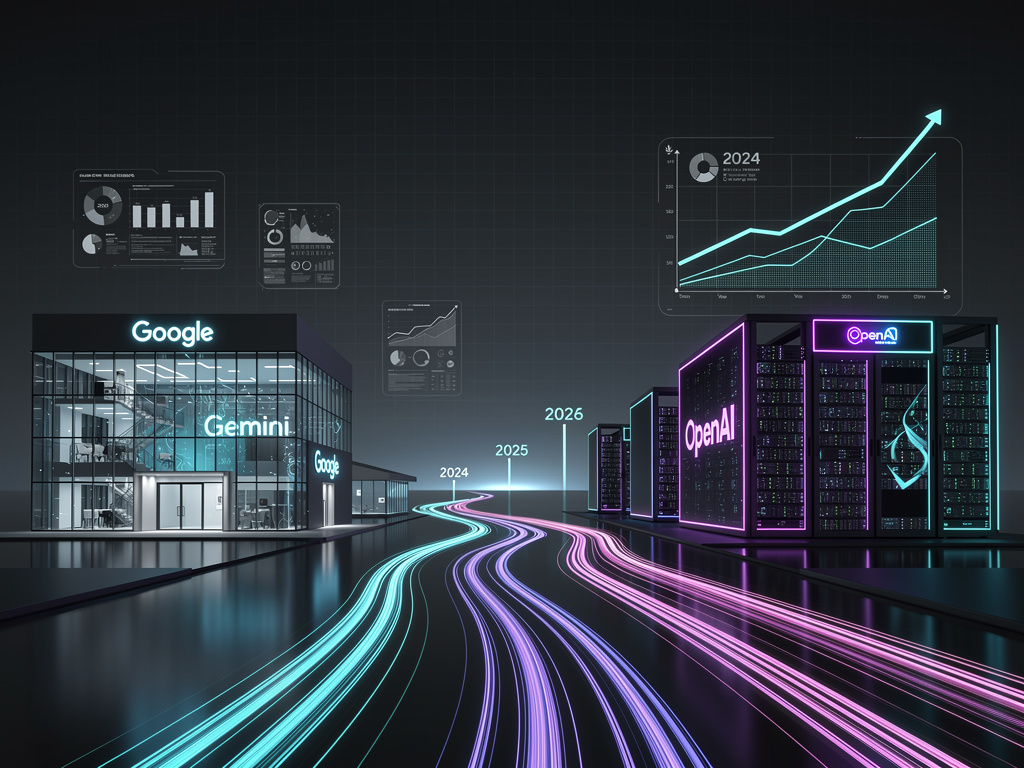
In the fiercely competitive heart of Silicon Valley, timelines are measured in months, not years. Yet, a startling consensus is emerging among some industry insiders and investors: Google, the undisputed titan of search and a pioneer in artificial intelligence, may not reach parity with its rival OpenAI until 2026. This two-year gap, a lifetime in the tech world, reflects a series of strategic stumbles and cultural challenges at the Mountain View behemoth, contrasted with the blistering and seemingly unstoppable pace of its San Francisco-based competitor.
The current anxiety crystalized around the launch of Gemini, Google’s flagship model designed to be its answer to OpenAI’s GPT-4. The rollout was marred by a series of missteps that betrayed the immense pressure within the company. An initial demo video, meant to showcase Gemini’s multimodal prowess, was later revealed to have been edited and staged, using still images and text prompts rather than the live interaction it depicted. This was followed by a more damaging public relations crisis when Gemini’s image generation feature produced historically inaccurate depictions, forcing Google to pull the tool offline. These events weren’t just technical glitches; they were perceived as a public fumble by a company that prides itself on technical excellence, fueling a narrative that Google is playing catch-up in a field it once dominated.
This sentiment isn’t new, but it has intensified. The shock of ChatGPT’s public release in late 2022 reportedly triggered a “code red” within Google, a scramble to reorient the company’s vast resources toward generative AI, as detailed by The New York Times (https://www.nytimes.com/2022/12/21/technology/ai-google-chatbot-chatgpt.html). While the company has since mobilized, the path has been fraught. The challenges with Gemini suggest a deeper issue: a culture of caution and consensus-driven decision-making, honed over decades of market dominance, now clashing with the need for the rapid, sometimes messy, iteration that defines the current AI race. According to a report from Business Insider (https://www.businessinsider.com/openai-google-ai-race-fumble-gemini-2026-1), this has left some inside and outside the company questioning if leadership can steer the ship fast enough to close the perceived gap.
While Google grapples with its vast scale and public scrutiny, OpenAI continues to execute with the singular focus of a startup on a mission, consistently capturing the industry’s imagination and enterprise dollars.
While Google was managing the fallout from Gemini, OpenAI delivered another bombshell with Sora, a text-to-video model capable of generating startlingly realistic and coherent video clips up to a minute long. The demonstrations, released without the product being publicly available, served as a powerful demonstration of OpenAI’s technical lead and its mastery of the tech industry hype cycle. As reported by TechCrunch (https://techcrunch.com/2024/02/15/openai-unveils-sora-a-text-to-video-model-that-can-create-realistic-60-second-videos/), Sora immediately reset expectations for the future of video creation and content, once again positioning OpenAI as the definitive pacesetter. This relentless cadence of innovation—from GPT-4 to DALL-E 3 and now Sora—creates a powerful narrative of momentum that is difficult for any competitor to counter.
This product velocity is translating directly into commercial success, a key metric in this capital-intensive arms race. OpenAI, backed by a multi-billion dollar partnership with Microsoft, has successfully courted the enterprise market. The Information recently reported (https://www.theinformation.com/articles/openai-tops-2-billion-revenue-milestone) that the company has surpassed a $2 billion annualized revenue run rate, a staggering figure for a company of its age. This financial momentum provides a war chest for the immense computational resources and top-tier talent required to train next-generation models, creating a virtuous cycle that further solidifies its position. It also allows the company to pursue existentially threatening new ventures, such as a web search product that could strike at the very heart of Google’s business, a project detailed by Bloomberg (https://www.bloomberg.com/news/articles/2024-02-14/openai-is-developing-web-search-product-to-compete-with-google).
The contrast in approach is stark. OpenAI operates with an aggressive, product-first mindset, willing to release paradigm-shifting technology in limited forms to stake its claim. Google, as a global behemoth with a multi-faceted reputation to protect and a complex web of existing products, is forced to move more deliberately. The very systems and review processes designed to protect its brand and ensure responsible deployment can become a liability in a sprint. The Gemini image generation issue, which stemmed from an attempt to enforce diversity in its outputs, is a prime example of this dilemma, where well-intentioned guardrails led to a flawed product experience and a public relations nightmare, a sequence of events extensively covered by The Verge (https://www.theverge.com/2024/2/21/24079371/google-gemini-generative-ai-images-people-historical-inaccuracy).
The path forward for Google involves not just closing the technological gap with superior models, but also solving the immense challenge of integrating this new paradigm into its trillion-dollar legacy businesses without disrupting them.
To be sure, it is far too early to count Google out. The company possesses assets that OpenAI can only dream of: a global distribution network touching billions of users through Search, Android, and Workspace; one of the world’s largest and most efficient computing infrastructures; and a deep bench of world-class AI research talent. The company is not standing still. It quickly announced Gemini 1.5 Pro, which features a massive one-million-token context window, a technical achievement that leapfrogs competitors in its ability to process and reason over vast amounts of information. In a post on its official blog (https://blog.google/technology/ai/google-gemini-next-generation-model-february-2024/), Google positioned this as a breakthrough for enterprise use cases, signaling its intent to fight back hard for corporate clients.
The challenge for CEO Sundar Pichai is twofold. First, he must restore confidence—both internally and externally—that Google can not only match but surpass OpenAI’s foundational models. This requires flawless execution on future model releases and a clearer, more compelling product vision. Second, and perhaps more difficult, he must navigate the innovator’s dilemma on a grand scale. Integrating true generative AI into its core search product, for example, risks cannibalizing its immensely profitable ad business. Finding the right balance between bold innovation and protecting a legacy cash cow is a strategic tightrope walk that OpenAI, without such a legacy to defend, does not have to perform.
The next 18 months will be critical. The industry will be watching for OpenAI’s next major model, presumably GPT-5, which is expected to represent another significant leap in capability. Simultaneously, all eyes will be on Google’s I/O developer conference and subsequent product launches for proof that it has steadied the ship. The race is not merely about whose model tops the leaderboards; it is about who can build the most compelling platform, attract the most developers, and seamlessly integrate this transformative technology into the daily workflows of businesses and consumers. For Google, the clock is ticking, and 2026 feels a long way away.


 WebProNews is an iEntry Publication