
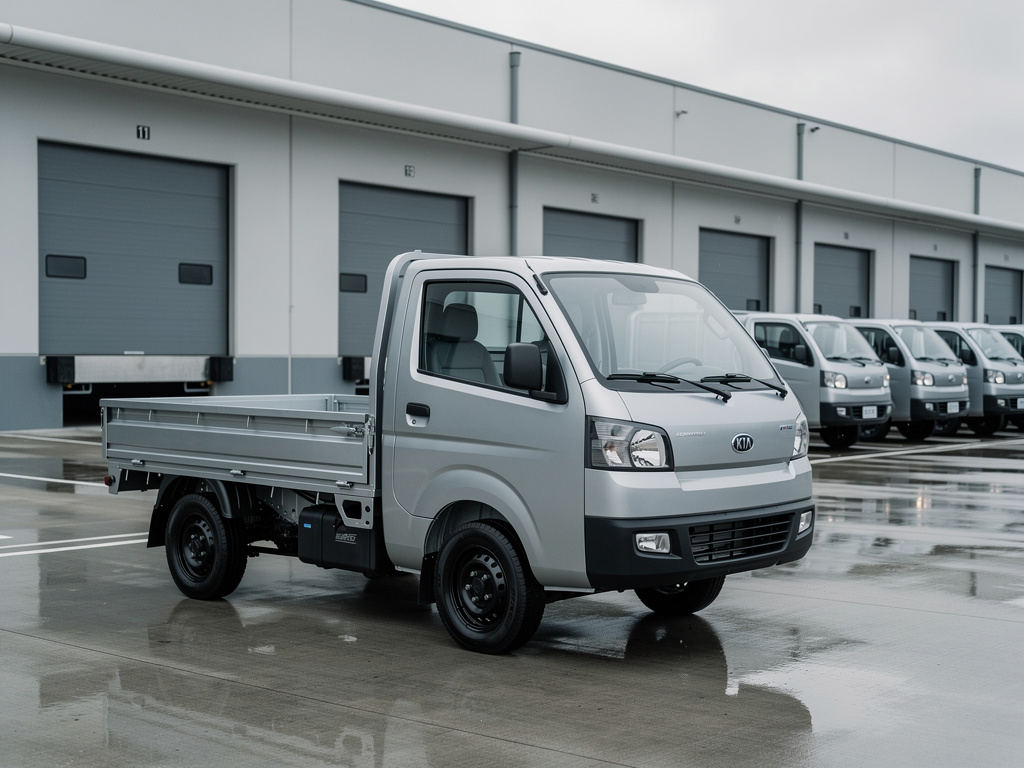
A startup called Slate Auto is making a wager that runs counter to nearly every instinct the American auto industry has followed for the past three decades: that buyers will pay for a vehicle that does less. Fewer miles of range. A smaller footprint. A cabin stripped to its essentials. No giant touchscreen. No over-the-air software updates promising features you didn’t know you needed. Just a truck.
It’s a fascinating bet. And it might actually work.
Slate unveiled the production-intent version of its debut vehicle this week — a compact electric pickup that the company says will start under $20,000 before any federal tax credits. The truck, simply called the Slate, is designed to be a work vehicle for tradespeople, fleet operators, municipalities, and the kind of buyer who sees a Ford F-150 Lightning and thinks: too much truck, too much money, too much complexity. As The Verge reported in its detailed look at the vehicle, Slate Auto is pursuing a philosophy of radical minimalism in an industry addicted to maximalism.
The specs tell the story. The base model offers roughly 150 miles of range from a lithium iron phosphate (LFP) battery — a chemistry favored for its durability and lower cost rather than energy density. That’s not a typo. In an era when automakers race to advertise 300-plus miles of range, Slate is deliberately offering half that. The company’s argument is straightforward: most work trucks don’t drive 150 miles in a day. Data on commercial fleet usage backs this up. According to the Department of Energy, the average light-duty commercial vehicle in the United States drives fewer than 70 miles per day. Slate isn’t building for road trips. It’s building for the job site and the return home.
The truck itself is compact — roughly the size of a Ford Maverick, sitting on a 112.5-inch wheelbase. It features a 4.5-foot bed, a front trunk, and a claimed payload capacity of around 1,500 pounds. That payload number matters enormously for the commercial market Slate is targeting. Landscapers, electricians, plumbers, small construction outfits — these buyers need to haul tools and materials, not tow fifth-wheel campers across Montana.
Inside, the minimalism is almost aggressive. As The Verge described, the interior is designed to be hosed out. Rubber floors. Durable surfaces. A dashboard with a small, functional display rather than the tablet-sized screens that have become ubiquitous in modern vehicles. There’s no leather. No ambient lighting. No massaging seats. The design language says: this is a tool, not a lifestyle accessory.
That positioning is deliberate and commercially shrewd.
The American pickup truck market has undergone a strange transformation over the past two decades. What was once a utilitarian vehicle — the default choice of farmers, contractors, and rural workers — became a luxury product. The average transaction price for a new pickup truck in the United States now exceeds $58,000, according to data from Kelley Blue Book. Fully loaded versions of the Ford F-150, Ram 1500, and Chevrolet Silverado regularly crest $70,000 or $80,000. Electric versions pushed even higher. The F-150 Lightning launched with promises of a $40,000 base model but quickly saw real-world pricing climb well above $50,000. The GMC Hummer EV started at over $100,000.
Somewhere along the way, the people who actually needed trucks for work got priced out. Or they kept buying 15-year-old used trucks with 200,000 miles on the odometer because that was what they could afford. Slate is explicitly going after this abandoned segment.
The company was founded by Chris Barman, who previously worked at Workhorse Group, another EV startup focused on commercial vehicles. Barman’s thesis is that the commercial and light-duty work truck market is underserved by every major automaker, all of whom have chased higher margins upmarket. Slate Auto is headquartered in Detroit and plans to manufacture in the United States, though the company has not yet disclosed its final assembly location. Production is targeted for 2026.
There’s a reason the sub-$20,000 price point matters beyond simple affordability. The Inflation Reduction Act’s commercial clean vehicle tax credit — Section 45W — can cover up to $7,500 for qualifying commercial EVs. For a vehicle with a base price under $20,000, that credit could bring the effective cost to a fleet buyer down to roughly $12,500. That’s less than a used F-150 with a clean title in most markets. For municipal governments looking to electrify their fleets under federal sustainability mandates, the math becomes almost irresistible.
But Slate isn’t operating in a vacuum. The affordable EV truck space, while still thin, is attracting attention. Chinese automakers have shown small electric trucks at international auto shows that carry similar price points, though tariff barriers make their entry into the U.S. market uncertain at best. Lordstown Motors attempted a commercial EV truck play with the Endurance and went bankrupt. Canoo pursued a similar small-footprint commercial EV strategy and collapsed. The graveyard of EV startups promising cheap, practical electric vehicles is well populated.
Slate’s leadership is aware of this history. The company has emphasized capital discipline, a staged production ramp, and a focus on pre-orders from commercial buyers rather than consumer hype. According to reporting from The Verge, Slate has secured letters of intent from several fleet operators, though the company hasn’t disclosed binding order numbers.
The LFP battery choice deserves closer scrutiny. Lithium iron phosphate cells are heavier and less energy-dense than the nickel-manganese-cobalt (NMC) cells used in most premium EVs. But they’re significantly cheaper per kilowatt-hour, more thermally stable (meaning less fire risk), and can endure far more charge-discharge cycles before degradation becomes noticeable. For a work truck that charges overnight at a depot and runs a predictable daily route, LFP is arguably the superior chemistry. Tesla has already shifted its standard-range Model 3 and Model 3 vehicles to LFP packs sourced from CATL. BYD uses LFP across much of its lineup. The technology is proven at scale.
What remains unproven is Slate’s ability to actually manufacture vehicles at its stated price point with positive margins. Building a vehicle for under $20,000 in the United States — with American labor costs, American regulatory compliance requirements, and domestic supply chain constraints — is extraordinarily difficult. Even legacy automakers with decades of manufacturing optimization and massive economies of scale struggle to make money on vehicles priced below $25,000. General Motors killed the Chevrolet Spark. Ford discontinued the Fiesta and Focus. Stellantis has largely abandoned the sub-$25,000 car market in North America.
Slate says its cost structure benefits from the vehicle’s simplicity. Fewer electronic systems. A smaller battery. Minimal interior fitment. No complex driver-assistance suite. Every feature not included is a cost not incurred. The company has also pointed to its modular platform architecture, which it claims will allow multiple body styles — including a van configuration — to share common underpinnings, spreading development costs across a broader product line.
This approach has historical precedent. The original Volkswagen Beetle. The Ford Model T. The Citroën 2CV. The Suzuki Carry. Throughout automotive history, the vehicles that achieved the broadest adoption were almost never the most capable or luxurious. They were the ones that were cheap enough, reliable enough, and practical enough for the greatest number of buyers. Slate is implicitly arguing that the EV industry has lost sight of this principle in its rush to prove that electric vehicles can match or exceed the performance and range of internal combustion vehicles at every level.
The timing may be right. Consumer sentiment around EVs has shifted noticeably over the past 18 months. Early adopters have largely been served. The next wave of buyers — the pragmatists, the fleet managers, the budget-conscious — cares less about zero-to-sixty times and more about total cost of ownership. A work truck that costs $12,500 after tax credits, charges for a few dollars a night, and requires almost no powertrain maintenance could fundamentally alter the economics of small business fleet operations.
And yet. The history of automotive startups is merciless. Capital markets have grown skeptical of EV companies without revenue. The SPAC boom that funded a generation of EV hopefuls has evaporated. Slate will need to raise significant additional capital to reach production, and it will need to do so in an environment where investors have been burned repeatedly by companies making similar promises.
The truck itself, based on the production-intent design shown this week, looks credible. It’s not flashy. It’s not trying to be. The proportions are honest — a stubby hood, a functional bed, visible structural elements that suggest durability rather than disguise it. The design won’t win awards at a concours d’elegance. That’s the point.
Whether Slate can cross the chasm from compelling prototype to volume production remains the central question. The company has the right thesis. The market gap is real. The price point is attractive. But execution in automotive manufacturing is brutally unforgiving, and being right about the product doesn’t guarantee being right about the business. Dozens of founders with good ideas and bad balance sheets can attest to that.
Still, Slate Auto is asking a question the industry needs to hear. Not every buyer wants more. Some just want enough — at a price that makes sense. If Slate can deliver on that promise, the implications for commercial fleet electrification would be significant. If it can’t, it will join a long list of startups that understood the problem perfectly and couldn’t survive long enough to solve it.
The truck is expected to enter production in 2026. Between now and then, everything is execution.


 WebProNews is an iEntry Publication