
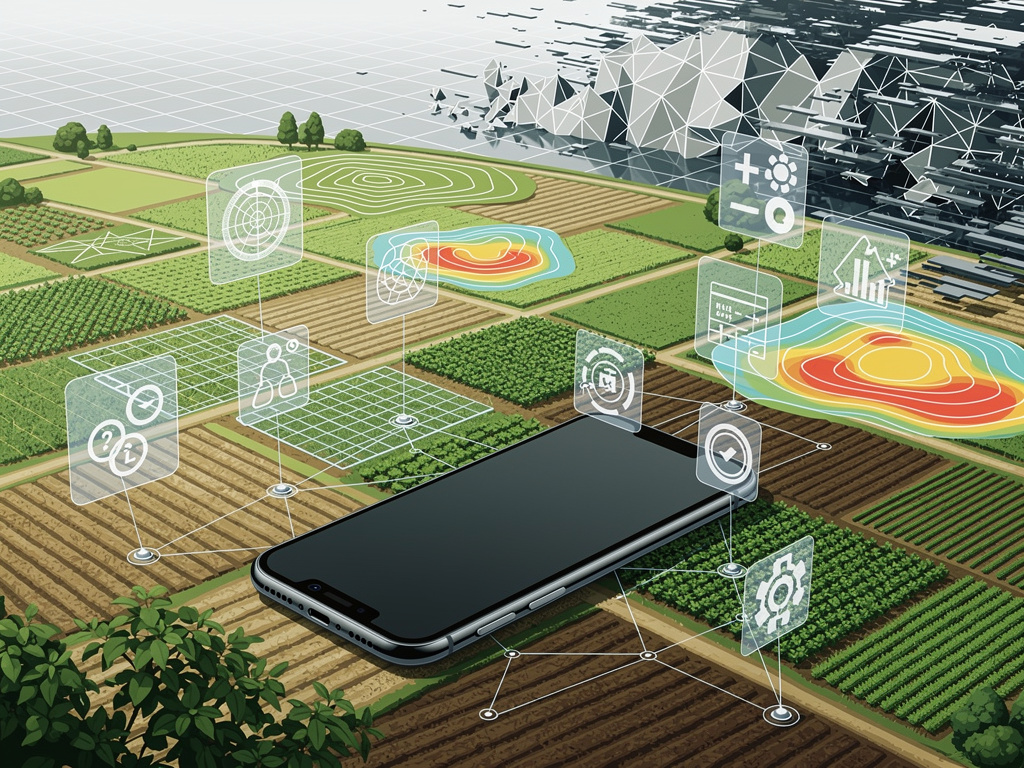
For decades, precision agriculture was a rich farmer’s tool. Satellite imagery, drone surveillance, variable-rate application maps — these technologies promised to optimize every acre, but their price tags kept them locked behind the gates of large-scale commercial operations. A corn grower managing 200 acres in central Iowa or a specialty crop farmer tending 50 acres in California’s Central Valley could read about the future of farming in trade journals. They just couldn’t afford to participate in it.
That’s starting to change.
Evion, a startup backed by venture capital and armed with a computer vision platform trained on millions of crop images, is pushing AI-powered crop analysis downstream — targeting small and mid-sized farms that have historically been priced out of precision agriculture. The company’s tool, which uses smartphone cameras and low-cost sensors to assess plant health, pest damage, nutrient deficiencies, and yield projections, doesn’t require a $150,000 drone fleet or a six-figure annual subscription to a satellite data provider. It requires a phone and an internet connection, as Business Insider reported in its coverage of the company’s recent launch.
The implications are significant, not just for the farmers themselves but for a global food system that depends far more on small and mid-sized operations than most people realize. According to the United Nations Food and Agriculture Organization, farms smaller than two hectares — roughly five acres — produce about 35% of the world’s food. In the United States, the USDA classifies roughly 89% of farms as “small,” meaning they generate less than $350,000 in annual gross cash farm income. These aren’t hobby farms. They’re the backbone of regional food systems, and they’ve been flying blind while their larger competitors have had access to increasingly sophisticated data tools.
Evion’s pitch is straightforward. Point your phone at a crop. The AI identifies the species, assesses its condition, flags potential problems, and offers recommendations. No agronomy degree required. No expensive hardware. The model runs inference both on-device and in the cloud, depending on connectivity — a practical concession to the reality that many rural areas still lack reliable broadband. The company told Business Insider that its system can detect early-stage disease with accuracy rates above 90%, often catching problems days before they’d be visible to the human eye.
This is not the first attempt to democratize farm-level AI. Companies like Plantix, Agrosmart, and FarmLogs (now part of Bushel) have all taken runs at bringing data-driven decision-making to smaller operations. But many of these efforts stumbled on the same problems: models trained on too-narrow datasets, interfaces designed by engineers rather than farmers, pricing structures that still assumed a certain scale of operation, and — perhaps most critically — a failure to account for the sheer diversity of growing conditions across different regions, climates, and crop types.
Evion appears to have learned from some of these missteps. The company claims its training dataset spans over 400 crop varieties across 60 countries, built through partnerships with agricultural extension services, university research stations, and a network of early-adopter farmers who contributed labeled images in exchange for free access to the platform. That breadth matters. An AI that can identify late blight on a tomato plant in Florida but fails to recognize it on a different cultivar in Guatemala isn’t useful at scale. And scale — specifically, the kind of geographic and agronomic scale that matches the diversity of global smallholder farming — is what Evion is betting on.
The timing isn’t accidental.
The convergence of several trends has created an opening that didn’t exist even three years ago. Smartphone penetration in rural areas of developing nations has surged. Edge computing capabilities on mobile devices have improved dramatically, allowing complex models to run locally without constant cloud connectivity. And the cost of training large vision models has dropped, thanks in part to open-source frameworks and the commoditization of GPU compute time. Meanwhile, climate volatility has made the need for early-warning crop diagnostics more urgent than ever. Farmers who once could rely on generational knowledge about weather patterns and pest cycles are finding that those patterns no longer hold.
The economic math is compelling, at least on paper. The USDA estimates that crop diseases, pests, and weeds cost U.S. agriculture roughly $40 billion annually. Globally, the FAO puts post-harvest losses alone at around $370 billion per year. If an AI tool can reduce even a fraction of those losses for small and mid-sized farms, the return on investment is enormous — not just for individual growers but for food security broadly.
But there’s a gap between a compelling pitch deck and field-level adoption. And that gap is where most agtech startups go to die.
The challenges are real and deeply practical. Farmers are, by necessity, conservative adopters of new technology. A bad recommendation from an AI — say, a false negative on a disease detection that leads a grower to skip a fungicide application — can mean the difference between a profitable season and a catastrophic one. Trust has to be earned crop cycle by crop cycle, and it can be destroyed in a single bad season. This is something the tech industry, with its “move fast and break things” ethos, has historically struggled to internalize. You can’t break a farmer’s livelihood and then iterate.
There’s also the question of data ownership. Evion, like many AI platforms, improves its models by collecting data from its users. Every image a farmer uploads, every diagnosis confirmed or corrected, feeds back into the training pipeline. For large agribusiness operations, this dynamic has already become a point of contention — who owns the data generated on a farm, and who profits from it? For smaller farmers, many of whom lack the legal resources to scrutinize terms of service agreements, the power imbalance is even more pronounced. Evion has said it anonymizes user data and does not sell it to third parties, but the broader industry has made similar promises before, and not all of them have held up.
Then there’s the competitive picture. The major players in agricultural technology — John Deere, AGCO, Bayer Crop Science, Corteva — are all investing heavily in AI and data analytics. Deere’s acquisition of Blue River Technology in 2017 for $305 million signaled the direction of travel, and the company has since integrated computer vision into its sprayers and planters for real-time weed detection and targeted application. Bayer’s Climate Corporation (now rebranded as Climate FieldView) offers a digital farming platform used on hundreds of millions of acres worldwide. These companies have distribution networks, dealer relationships, and brand recognition that a startup simply cannot match.
But they also have a structural blind spot. Their business models are built around selling equipment and inputs — tractors, seeds, chemicals — and their digital platforms tend to be optimized for the large-scale operations that buy those products. A farmer managing 100 acres of diversified vegetables doesn’t need a $500,000 combine with integrated AI. They need a tool that fits in their pocket and costs less than a bag of seed corn. That’s the niche Evion is targeting, and it’s a niche that the incumbents have largely ignored because the per-customer revenue is too small to justify their overhead.
So the question isn’t whether AI crop analysis works. It does. The computer vision models have matured to the point where they can reliably identify hundreds of diseases, pests, and nutrient deficiencies from a photograph. The question is whether the business model works — whether a company can build a sustainable enterprise by serving the long tail of global agriculture, where individual customers might pay $10 or $20 a month rather than $10,000 a year.
Evion’s answer, based on the Business Insider report, involves a freemium model. Basic crop identification and disease detection are free. Premium features — yield forecasting, historical trend analysis, integration with weather data, and personalized treatment recommendations — sit behind a subscription paywall. The company is also exploring B2B partnerships with agricultural cooperatives, microfinance institutions, and crop insurance providers, who could bundle the tool with their existing services. That last channel is particularly interesting. If an insurer can reduce claims by giving policyholders access to better diagnostics, the economics of subsidizing the subscription cost make sense for everyone involved.
This model has precedent outside agriculture. In healthcare, AI diagnostic tools have followed a similar trajectory — starting with free or low-cost consumer-facing apps, then moving into partnerships with institutional payers who have a financial incentive to catch problems early. The parallels between crop health and human health diagnostics are surprisingly close. Both involve pattern recognition on visual data. Both require models trained on diverse populations to avoid bias. And both face the same fundamental tension between accessibility and accuracy — the desire to put powerful tools in everyone’s hands versus the risk of misdiagnosis when those tools are used without expert oversight.
Growing up in the Midwest, I spent enough time around farms to understand something that often gets lost in Silicon Valley’s enthusiasm for agtech: farming is not a software problem. It’s a biological, meteorological, economic, and deeply human enterprise. The best technology in the world is worthless if it doesn’t fit into the rhythms and realities of a farmer’s day. A tool that requires 20 minutes of data entry after a 14-hour day in the field won’t get used. A recommendation engine that doesn’t account for local input prices, market access, and labor availability will generate advice that looks smart on a screen and makes no sense in the dirt.
The companies that succeed in this space will be the ones that understand this. Not just intellectually, but operationally — in the design of their interfaces, the structure of their pricing, and the humility of their recommendations. “Here’s what we think we see, and here are some options” is a very different message than “spray this chemical now,” and the difference matters enormously when a farmer’s season — and sometimes their farm — is on the line.
Evion is early. The company has not yet published peer-reviewed validation studies, and its accuracy claims, while promising, have not been independently verified at scale. The agricultural AI space is littered with startups that generated impressive demo results and then struggled to replicate them across the messy, variable, uncontrolled conditions of real-world farming. Soil types change across a single field. Lighting conditions vary by hour. Two plants with the same disease can look different depending on variety, growth stage, and environmental stress. Building a model that handles this complexity reliably is extraordinarily difficult, and the only real test is time — seasons of deployment across thousands of farms in dozens of regions.
But the direction is right. The democratization of agricultural intelligence — making data-driven farming accessible to the 500 million smallholder farms that feed most of the world — is one of the most consequential applications of AI currently underway. It won’t be flashy. It won’t generate the breathless headlines that accompany each new large language model release. But it could, over the next decade, meaningfully reduce crop losses, improve food security, and give hundreds of millions of farmers tools that their wealthier counterparts have had for years.
And if it works — really works, at the scale and price point Evion is targeting — it will be worth far more than another chatbot.


 WebProNews is an iEntry Publication