
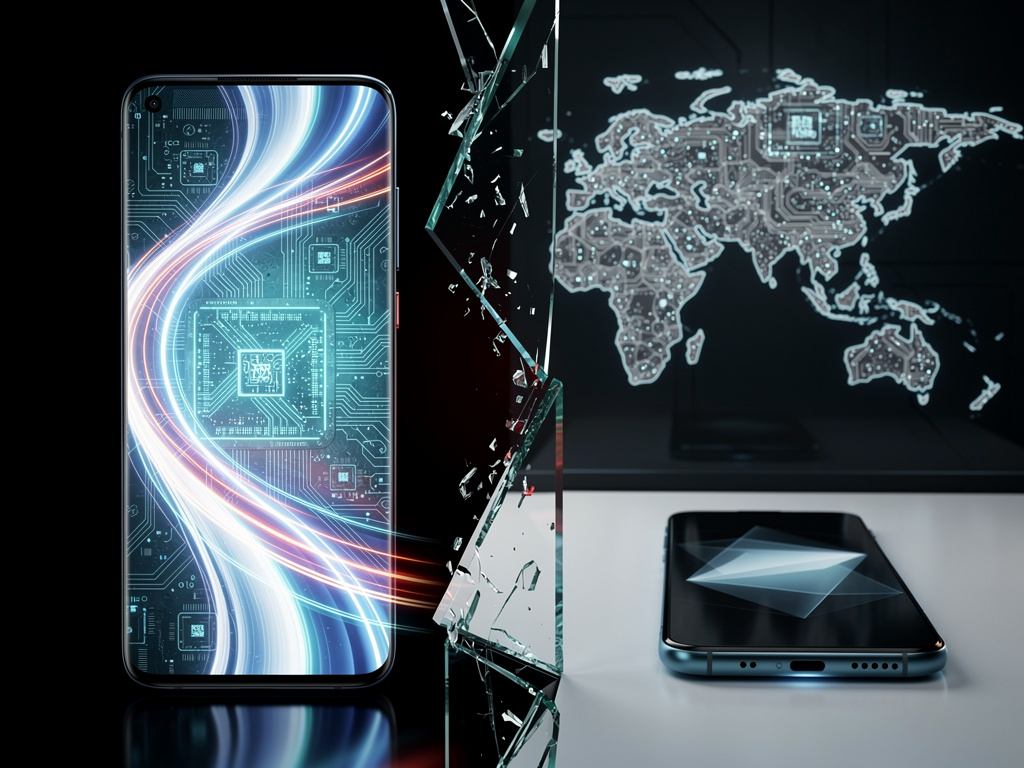
The refresh rate war in smartphones has entered a new phase, and the United States is once again on the outside looking in. MediaTek’s freshly announced Dimensity 9400e chipset supports display refresh rates up to 185Hz — a figure that would have seemed absurd just a few years ago when 60Hz was the standard. But there’s a catch. The first phones to carry this chip are almost certainly headed to China first, and whether American consumers will ever see them remains an open question.
This isn’t a new pattern. It’s an accelerating one.
As Digital Trends reported, the Dimensity 9400e is a slightly trimmed version of MediaTek’s flagship Dimensity 9400 chip, which already powers devices like the OnePlus 13 and the Vivo X200 Pro. The “e” variant drops the clock speed modestly — from 3.63GHz to 3.5GHz on the prime Cortex-X925 core — but adds something the original didn’t have: support for that eye-catching 185Hz refresh rate. The GPU remains an Arm Immortalis-G925, the same twelve-core unit found in the full-fat 9400. MediaTek is positioning this as a chip that delivers near-flagship performance at a lower price point, likely targeting the upper-midrange segment that Chinese manufacturers have turned into a fiercely competitive arena.
The refresh rate figure itself deserves scrutiny. At 185Hz, a display redraws the image on screen 185 times per second, compared to 120 times for the panels currently standard on premium phones. The difference is perceptible — barely — in fast-scrolling content and certain gaming scenarios. Whether it’s perceptible enough to matter to most users is another question entirely. But in China’s smartphone market, where differentiation on spec sheets can make or break a device’s success on platforms like JD.com and Tmall, numbers talk. And 185Hz is a number that talks loudly.
The real story isn’t the refresh rate. It’s the geography.
MediaTek’s Dimensity chipsets have long had a complicated relationship with the American market. While the company’s processors power hundreds of millions of phones globally — MediaTek has been the world’s largest smartphone chipmaker by volume since 2020, according to Counterpoint Research — its presence in U.S.-sold flagship and near-flagship devices remains thin. Qualcomm’s Snapdragon platform dominates the American premium tier, partly through long-standing carrier relationships and partly because Samsung and Google, the two brands that matter most in the U.S. market, have historically defaulted to Snapdragon for their North American variants. Samsung uses its own Exynos chips in some regions and Snapdragon in others; Google designs custom Tensor silicon. Neither has shown interest in MediaTek for their mainline devices sold stateside.
The phones most likely to debut the Dimensity 9400e — devices from brands like Vivo, Oppo, Realme, and possibly Xiaomi’s Redmi sub-brand — have minimal or zero U.S. retail presence. OnePlus, which does sell in America, used the Dimensity 9400 in its OnePlus 13 in China but shipped the Snapdragon 8 Elite in the global version. That kind of regional chip-swapping is standard practice, and it means American buyers rarely get to experience what MediaTek’s top silicon can actually do in a finished product.
So the 185Hz screen phone will launch. It will get reviewed by Chinese tech media. It will sell millions of units in Asia. And the average American consumer won’t know it exists.
This dynamic reflects a broader divergence in how the smartphone industry operates across the Pacific. Chinese OEMs iterate at a pace that Western markets simply don’t match. Product cycles are shorter. Feature experimentation is more aggressive. A brand like Vivo or Xiaomi might release three or four flagship-tier devices in a single year, each tweaking the formula — faster charging, higher refresh rates, new camera sensor configurations — while Samsung releases two major phone lines annually and Apple releases one. The competitive pressure in China rewards marginal spec advantages in ways that the more brand-loyalty-driven U.S. market does not.
There’s also the question of whether 185Hz actually improves the user experience in a meaningful way, or whether it’s a case of diminishing returns dressed up in marketing. The jump from 60Hz to 120Hz was genuinely transformative — scrolling felt smoother, animations looked more fluid, and the phone simply felt faster even when it wasn’t doing anything computationally harder. The leap from 120Hz to 144Hz, adopted by some gaming phones, was less dramatic. Going from 144Hz to 185Hz? The human eye’s ability to perceive differences at these frequencies is limited, particularly on a 6.7-inch display held at arm’s length. But perception and reality don’t always align in consumer electronics. If a phone can claim the highest refresh rate on the market, someone will buy it for that reason alone.
MediaTek clearly understands this. The company has been steadily climbing the performance ladder, and the Dimensity 9400 series represents its most credible challenge yet to Qualcomm’s Snapdragon 8 Elite at the top of the Android food chain. Benchmark results have been competitive. Real-world performance in Chinese-market phones has drawn praise from reviewers. And now, with the 9400e, MediaTek is pushing that performance — and the 185Hz headline feature — into a lower price bracket where it can reach even more buyers.
But reaching American buyers? That remains the sticking point.
The U.S. carrier system is part of the problem. Unlike in China and much of Europe, where unlocked phones dominate, the American market still runs heavily through Verizon, AT&T, and T-Mobile. Getting a phone certified and sold through those carriers requires extensive testing, band compatibility verification, and commercial agreements that smaller or China-focused brands often don’t pursue. It’s expensive, time-consuming, and uncertain. For a company like Realme or iQOO, the return on investment of entering the U.S. carrier channel simply doesn’t justify the effort when domestic demand is strong.
There are workarounds. Enthusiasts can import phones directly from Chinese retailers. OnePlus and Motorola (owned by Lenovo) serve as partial bridges, occasionally bringing MediaTek-powered devices to Western markets. And Google’s Pixel lineup, while not using MediaTek chips, has borrowed display technology ideas that first appeared in Chinese-market phones. The influence flows, even if the products don’t.
The timing of the Dimensity 9400e announcement also matters. It arrives as the smartphone industry grapples with a broader question about where the next wave of meaningful upgrades will come from. Camera improvements are hitting physical limits imposed by sensor size and lens optics. Battery life gains are incremental. AI features — the industry’s current obsession — are largely software-driven and chip-agnostic to a degree. Display technology, then, remains one of the few areas where hardware specs can still generate genuine excitement, even if the practical benefits are debatable.
Samsung’s Galaxy S25 Ultra runs at 120Hz. Apple’s iPhone 16 Pro maxes out at 120Hz with ProMotion. If a $400 Chinese phone hits the market at 185Hz, the optics are striking — even if the visual difference is, quite literally, almost invisible to the naked eye.
And that’s the tension at the heart of this story. The technology exists. The chips are ready. The screens can be built. But the market structures, carrier relationships, and brand dynamics that govern what Americans can actually buy remain stubbornly resistant to change. The 185Hz phone isn’t a fantasy. It’s just not coming to a Best Buy near you.
For industry watchers, the Dimensity 9400e is less about the refresh rate and more about what it signals: MediaTek’s continued ascent, China’s role as the world’s most aggressive smartphone laboratory, and the growing gap between what’s technologically possible and what’s commercially available in the world’s most lucrative smartphone market. The U.S. isn’t falling behind because the technology doesn’t exist here. It’s falling behind because the business incentives to bring it here don’t exist — at least not yet.
Whether that changes depends on forces larger than any single chip. If MediaTek secures a major design win with Samsung or Google for a U.S.-sold device, the calculus shifts overnight. If Chinese brands find a viable path into American retail — perhaps through Amazon’s growing electronics channel or through partnerships with MVNOs — the door cracks open. But those are big ifs. For now, the 185Hz screen remains a feature you can read about, argue about, and covet from afar. Just don’t expect to swipe through one at your local carrier store anytime soon.


 WebProNews is an iEntry Publication