
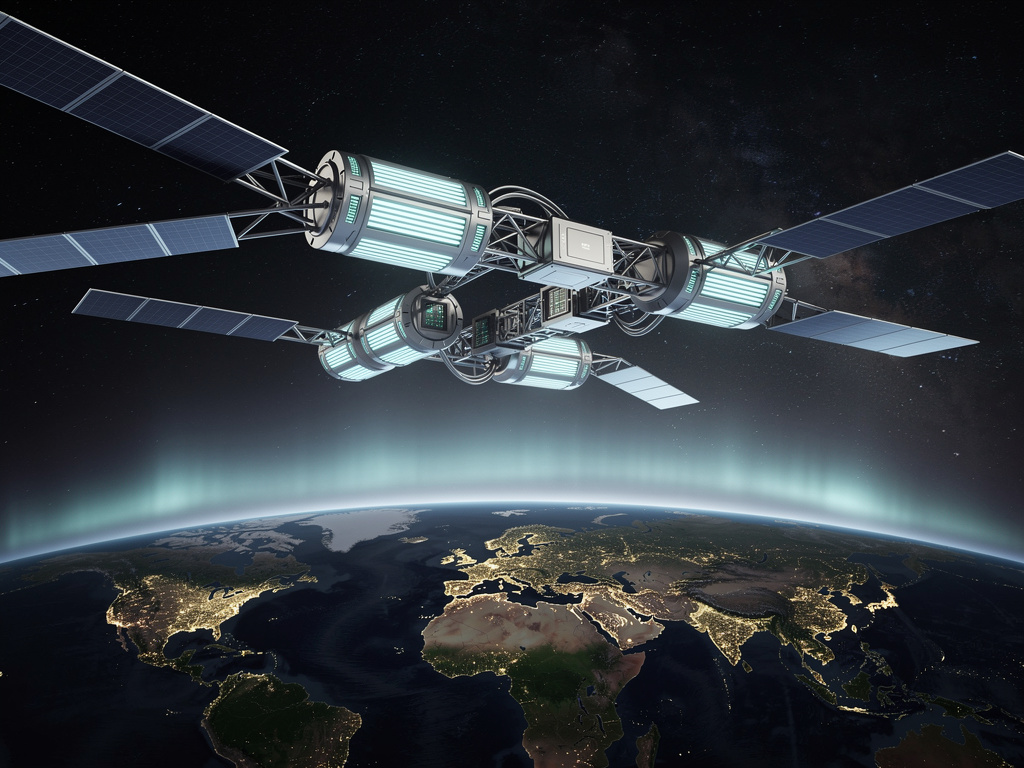
A startup called Starcloud has raised $170 million to do something that sounds like it belongs in a science fiction pitch meeting: build data centers in space. The round, reported by The Information, positions the company at the intersection of two of the most capital-intensive industries on Earth — cloud computing and space launch — at a moment when demand for compute power has never been higher and the cost of reaching orbit has never been lower.
That combination is precisely what makes the idea plausible now, when it would have been laughable a decade ago.
Starcloud’s premise is straightforward in concept, staggering in execution. Rather than building massive terrestrial facilities that consume enormous amounts of electricity and water for cooling, the company wants to launch server racks into low Earth orbit, where the vacuum of space provides a natural thermal environment and solar panels can supply power without drawing from overtaxed grids. The $170 million raise gives Starcloud runway to develop its first orbital computing platforms, though the company’s total capital needs will almost certainly dwarf that figure before a single customer workload runs in space.
Why Space, Why Now
The timing isn’t accidental. The global data center industry is slamming into physical constraints that no amount of engineering cleverness on the ground can fully resolve. Power is the bottleneck. In Northern Virginia — the world’s largest data center market — utilities have warned that new facilities may face years-long waits for grid connections. Similar power crunches are playing out in Dublin, Amsterdam, Singapore, and dozens of other markets where hyperscalers and AI companies are racing to build.
AI has supercharged the problem. Training large language models and running inference at scale requires GPU clusters that draw megawatts of power and generate tremendous heat. Microsoft, Google, Amazon, and Meta collectively plan to spend north of $200 billion on data center infrastructure in 2025 alone, according to estimates compiled by multiple analysts. And yet even that spending may not be enough. The International Energy Agency projects that global data center electricity consumption could more than double by 2030.
So the physics of space start to look attractive. No land acquisition battles. No permitting delays. No water for cooling towers. No neighbors complaining about noise from backup generators. And critically, no competition for scarce grid capacity.
But the challenges are immense.
Launching hardware to orbit remains expensive, even with SpaceX’s Falcon 9 driving costs down to roughly $2,700 per kilogram. A single server rack weighs hundreds of kilograms. Radiation in low Earth orbit degrades electronics. Latency between ground stations and orbital servers — even at the speed of light — introduces delays that make space-based compute unsuitable for many real-time applications. And servicing failed hardware in orbit isn’t like sending a technician to swap a drive in a Loudoun County facility.
Starcloud isn’t the only company chasing this idea. Lumen Orbit, another startup, has been developing orbital data center concepts and raised its own funding. The European Space Agency has studied the feasibility of space-based data processing. And several defense and intelligence agencies have long operated computing assets in orbit for classified workloads, though at costs that would be prohibitive for commercial customers.
What distinguishes Starcloud’s approach, based on available disclosures, is its focus on specific workload types that tolerate higher latency and benefit from the unique advantages of orbital placement. Batch processing for AI training, satellite data processing in orbit rather than downlinking raw data, and certain scientific computing tasks are all candidates. These aren’t latency-sensitive consumer applications. They’re heavy computational jobs where the math on power costs and cooling efficiency could genuinely favor space over ground.
The Money and the Math
The $170 million raise is significant but should be understood in context. Building a single large terrestrial data center costs $500 million to over $1 billion. Launching and operating computing infrastructure in orbit will likely cost more per unit of compute, at least initially. Starcloud’s funding is essentially a down payment on proving the concept works at a scale beyond a technology demonstration.
Investors are making a bet that the economics will improve rapidly as launch costs continue to fall. SpaceX’s Starship, if it achieves its target of dramatically lower per-kilogram costs, could change the equation fundamentally. A tenfold reduction in launch costs — which SpaceX has publicly discussed as a goal — would make orbital data centers far more competitive with their terrestrial counterparts for certain workloads.
There’s also a sovereignty angle. Nations that lack the power infrastructure or physical space for large data centers could theoretically lease orbital compute capacity without building anything on the ground. For island nations, developing economies, or countries with strict data localization laws but limited infrastructure, space-based computing offers a workaround that doesn’t exist today.
The defense and intelligence market is another obvious customer base. Orbital computing that can process satellite imagery, signals intelligence, or other sensor data in space — before it ever touches a ground station — reduces downlink bandwidth requirements and speeds up decision-making cycles. The U.S. Space Force and intelligence community have signaled growing interest in commercial space computing capabilities.
Still, skeptics have legitimate concerns. Orbital debris is a growing problem, and adding more hardware to an already congested low Earth orbit environment raises safety questions. The regulatory framework for commercial data centers in space is essentially nonexistent. And the track record of startups promising to do things in space that sound transformative is littered with failures — from satellite broadband ventures that went bankrupt in the early 2000s to more recent launch companies that never reached orbit.
Starcloud will need to demonstrate not just that it can put servers in space, but that those servers can operate reliably for years, handle real customer workloads, and do so at a cost that makes economic sense compared to terrestrial alternatives. That’s a series of engineering and business challenges, each formidable on its own.
A Broader Race for Compute at the Edge of Earth
The raise comes amid a broader frenzy of investment in alternative approaches to the data center power crisis. Nuclear energy — both conventional small modular reactors and fusion startups — has attracted billions in funding from tech companies desperate for clean, reliable baseload power. Microsoft signed a deal to restart a unit at Three Mile Island. Google and Amazon have invested in nuclear startups. Meta has sought proposals for nuclear-powered data centers.
Underwater data centers have also been explored. Microsoft’s Project Natick tested submerged server pods off the coast of Scotland, finding that the sealed, cooled-by-seawater environment actually improved reliability compared to land-based facilities. Microsoft ultimately decided not to commercialize the concept, but the experiment proved that unconventional environments can work.
Space represents the most extreme version of this trend: if you can’t solve the power and cooling problem on the ground, go somewhere the problem doesn’t exist in the same way.
Whether Starcloud can convert $170 million and an audacious thesis into a functioning business remains an open question. The company is attempting something that has never been done commercially. But the forces driving interest in its approach — insatiable demand for compute, constrained terrestrial power, falling launch costs — are real and intensifying.
And in a market where the biggest technology companies on Earth are spending hundreds of billions just to keep up with demand, the idea of looking upward doesn’t seem quite so crazy anymore.


 WebProNews is an iEntry Publication