
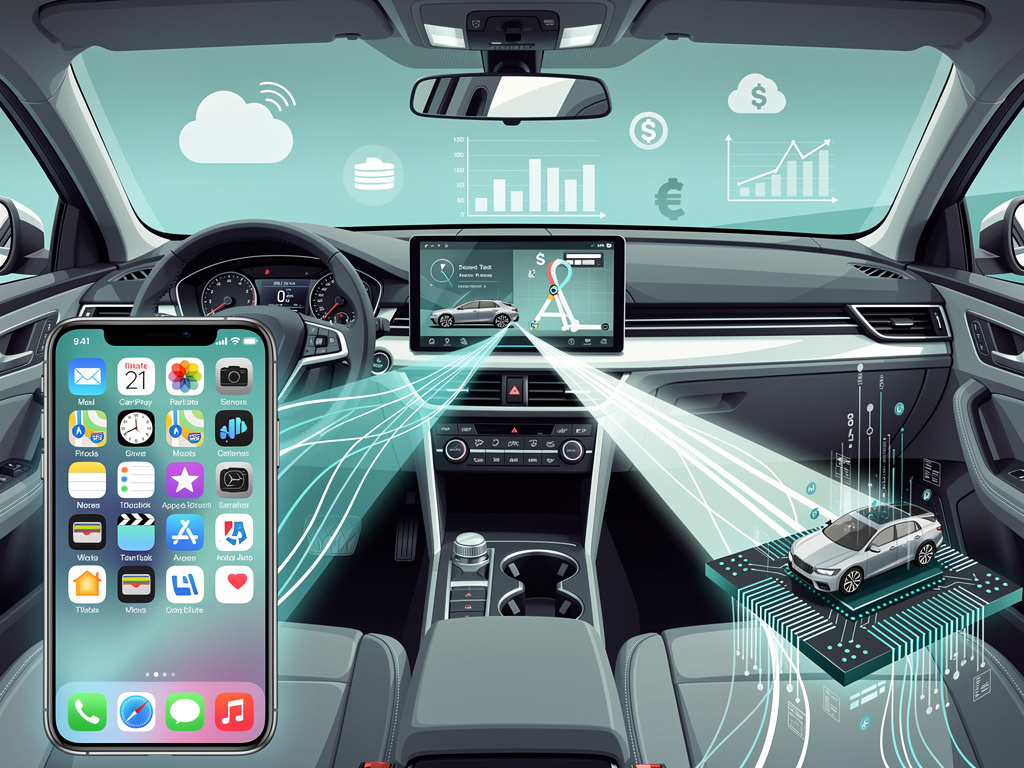
For years, plugging your iPhone or Android phone into your car’s infotainment system and letting Apple CarPlay or Android Auto take over the screen was a given — a feature so ubiquitous that consumers barely thought about it. But behind the scenes, a fierce battle over the car dashboard is intensifying, and automakers are increasingly willing to sacrifice customer convenience for a prize worth an estimated $14 billion annually: the data and subscription revenue flowing through your vehicle’s touchscreen.
General Motors fired the first high-profile shot in 2023 when it announced that its new electric vehicles would drop support for both Apple CarPlay and Android Auto, opting instead for a built-in infotainment system powered by Google’s Android Automotive operating system. The backlash was immediate and fierce. Consumer surveys showed overwhelming preference for phone-mirroring systems, and GM’s decision became a flashpoint in an industry-wide debate about who should control the most valuable piece of real estate inside a modern car.
A Revenue Stream Too Lucrative to Surrender
The financial calculus driving automakers away from CarPlay and Android Auto is straightforward. According to reporting by MSN, the global automotive software and services market — including navigation subscriptions, in-car app stores, over-the-air updates, and data monetization — is projected to generate roughly $14 billion in annual revenue. When Apple CarPlay or Android Auto occupies the screen, the automaker is effectively handing that revenue stream to Silicon Valley. Navigation data goes to Apple or Google. Music and podcast engagement flows through Spotify or Apple Music via the phone. The car company becomes little more than a dumb terminal on wheels.
Automakers have watched Tesla build a vertically integrated software model that generates recurring revenue from features like Full Self-Driving subscriptions, premium connectivity packages, and over-the-air feature unlocks. That model has become the envy of Detroit, Stuttgart, and Tokyo alike. Every major manufacturer now has a software division or partnership aimed at replicating some version of Tesla’s approach, and the first step in that strategy is regaining control of the dashboard.
GM’s Gamble and the Consumer Revolt
General Motors’ decision to remove CarPlay and Android Auto from its Chevrolet Blazer EV, Equinox EV, and other new models was presented as a forward-thinking move. The company argued that its Google-powered infotainment system offered a more integrated experience, with Google Maps, Google Assistant, and the Google Play Store built directly into the vehicle. No phone connection required.
But consumers have not been persuaded. Multiple surveys, including data from J.D. Power, have consistently shown that Apple CarPlay and Android Auto rank among the most desired features in new vehicles. A 2024 study found that a significant percentage of car buyers would actively avoid purchasing a vehicle that lacked phone-mirroring capability. GM acknowledged the friction, and by early 2025, reports emerged suggesting the company was reconsidering its hardline stance — or at least exploring ways to soften the blow for customers who felt locked out of their preferred phone-based apps.
The Apple Factor: CarPlay’s Next Generation Raises the Stakes
Apple has not been sitting idle. The company previewed its next-generation CarPlay system in 2022, promising a version that would take over not just the center screen but the entire instrument cluster — speedometer, tachometer, climate controls, and all. This expanded CarPlay would render the automaker’s own software almost invisible to the driver, a prospect that has alarmed manufacturers who see it as a total surrender of the in-car experience.
The rollout of this next-generation CarPlay has been slower than expected. Apple initially suggested it would arrive in vehicles by late 2024, but as of mid-2025, only a handful of manufacturers — notably Porsche and Aston Martin — have publicly committed to supporting the full-dashboard version. The delay reflects the deep tension between automakers and Apple over how much control each side gets. Automakers worry that ceding the instrument cluster to Apple means losing the ability to display vehicle-specific information, push their own services, or differentiate their brand experience from competitors.
Google’s Two-Track Strategy Creates Unusual Dynamics
Google occupies a peculiar position in this fight. On one hand, it offers Android Auto, the phone-mirroring system that competes directly with Apple CarPlay and gives consumers a familiar interface. On the other hand, it sells Android Automotive OS — a full operating system that runs natively on the car’s hardware, independent of any phone. When GM dropped CarPlay and Android Auto, it did so in favor of Android Automotive, meaning Google actually won twice: it lost the phone-mirroring connection but gained something far more valuable — deep integration into the vehicle’s core software.
This dual strategy means Google is positioned to profit regardless of which direction the industry moves. If automakers keep phone mirroring, Android Auto maintains its massive installed base. If they abandon phone mirroring, many will turn to Android Automotive as the foundation for their proprietary systems. Volvo, Polestar, Ford, and Renault have all adopted Android Automotive in various forms, often layering their own branded interfaces on top of Google’s platform. The result is that Google’s Maps, Assistant, and Play Store are embedded in millions of vehicles worldwide, generating data and advertising revenue even without a phone plugged in.
The Data Gold Mine Behind Your Steering Wheel
The revenue argument extends well beyond subscription fees for heated seats or navigation updates. Modern connected vehicles generate enormous volumes of data — driving patterns, location history, media preferences, voice commands, and even biometric information from driver-monitoring cameras. This data has significant value to advertisers, insurers, urban planners, and the automakers themselves.
When a driver uses Apple CarPlay, much of that data flows to Apple, which has built its brand around privacy protections that limit how the information can be monetized. When the automaker controls the infotainment system, it retains far more latitude to collect, analyze, and sell that data — subject to varying privacy regulations in different markets. A 2024 investigation by the Mozilla Foundation found that automobiles were among the worst consumer products for data privacy, with most major brands reserving broad rights to collect and share driver information. The financial incentive to keep that data pipeline under manufacturer control is a powerful motivator in the push away from phone-mirroring systems.
Consumer Loyalty vs. Corporate Ambition
The fundamental tension in this battle is between what consumers want and what automakers believe they need for long-term profitability. Drivers overwhelmingly prefer the simplicity of plugging in their phones and accessing familiar apps through CarPlay or Android Auto. The interfaces are updated frequently by Apple and Google, they work consistently across different vehicle brands, and they keep the driver’s digital life connected without requiring a separate subscription or login.
Automakers, however, see a future where the car is a platform — a recurring-revenue machine that generates income long after the initial sale. Subscription services for advanced driver-assistance features, premium audio, enhanced navigation, and even performance upgrades are all part of this vision. BMW briefly experimented with charging a subscription for heated seats before consumer outrage forced a reversal, but the underlying ambition has not changed. The car industry wants to become more like the smartphone industry, where hardware is a gateway to a profitable services business.
Where the Industry Goes From Here
The next two years will be decisive. If GM’s experiment results in measurably lower sales or customer satisfaction scores, other manufacturers will likely think twice before following suit. Conversely, if GM can demonstrate that its built-in system generates meaningful recurring revenue and that consumers eventually adapt, the rest of the industry will accelerate its own transitions.
Some manufacturers are hedging their bets. Ford, for example, uses Android Automotive as its underlying platform but still supports Apple CarPlay and Android Auto on top of it — giving consumers their preferred phone-mirroring experience while retaining some of the data and integration benefits of a native operating system. This hybrid approach may prove to be the most commercially viable path, at least in the near term.
Stellantis, the parent company of Jeep, Ram, Dodge, and Chrysler, has also signaled interest in developing its own software capabilities, partnering with Amazon for certain connected-car features while maintaining CarPlay and Android Auto support. Hyundai and Toyota have remained committed to offering phone-mirroring options, recognizing that in highly competitive segments, removing a feature consumers expect is a risky proposition.
The $14 Billion Question Nobody Can Dodge
The automotive industry is placing an enormous bet that the dashboard of the future will be worth fighting over. The $14 billion figure represents not just what exists today but what manufacturers believe will grow as vehicles become more connected, more autonomous, and more dependent on software. The companies that control the screen — and the data flowing through it — will capture a disproportionate share of that value.
For consumers, the stakes are more personal. The question is whether the car you buy in 2026 or 2027 will still let you use the apps and interfaces you prefer, or whether you’ll be forced into a manufacturer-controlled environment designed primarily to extract subscription fees and harvest data. The answer will depend on which side — Silicon Valley or the auto industry — blinks first in a standoff that shows no signs of resolution.


 WebProNews is an iEntry Publication