
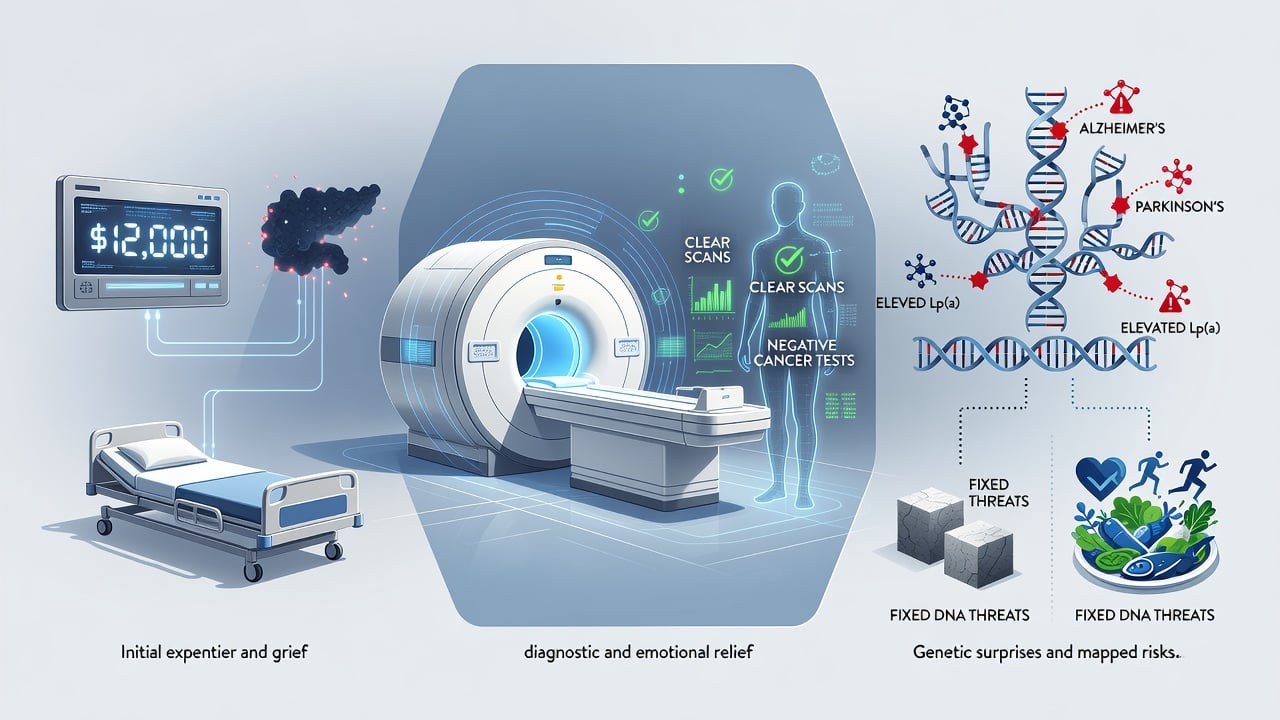
Daniel T. Allen lost his father to pancreatic cancer last year. The man was 72. That event sent the Business Insider producer and Emmy-winning journalist down a path many affluent professionals now follow. He paid roughly $12,000 for a comprehensive executive health assessment at Human Longevity in Silicon Valley.
The clinic, founded in 2013 by genomics pioneer J. Craig Venter, promises to spot trouble long before symptoms appear. Its program bundles whole-body MRI, extensive blood panels, and whole-genome sequencing. Artificial intelligence then crunches the data to flag risks. Allen walked in hoping for clarity. He left with a mix of relief and unease. Some cards were already on the table.
Tests ran for about four hours. Allen, who stands 6-foot-4 and weighs 246 pounds, underwent scans that produced reams of information. His whole-body MRI came back clear. No signs of tumors. Arteries showed zero calcification. A blood test capable of detecting signals from more than 50 cancers returned negative. Those outcomes mattered most to him.
During the follow-up, clinician Dr. Keon Pearson highlighted two specific markers tied to pancreatic cancer risk. Allen’s CA19-9 biomarker sat at normal levels. The GRAIL Galleri liquid biopsy, which the doctor described as particularly sensitive for pancreatic, liver, head and neck, and esophageal cancers, also came back clean. Pearson told him the results pointed to a 99% chance of being cancer-free at that moment. Business Insider documented the exchange in detail.
Genetic sequencing added another layer of reassurance. Counselors screened for high-risk inherited mutations across more than 2,000 conditions, including hereditary cancer syndromes. None turned up. For a man whose father had died of pancreatic cancer, the absence delivered real comfort. No red flags in the family DNA on that front.
But the report contained surprises. Allen’s body-mass index registered 30.1, landing him in the obese category by standard charts. Pearson dismissed that metric quickly. Muscle mass told a different story. The producer’s skeletal muscle index ranked among the highest the doctor had seen. Bone density placed in at least the 84th percentile for his age and sex. Those metrics looked strong.
Other measurements landed in gray zones. Body-fat percentage hit 23.6 percent, a touch above the clinic’s target for men. Liver fat measured 3.1 percent. Normal on paper, yet Pearson called it higher than optimal for long-term health. Small signals. Modifiable ones, in theory.
One finding resisted easy fixes. Allen carries elevated lipoprotein(a), or Lp(a). This genetically driven particle raises odds of heart attack, stroke, and stiffened heart valves. Pearson put the risk in stark terms. “It’s probably six times more dangerous pound for pound compared to LDL cholesterol,” he said. The clinician added that diet and exercise show little effect. Prescription drugs represent the main option. That revelation landed heavily.
Then came the genome results that caught Allen off guard. He carries one copy of a variant linked to phenylalanine hydroxylase deficiency, commonly known as PKU. The condition can cause severe neurological damage if untreated in infants, which is why aspartame warnings appear on diet sodas. Because Allen carries only one copy and his wife does not carry it, his children face no elevated risk. Carrier status, not disease.
Neurological risks hit closer to home. Allen possesses one APOE3 and one APOE4 allele. The combination, according to the clinic’s analysis, lifts lifetime Alzheimer’s risk above average population levels. He told the genetic counselor his first reaction was alarm. His grandparents had all reached old age without dementia, which offered some counterbalance. Still, the data lingered.
The report also placed him in the 99th percentile for genetic markers tied to Parkinson’s disease. Absolute lifetime risk stayed modest at around 2.7 percent, the counselor stressed. Numbers like these invite endless what-if scenarios. They do not deliver certainty.
One variant offered a counterpoint. Allen carries a version of the FOXO3 gene associated with greater odds of reaching age 90 and beyond. He immediately thought of his maternal grandfather, who lived to 98. The finding injected optimism into an otherwise complicated picture.
Human Longevity has built a business around exactly these kinds of comprehensive readouts. A 2026 ranking of 55 clinics worldwide by World Longevity Clinics placed it fifth overall and highlighted its strength in diagnostics, genomics, and imaging. The company’s Health Nucleus program relies on 30x-coverage whole-genome sequencing, full-body MRI, advanced blood biomarkers, DEXA scans, and AI-driven risk modeling. Past studies cited by the clinic suggest that 14.4 percent of clients reveal previously undetected clinical findings.
Pricing reflects the intensity. Executive health assessments start around $8,000, with many clients opting for $12,000 annual programs that include multiple visits. Higher tiers reach $19,000 for concierge-level follow-up, according to earlier reporting. Demand persists among tech executives and high-net-worth individuals in their early 50s on average. The clinic has served more than 10,000 clients.
Yet questions swirl around the broader field. Comprehensive scans can surface incidental findings that trigger cascades of additional tests, anxiety, and costs without proven gains in lifespan. An older Science magazine investigation into similar $25,000 physicals captured the tension. Some participants benefited from early tumor detection. Critics, including epidemiologists, warned of overdiagnosis, psychological strain, and lack of rigorous evidence that broad screening improves outcomes for asymptomatic people. Those concerns have not vanished in 2026.
Recent coverage adds nuance. A May 2026 announcement revealed Human Longevity created a new entity, Human Life Foundation Models, to build AI foundation models for longevity science in partnership with Insilico Medicine. The company continues to amass one of the largest integrated datasets of genomics, imaging, and clinical data. Its website now promotes patient stories, including one claiming early pancreatic cancer detection that “saved my life.”
Allen’s experience captures the current reality. The $12,000 exam did not forecast his exact lifespan. No technology does. It did map certain fixed risks encoded in his DNA against areas still open to diet, exercise, and medical intervention. Elevated Lp(a) will likely require pharmaceutical attention. Liver fat and body composition can shift through sustained habits. The Alzheimer’s and Parkinson’s genetic signals invite vigilance but resist simple prediction.
Industry insiders watch this space closely. Clinics like Human Longevity, Fountain Life, and others market precision prevention to those who can afford it. Data integration has improved. AI interpretation grows more sophisticated. Evidence that these programs extend healthy years across large populations remains thinner than the marketing suggests. Studies show detection of hidden conditions. Long-term randomized trials proving reduced mortality or compressed morbidity stay rare.
Allen closed his account on a pragmatic note. Some risks appear hardwired. Others respond to daily decisions. The test clarified the distinction. That knowledge carries value, even if the price tag prompts debate about who should access it and whether society gains when only the wealthy buy such detailed biological portraits.
Broader interest in these programs shows no sign of slowing. Searches for longevity clinic costs and reviews have climbed. New articles this week revisit the tension between hype and data. One June 2026 guide to clinic pricing notes that diagnostic-only programs often run between $5,000 and $15,000, aligning with what Allen paid. Another analysis questions whether annual executive physicals at this level deliver returns that justify the outlay for most people.
The allure is obvious. A single visit that peers inside the body and genome with tools once reserved for research feels empowering. The discomfort arrives when results reveal probabilities instead of prescriptions. Elevated genetic risk for neurodegenerative disease cannot be exercised away. A negative cancer screen today offers no guarantee against tomorrow. The hand is dealt. Play continues regardless.
Human Longevity and its peers argue that informed play beats blind bets. Skeptics counter that the information can overwhelm without changing trajectories enough to matter. Allen’s story adds one data point to that debate. Reassurance on cancer. Concern over heart and brain risks. A longevity gene variant to balance the scales. And the persistent knowledge that biology sets boundaries even the most expensive scan cannot fully redraw.


 WebProNews is an iEntry Publication