
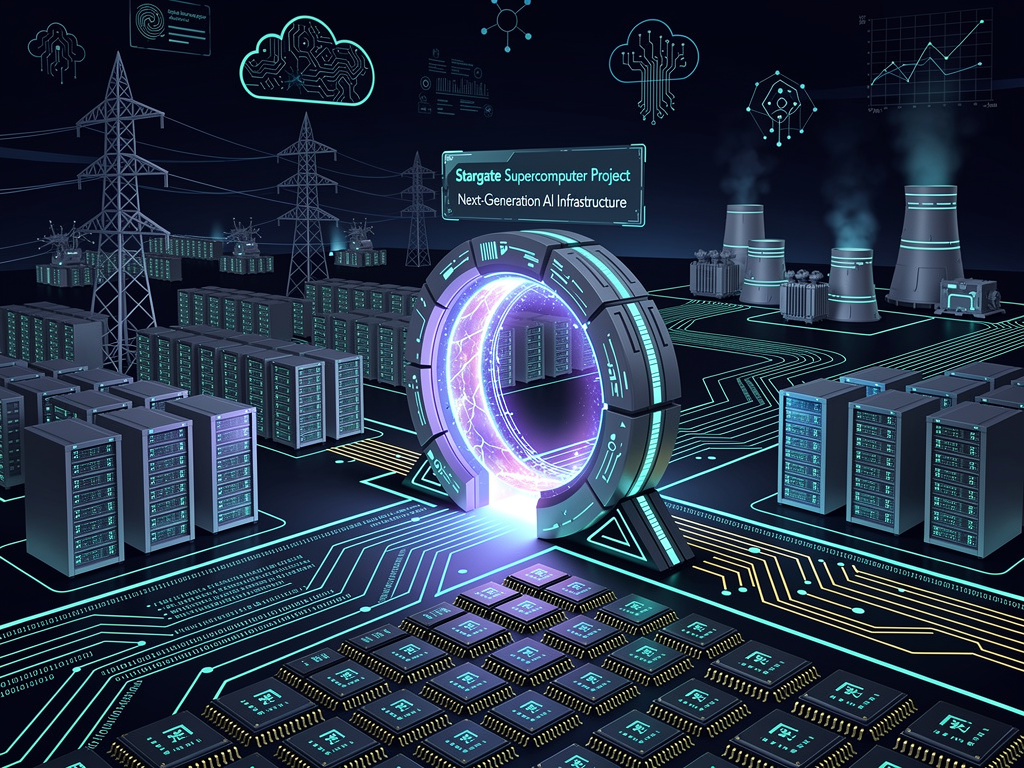
REDMOND, Wash. — In the fiercely competitive race to build the next generation of artificial intelligence, Microsoft and OpenAI are preparing a wager of astronomical proportions. The two companies are drawing up plans for a secretive data center project, codenamed “Stargate,” that would house a revolutionary new AI supercomputer. The initiative, expected to launch as soon as 2028, carries a price tag that could soar to $100 billion, a figure that would make it one of the most expensive single technology projects in history, according to a report first published by The Information.
This colossal investment, primarily shouldered by Microsoft, represents a bold declaration of intent: to build the computational foundation necessary for creating artificial general intelligence, or AGI—a form of AI with human-like cognitive abilities. Stargate is envisioned as the capstone of a five-phase plan, a machine so powerful it would dwarf even the most advanced supercomputers operating today. Its success, however, hinges on solving monumental challenges in processing power, chip procurement, and, most critically, energy consumption that are pushing the boundaries of modern engineering.
The plan underscores the deepening, and increasingly costly, symbiosis between the software giant and the AI startup. Microsoft, which has already invested more than $13 billion into OpenAI, is betting its future as a dominant force in technology on ensuring Sam Altman’s firm has the raw power needed to stay ahead of rivals like Google and Meta. For OpenAI, Stargate is not just an upgrade; it is the essential crucible for forging the models that could one day achieve its founding mission of AGI.
A Blueprint for Unprecedented Computational Scale
The Stargate initiative is slated to be the fifth and final phase of an ambitious infrastructure roadmap the partners have been developing. Details suggest the project will be based in the United States and will require the acquisition and development of a massive campus. The supercomputer itself will be constructed around millions of specialized AI accelerator chips, forming a cohesive system designed to train and run models of unprecedented complexity. The sheer scale of this endeavor makes previous supercomputing projects look modest by comparison, with sources telling Reuters that the final cost is still fluid but is expected to be 100 times more expensive than some of today’s largest data centers.
This push for computational supremacy is driven by the insatiable appetite of large language models. Each successive generation, from GPT-3 to GPT-4 and beyond, has required exponentially more data and processing power to train. Industry insiders believe that the next leap in AI capabilities—moving from sophisticated pattern recognition to genuine reasoning and understanding—will require a hardware infrastructure that does not yet exist. Stargate is Microsoft and OpenAI’s attempt to build that future before their competitors can.
The project’s timeline is aggressive, targeting a 2028 launch for the initial phase of Stargate. This leaves little room for error in a plan that relies on advancements in semiconductor technology and data center design that are still on the drawing board. A significant portion of the early-stage cost will involve identifying a suitable location with access to immense power and developing the highly specialized architecture needed to network millions of chips efficiently.
The Gigawatt Dilemma and a Nuclear Solution
Perhaps the most daunting obstacle facing Stargate is its colossal energy requirement. The supercomputer is projected to consume several gigawatts of power, with some estimates reaching as high as five gigawatts by 2030, according to a report from TechRepublic. To put that figure in perspective, a single gigawatt can power roughly 750,000 homes; Stargate would require the output of multiple full-scale nuclear power plants, creating a significant strain on any regional power grid.
This unprecedented power draw is forcing Microsoft and OpenAI to explore unconventional energy solutions. The search has led them to seriously consider alternative power sources, most notably nuclear fusion. This is not merely a theoretical exercise. OpenAI CEO Sam Altman is a prominent investor in Helion, a privately held fusion energy company. In a landmark deal, Microsoft has already agreed to purchase electricity from Helion’s first fusion power plant, which is projected to come online in 2028—a timeline that aligns neatly with Stargate’s proposed launch. As detailed by The Wall Street Journal, this synergy between Altman’s AI ambitions and his energy investments is becoming a central pillar of the Stargate strategy.
The energy challenge reflects a growing crisis across the tech industry, where the AI boom is creating an “insatiable demand for energy,” according to a recent analysis by CNBC. If Stargate is to be realized without crippling local energy infrastructure or generating a massive carbon footprint, pioneering new, clean, and dense power sources like fusion may be not just an option, but a necessity.
A Strategic Bet to Reshape the Chip Market
At the heart of Stargate will be millions of specialized AI chips. While Nvidia currently dominates this market with its highly sought-after GPUs, the sheer volume of processors required for this project means Microsoft and OpenAI are unlikely to rely on a single supplier. The $100 billion budget will encompass not only the chips themselves but also the intricate networking fabric and cooling systems required to make them work in concert. This presents a massive opportunity for other players in the semiconductor industry, including AMD and potentially even custom silicon designed by Microsoft itself, such as its recently announced Maia AI accelerator chip.
The project’s chip strategy appears to be one of diversification, mitigating the risk of supply chain bottlenecks and fostering competition in a market largely controlled by one company. According to The Verge, part of Stargate’s design challenge is to create a system that can flexibly integrate hardware from different vendors. This approach could fundamentally alter the power dynamics in the AI hardware sector, creating a new and lucrative market for any company that can meet the project’s demanding performance and efficiency specifications.
For Microsoft, this is also a strategic move to control its own destiny. By co-designing the supercomputer and potentially supplying its own custom chips, the company reduces its dependence on third-party vendors and can optimize the entire stack, from silicon to software, for OpenAI’s models. This vertical integration is a classic strategy for gaining a competitive edge, one that Microsoft is now applying to the era of generative AI.
Defining the Future of a High-Stakes Partnership
The Stargate project is the ultimate expression of the unique and occasionally fraught relationship between Microsoft and OpenAI. While Microsoft provides the capital and cloud infrastructure, OpenAI delivers the AI breakthroughs that make Microsoft’s platforms, from Azure to Office, more competitive. Stargate solidifies this arrangement for the next decade, making the two companies inextricably linked in their pursuit of AGI. This massive financial commitment from Microsoft signals its belief that OpenAI remains the world’s leading AI research lab and its best bet for winning the AI race.
Microsoft’s existing Azure infrastructure, which was purpose-built to handle OpenAI’s demanding workloads, serves as the foundation for this next great leap. In a company blog post, Microsoft detailed how its current supercomputers were co-designed with OpenAI to train models like ChatGPT, stating that “building true AI supercomputers requires rethinking and redesigning datacenters from the ground up,” as noted by Microsoft. Stargate is the logical, albeit breathtakingly expensive, next step in that redesign process.
Whether this colossal bet pays off remains to be seen. The technical and logistical hurdles are immense, and the project’s success is contingent on innovations that have not yet occurred. But in an industry where computational power is the ultimate currency, Microsoft and OpenAI are signaling that they are willing to spend whatever it takes to build the machine that could unlock the future of intelligence itself.


 WebProNews is an iEntry Publication