
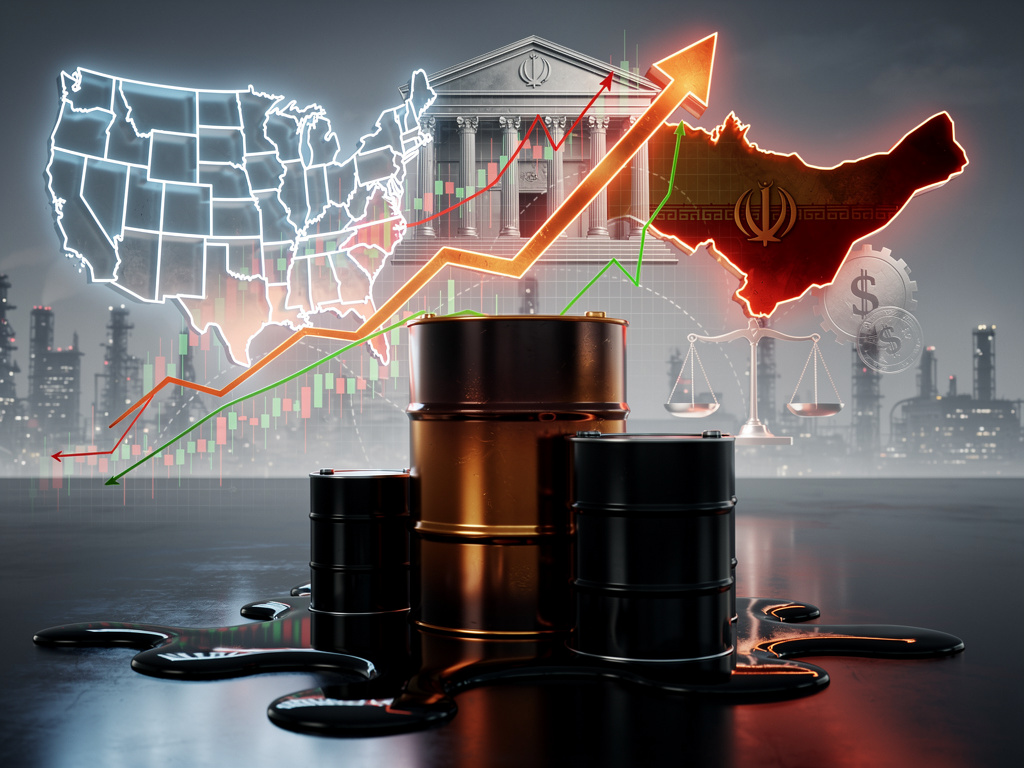
The last time oil prices surged past $100 a barrel on geopolitical shock, the global economy buckled. Recessions followed. Consumer confidence cratered. Central bankers scrambled. Now, with tensions between the United States and Iran escalating toward what some analysts describe as a genuine military confrontation, Wall Street is quietly running the numbers on what another oil price spike would mean for an American economy already walking a tightrope.
It wouldn’t be pretty.
According to Business Insider, a full-scale conflict involving Iran — the third-largest producer in OPEC — could send crude prices surging by 20% to 40% or more, depending on the severity of supply disruptions and whether the Strait of Hormuz becomes a chokepoint in active conflict. Roughly 20% of the world’s traded oil passes through that narrow waterway every day. A disruption there wouldn’t just rattle energy markets. It would cascade through global shipping, petrochemical supply chains, and consumer prices in ways that make the 2022 inflation spike look manageable.
The concern isn’t hypothetical anymore. The Trump administration has ratcheted up its rhetoric toward Tehran in recent months, and reports suggest military planning has moved beyond the contingency stage. Iran’s nuclear program, its proxy network across the Middle East, and its growing alignment with Russia and China have all contributed to a posture in Washington that increasingly treats confrontation as a matter of when, not if.
For equity markets, the math is brutal. Historical analysis shows that every major oil price shock since the 1970s has preceded or coincided with a U.S. recession. The 1973 Arab oil embargo. The 1979 Iranian Revolution. Iraq’s invasion of Kuwait in 1990. The 2007-2008 commodity supercycle that preceded the financial crisis. The pattern is consistent enough that economists treat oil shocks as one of the most reliable recession indicators in the modern era.
Business Insider’s analysis points to research showing that a sustained $20-per-barrel increase in oil prices typically shaves about 0.5% off U.S. GDP growth within a year. A $40 spike — entirely plausible in a scenario where Iranian oil exports are fully taken offline and Strait of Hormuz transit is disrupted — could push that drag to a full percentage point or more. With the U.S. economy currently growing at roughly 2% to 2.5% annually, that kind of hit would put the country dangerously close to stall speed.
And stall speed, in an economy carrying $35 trillion in federal debt and consumer credit card balances at all-time highs, is a precarious place to be.
The stock market has largely shrugged off geopolitical risk in 2025 and into 2026, buoyed by AI-driven optimism in tech and expectations that the Federal Reserve will eventually resume cutting rates. But that complacency has a shelf life. Energy stocks would obviously benefit from a price surge — Exxon, Chevron, and ConocoPhillips have historically outperformed during supply shocks — but the broader S&P 500 tends to suffer. Airlines, trucking companies, retailers, and any business with significant transportation costs would see margins compress almost immediately.
Consumer spending, which accounts for roughly 70% of U.S. economic activity, is the real vulnerability. Gasoline prices act as a de facto tax on households. When pump prices rise, discretionary spending falls. It’s that simple. A move from $3.50 a gallon to $5.00 or beyond would hit lower- and middle-income households hardest, precisely the demographic cohorts already stretched by elevated food prices and housing costs.
The Federal Reserve would face an impossible dilemma. Rising energy prices would push headline inflation higher, making rate cuts politically and institutionally difficult. But the recessionary impulse from an oil shock would argue for monetary easing. This is the stagflationary trap that haunted policymakers in the 1970s, and it’s one the current Fed has no good playbook for. Chair Jerome Powell has repeatedly said the Fed’s tools are designed to address either inflation or growth weakness — not both simultaneously.
Some analysts argue the U.S. is better insulated from oil shocks than it was a generation ago. Domestic production has surged thanks to the shale revolution, and the country is now a net exporter of petroleum products. That’s true. But it doesn’t eliminate the transmission mechanism. Oil is priced globally. When Brent crude rises, West Texas Intermediate follows. American producers benefit, but American consumers still pay more. The net effect on GDP depends on the balance between producer gains and consumer losses, and most econometric models suggest the consumer losses dominate in the short run.
There’s also the financial market contagion to consider. Credit default swaps on energy-importing emerging market sovereigns would widen sharply. Countries like India, Japan, South Korea, and much of Europe — all heavily dependent on Middle Eastern crude — would face simultaneous inflation and growth shocks. A synchronized global slowdown would feed back into U.S. corporate earnings, particularly for multinationals with significant overseas revenue exposure.
Recent reporting from Reuters has highlighted the intensifying diplomatic standoff, with European allies urging restraint while Gulf states quietly prepare contingency plans for supply disruptions. Saudi Arabia and the UAE have spare production capacity that could partially offset lost Iranian barrels, but analysts estimate that spare capacity globally sits at roughly 3 to 4 million barrels per day — not enough to fully replace Iran’s 3.2 million barrels of daily production plus any collateral disruption to neighboring exporters.
The Strait of Hormuz factor multiplies the risk exponentially. Iran has repeatedly threatened to close the strait in the event of military conflict, and while the U.S. Navy’s Fifth Fleet maintains a significant presence in the region, even a partial disruption — mines, harassment of tankers, missile threats to port infrastructure — could effectively halt transit for days or weeks. Insurance rates for tankers transiting the strait would skyrocket, adding costs that flow directly to consumers.
Not every analyst is sounding the alarm at the same volume. Some point out that strategic petroleum reserves, while depleted relative to historical levels after the Biden administration’s 2022 drawdown, could still provide a buffer. Others note that demand destruction in a recessionary environment would eventually bring prices back down — cold comfort for workers losing jobs in the interim, but a market mechanism that has historically limited the duration of price spikes.
But here’s the problem with the optimistic case: it assumes rational actors and predictable escalation. Wars rarely cooperate with base-case scenarios. The Gulf War was supposed to be quick. The Iraq invasion was supposed to stabilize the region. Iran’s military doctrine emphasizes asymmetric warfare — proxy attacks, cyber operations, disruption of critical infrastructure — precisely because it can’t match the U.S. in conventional terms. That asymmetry makes the range of possible outcomes unusually wide and the tail risks unusually fat.
For investors, the implications are concrete. Portfolio hedging through energy exposure, options strategies on crude oil futures, and defensive positioning in sectors less sensitive to energy costs — healthcare, utilities, certain technology segments — all deserve consideration. Gold, historically a beneficiary of geopolitical uncertainty, has already been on a tear and could extend further. Treasury bonds would likely rally initially on a flight to safety, though the inflation implications of an oil shock could eventually push yields higher on the long end of the curve.
The bond market, in fact, may be the clearest early warning system. A sudden steepening of the yield curve driven by rising inflation expectations at the long end, combined with rate-cut pricing at the short end, would signal that markets are pricing in the stagflationary scenario. That hasn’t happened yet. But the conditions for it are assembling.
Corporate America isn’t sitting still. Major airlines have been increasing their fuel hedging positions, according to recent earnings calls. Retailers are evaluating supply chain contingencies. And energy companies are quietly accelerating capital expenditure plans, betting that any conflict-driven price surge would be sustained long enough to justify additional drilling activity.
The political dimension adds another layer of uncertainty. An oil price shock during a period of already elevated partisan tension over economic policy could produce unpredictable legislative responses — windfall profit taxes on energy companies, emergency price controls, accelerated drawdowns of strategic reserves. Each of these carries its own set of market consequences, few of them positive for equity valuations.
So where does this leave the average investor? Watching. Hedging at the margins. And recognizing that the single biggest risk to the current bull market may not be earnings multiples or Fed policy or AI valuations. It may be a centuries-old chokepoint in the Persian Gulf and the decisions being made in Washington and Tehran about whether to cross a line that can’t be uncrossed.
History doesn’t repeat, as the saying goes. But oil shocks rhyme with devastating consistency. And the next verse may already be writing itself.


 WebProNews is an iEntry Publication