
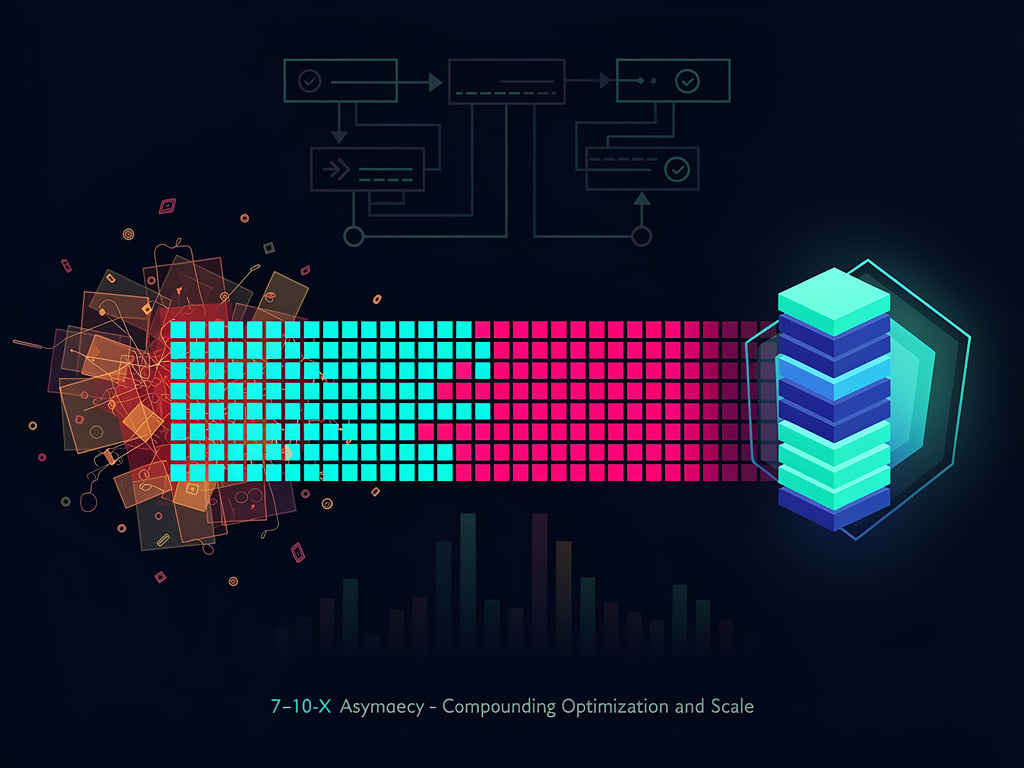
Developers discovered something striking last year. One prompt style produced code in 60 tokens. Another, the verbose default many teams accept without question, ran to 500. The difference wasn’t accuracy. It was cost. Multiply that gap across thousands of daily generations and infrastructure expenses balloon.
Style Shapes Spend
Jim Montgomery laid out the numbers in detail. Asking an LLM to parse query parameters the long way consumed 140 tokens. A directive to use the platform’s native URLSearchParams cut it to 12. That’s more than 90 percent savings on a single pattern. Forms told a similar story. Hand-rolled parsing logic ate 200 tokens or more. The native FormData object required just 14. Fetch setups dropped from 90 tokens to 12. Parallel async patterns went from 100 to 10. A full Deno request handler that once generated 400 to 600 tokens shrank to 60-90. The patterns compound. Montgomery calculated 7x to 10x differences on routine infrastructure code. (jimmont.com)
But. These aren’t theoretical. They come from real runs on current models in the Deno runtime. The same API surface works in browsers and servers. No extra libraries. Fewer bugs too. Native implementations avoid prototype pollution, information leaks and other mistakes models invent when left to improvise.
Output pricing makes the gap matter more than ever. Providers charge three to ten times as much for tokens the model generates as for those it reads. A 2026 analysis found output tokens remain the dominant driver. Reducing average response length by 40 percent can lower total spend 20 to 30 percent. (iternal.ai)
Prices themselves keep falling. GPT-4o input rates slid roughly 50 percent from early 2025 levels. Yet the asymmetry persists. Enterprise teams running agent loops, long conversations or code generation see context and output tokens multiply fast. One recent observation noted conversation history, retrieved documents and verbose prompts silently inflate usage even when user traffic looks flat.
Formatting plays a supporting role. Researchers measured what happens when indentation, newlines and whitespace disappear from code passed to large language models. On fill-in-the-middle completion tasks across Java, Python, C++ and C#, performance held steady. Pass@1 scores actually edged up slightly from 79.1 percent on formatted code to 80.0 percent without it. Input tokens fell 24.5 percent on average. Output tokens dropped only 2.9 percent. Prompting the model to emit unformatted code cut output length up to 36.1 percent with no loss in correctness. The paper’s authors built a bidirectional transformation tool that keeps abstract syntax tree semantics intact while trimming the fat. (arxiv.org/abs/2508.13666)
Comments add another layer. Models treat them as intent signals. One study found they follow comment instructions even when those instructions contradict the actual code. Stale comments, however, degrade comprehension. Security researchers have warned for years that documentation influences generation quality. Montgomery saw the native API directive produce the biggest visible change in output style and length.
So costs drop when teams get specific. “Use Web APIs natively.” “Return minimal valid code.” “Emit JSON only.” These directives constrain the model better than vague requests for “clean” or “production-ready” implementations. The result isn’t just shorter. It’s more reliable.
Market data from mid-2025 already showed the shift. One analysis pegged Gemini 2.5 Flash at $0.40 per million tokens, Qwen3 30B models even lower. By early 2026, further declines made small differences in token count feel less urgent for light users. Yet at production scale the math changes. A system generating 10 million output tokens monthly at $0.015 per thousand suddenly saves thousands of dollars by trimming 30 percent of that volume. (snellman.net)
Anthropic, OpenAI and Google continue to adjust tiers. Heavy users unlock lower effective rates. Nonlinear pricing rewards volume but still penalizes inefficiency. Structured outputs, max_tokens caps and post-processing steps have become standard in cost-conscious stacks. Teams that once accepted chatty explanations now demand concise functions.
The pattern repeats across domains. Summarization tasks that once returned paragraphs now return bullet points. Agents that once explained every step now act and report only results unless asked. Each choice trims the bill without obvious sacrifice in utility.
Security and correctness improve alongside the savings. Native platform features carry battle-tested edge-case handling. Models reinventing the wheel introduce flaws. Fewer tokens mean less surface for hallucinated logic. Shorter contexts reduce distraction from irrelevant detail.
Researchers keep refining the point. A 2025 state-of-AI report tracked 100 trillion tokens of usage and tied retention to models that delivered value without excess overhead. Engineering teams report similar findings internally. The models didn’t get dumber when told to be brief. They simply stopped padding answers with ceremony.
Still, habits die hard. Many codebases and prompt libraries carry verbose defaults born in the era when token prices felt abstract. Migrating them requires measurement. Teams now instrument token usage per feature, per prompt template, per model. The data reveals surprises. One team’s “helpful” system prompt added hundreds of unnecessary tokens per call. Removing it changed nothing for users and everything for the budget.
Montgomery’s experiments point to a broader principle. Platforms have already solved many problems securely and efficiently. Asking the model to rediscover those solutions wastes tokens and introduces risk. The winning style leans on what exists. It signals intent clearly. It demands economy.
That approach scales. As context windows grow and agent workflows multiply, the penalty for verbosity grows with them. Early adopters who tightened their prompts and code style report not only lower bills but faster iteration and cleaner deployments. The rest will follow once the monthly invoice arrives.


 WebProNews is an iEntry Publication