
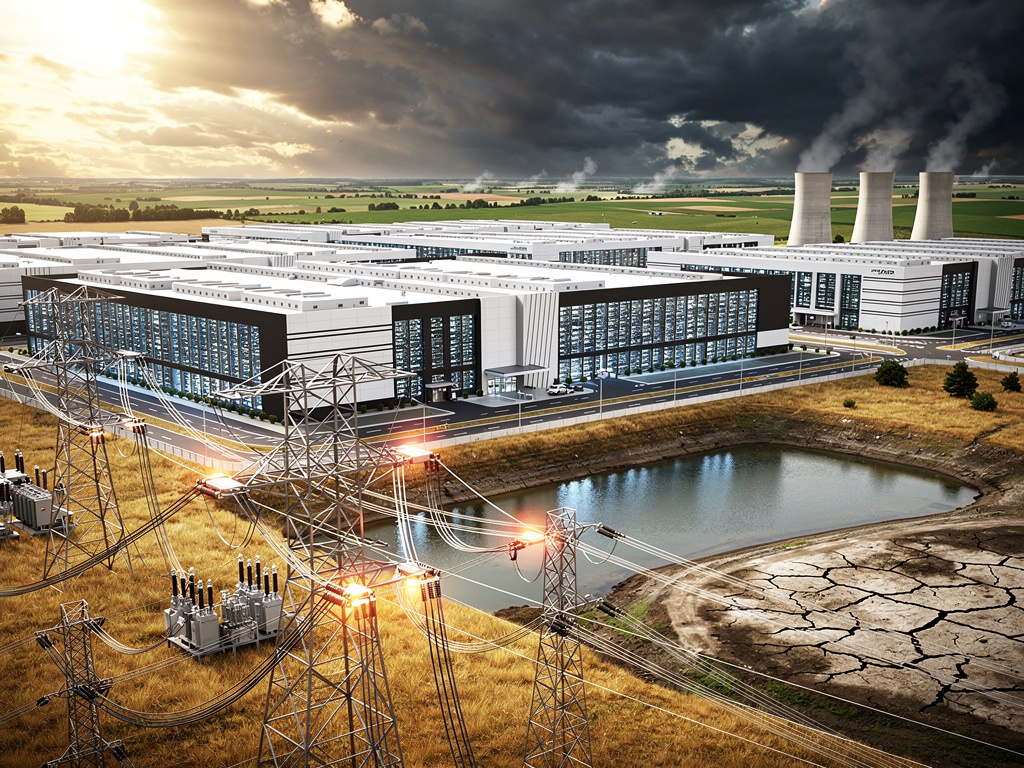
The artificial intelligence revolution is triggering an unprecedented infrastructure boom across the United States, with data center construction reaching levels not seen since the dot-com era. Yet behind the gleaming facilities and promises of economic transformation lies a complex calculus of costs, benefits, and mounting concerns about whether communities can sustain this explosive growth.
According to TechRepublic, the AI data center boom is creating a fundamental tension between technological progress and practical resource constraints. The scale of investment is staggering: industry analysts project that data center construction could exceed $1 trillion globally over the next decade, with a significant portion concentrated in the United States. This represents not just a business opportunity but a wholesale reimagining of how digital infrastructure integrates with physical communities.
The economic benefits appear substantial on paper. Data centers bring high-paying jobs, significant tax revenue, and the promise of positioning regions as technology hubs. Major tech companies including Microsoft, Google, Amazon, and Meta are racing to secure land and power contracts, often committing hundreds of millions of dollars to individual projects. These facilities require skilled technicians, engineers, and support staff, creating employment opportunities in areas that have sometimes struggled with economic stagnation.
The Power Dilemma: When Digital Demand Meets Grid Reality
The most pressing challenge facing the data center expansion is electrical power. AI workloads, particularly those involving large language models and machine learning operations, consume exponentially more energy than traditional computing tasks. A single AI data center can require as much electricity as a small city, placing unprecedented strain on regional power grids that were never designed for such concentrated demand.
Reports from The Wall Street Journal indicate that utilities across the country are scrambling to meet projected demand, with some warning that new data center projects could delay the retirement of fossil fuel plants or even require the construction of dedicated power generation facilities. In Virginia’s Loudoun County, home to the world’s highest concentration of data centers, officials have raised concerns about the sustainability of continued expansion given existing infrastructure constraints.
The situation has created unusual alliances and conflicts. Environmental groups that typically oppose fossil fuel infrastructure find themselves in complex debates about whether natural gas plants should remain operational to support AI development. Meanwhile, tech companies are investing heavily in renewable energy contracts and even exploring small modular nuclear reactors as potential solutions, though these technologies remain years away from widespread deployment.
Water Usage: The Hidden Resource Crisis
Beyond electricity, water consumption presents another critical challenge that has received less public attention but poses equally serious concerns. Modern data centers rely on sophisticated cooling systems that can consume millions of gallons of water daily. In regions already facing water scarcity or drought conditions, this additional demand raises questions about long-term sustainability and competing priorities for essential resources.
According to research highlighted by Nature, a typical large-scale data center can use between 1 and 5 million gallons of water per day for cooling purposes. This consumption occurs regardless of whether the facility uses traditional cooling towers or more advanced liquid cooling systems. In areas like Arizona and Nevada, where water rights are already contentious and climate change is intensifying drought conditions, the addition of water-intensive data centers has sparked community opposition and regulatory scrutiny.
Tech companies have responded by developing more efficient cooling technologies and committing to water replenishment programs, but critics argue these measures don’t adequately address the fundamental issue of adding significant new demand to stressed water systems. Some facilities are exploring alternative cooling methods, including air cooling and closed-loop systems that recycle water, though these approaches often come with increased energy costs or reduced efficiency.
Economic Promises Versus Community Realities
The economic development narrative surrounding data centers often emphasizes job creation and tax revenue, but the reality proves more nuanced. While construction phases do create temporary employment, operational data centers are remarkably automated, typically requiring far fewer permanent employees than their massive physical footprint might suggest. A facility covering hundreds of thousands of square feet might employ only a few dozen full-time workers once operational.
Local governments frequently offer substantial tax incentives to attract data center projects, including property tax abatements, sales tax exemptions on equipment purchases, and reduced utility rates. Bloomberg has reported that these incentives can total hundreds of millions of dollars over the life of a project, raising questions about whether communities receive adequate return on their investment, particularly when infrastructure costs for roads, utilities, and emergency services must be borne by local taxpayers.
Some regions have begun reassessing their approach to data center development. In Ireland, which became a European hub for tech infrastructure, authorities have implemented moratoriums on new data center connections to the power grid in certain areas due to capacity concerns. Similar discussions are occurring in parts of the United States, where rapid development has outpaced infrastructure planning.
The National Security and Strategic Considerations
Beyond local impacts, the data center boom carries significant national security and strategic implications. The concentration of AI computing power in specific geographic regions creates potential vulnerabilities, while also positioning those areas as critical infrastructure that requires enhanced protection and resilience planning. Federal officials have increasingly viewed data center capacity as a matter of national competitiveness, particularly in relation to China’s aggressive investments in AI infrastructure.
The CHIPS and Science Act, along with other federal initiatives, has directed billions of dollars toward semiconductor manufacturing and computing infrastructure, recognizing that AI capabilities depend on physical hardware and data processing capacity. This government support has accelerated private sector investment but also raised questions about strategic planning, equitable distribution of resources, and ensuring that infrastructure development serves broader national interests rather than purely commercial objectives.
Intelligence and defense agencies are particularly concerned about supply chain security for data center components, many of which are manufactured overseas. The push for domestic production capacity and secure facilities has led to specialized data center projects with enhanced security protocols, adding another layer of complexity to an already challenging development environment.
Environmental Footprint and Climate Commitments
The environmental impact of AI data centers extends beyond water and electricity consumption to include carbon emissions, electronic waste, and land use changes. While major tech companies have made ambitious carbon neutrality commitments, the reality of powering AI workloads often conflicts with these goals. The rapid growth of AI applications has led some companies to acknowledge that their emissions are increasing rather than decreasing, despite renewable energy investments.
According to The Guardian, the carbon footprint of training large AI models can equal the lifetime emissions of several automobiles. When multiplied across thousands of models being developed and deployed simultaneously, the cumulative environmental impact becomes substantial. This has sparked debates within the tech industry about the sustainability of current AI development trajectories and whether efficiency improvements can keep pace with expanding computational demands.
Some companies are exploring innovative approaches, including locating data centers in regions with abundant renewable energy, implementing advanced cooling technologies that reduce energy consumption, and designing AI models that require less computational power. However, these efforts remain in early stages, and the overall trend continues toward increased resource consumption as AI capabilities expand and adoption accelerates across industries.
Regulatory Responses and Policy Evolution
Government agencies at local, state, and federal levels are grappling with how to regulate and manage data center development. The challenge lies in balancing economic development goals with infrastructure capacity, environmental protection, and community interests. Some jurisdictions have implemented more stringent review processes for data center projects, requiring detailed assessments of power and water impacts before approving construction permits.
State legislatures are considering various policy approaches, from imposing fees on data center water and electricity usage to requiring renewable energy commitments as conditions for tax incentives. Virginia, home to the nation’s largest concentration of data centers, has debated legislation that would give state regulators more authority over utility planning to ensure adequate capacity for both data centers and residential customers. These policy discussions reflect growing recognition that laissez-faire approaches to data center development may not adequately protect public interests.
At the federal level, agencies including the Department of Energy and Environmental Protection Agency are developing guidelines and efficiency standards for data centers, though enforcement mechanisms remain limited. The lack of comprehensive federal regulation has created a patchwork of state and local rules that companies must navigate, adding complexity to site selection and development processes.
Looking Forward: Sustainable Growth or Inevitable Reckoning
The trajectory of AI data center development will likely determine not just the pace of artificial intelligence advancement but also the broader relationship between digital technology and physical infrastructure. Industry leaders argue that innovation will solve current constraints through improved efficiency, alternative energy sources, and better resource management. Skeptics contend that the fundamental physics of computation and cooling impose limits that cannot be overcome simply through technological optimization.
The coming years will test whether the United States can maintain its position as a global AI leader while addressing legitimate concerns about resource consumption, environmental impact, and community sustainability. Some experts predict a shift toward distributed computing architectures that spread workloads across smaller facilities rather than concentrating them in massive data centers, potentially alleviating some infrastructure pressures while introducing new technical challenges.
What remains clear is that the AI data center boom represents more than just a technology story—it’s a fundamental question about how society allocates scarce resources, plans for infrastructure needs, and balances competing priorities in an era of rapid technological change. The decisions made today about data center development will shape communities, economies, and environmental outcomes for decades to come, making it imperative that all stakeholders engage seriously with both the opportunities and challenges this transformation presents.


 WebProNews is an iEntry Publication