
The music industry has spent the better part of three years sounding alarms about artificial intelligence threatening to upend the creative economy. Labels have filed lawsuits, artists have signed open letters, and legislators on both sides of the Atlantic have debated new protections for human-made works. Yet a new report suggests the actual commercial impact of AI-generated music remains remarkably modest — even as the sheer volume of machine-made tracks surging onto streaming platforms creates real structural headaches for the business.
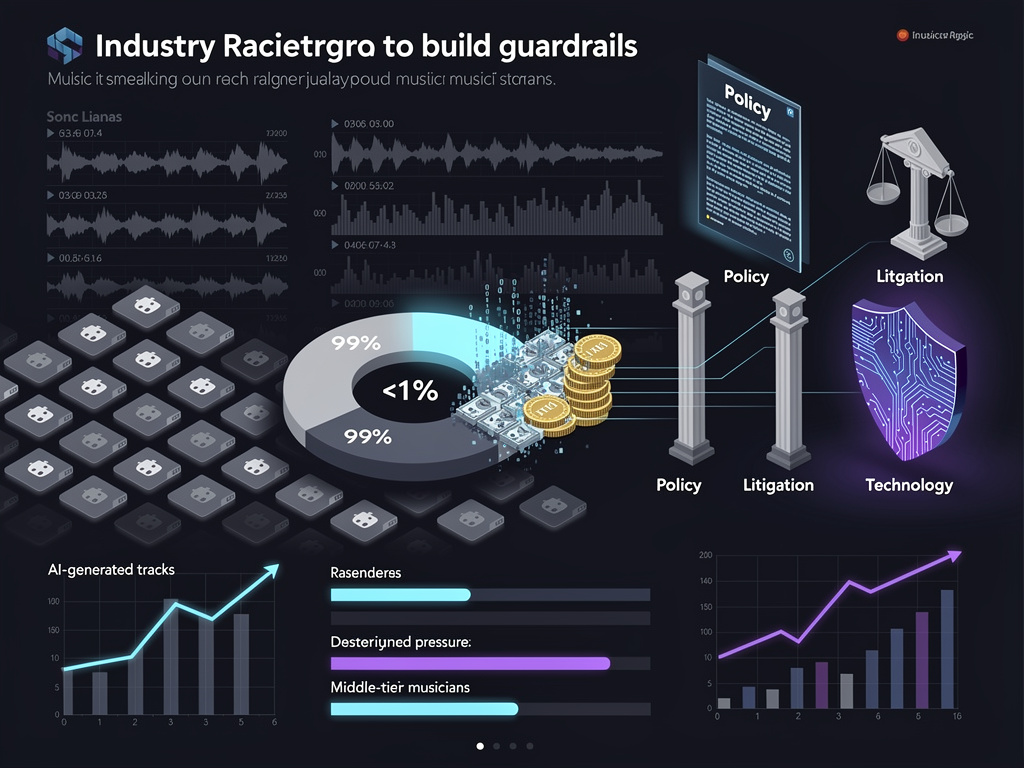
According to a report covered by Advanced Television, AI-generated music uploads now account for less than one percent of total streams on major platforms. The finding underscores a paradox that has quietly taken shape inside the industry: the flood of AI content is enormous in volume but negligible in audience engagement, at least for now. The data indicates that AI adoption is strongest in functional and low-stakes settings — background music for podcasts, YouTube videos, corporate presentations, and meditation playlists — rather than in the hit-driven mainstream that dominates cultural conversation.
A Winner-Takes-All Business Meets an Infinite Supply Machine
The music industry has long been defined by an extreme winner-takes-all dynamic. A small number of tracks, artists, and catalogs generate the vast majority of revenue. The top one percent of songs on Spotify, for instance, routinely capture more than 90 percent of all streams. This concentration of attention means that even as hundreds of thousands of AI-generated tracks are uploaded daily, they are largely invisible to the average listener scrolling through curated playlists and algorithmically recommended feeds.
But invisibility to consumers does not mean irrelevance to the business. The proliferation of low-quality, low-effort AI tracks creates what industry executives have begun calling a “dilution problem.” Every AI-generated ambient track or lo-fi beat that lands on a platform competes — however marginally — for the same finite pool of royalty payments. Under the pro-rata payment model used by most major streaming services, total revenue is divided proportionally among all streams. That means even a fraction of a percent of streams captured by AI-made content can redirect meaningful sums away from human artists, particularly those in the middle and lower tiers of the market who are already struggling to earn a living wage from streaming.
Functional Music: The Quiet Beachhead for AI
The report’s finding that AI adoption is most pronounced in functional music categories is consistent with what multiple industry observers have noted over the past year. Companies like Mubert, AIVA, and Suno have built thriving businesses generating royalty-free or low-cost background music for content creators who previously relied on stock music libraries. For a YouTuber or a small business producing a promotional video, the appeal is obvious: AI tools can produce serviceable, mood-appropriate tracks in seconds at a fraction of the cost of licensing a human-composed work.
This shift has already begun to reshape the economics of the production music sector, a segment of the industry worth an estimated $1.5 billion annually. Production music libraries such as Epidemic Sound and Artlist, which employ thousands of composers and session musicians, now face direct competition from AI generators that can produce comparable output with no ongoing royalty obligations. Several production music companies have responded by integrating AI tools into their own workflows, using machine learning to assist human composers rather than replace them — a strategy that mirrors the broader industry’s attempt to position AI as a collaborator rather than a competitor.
The Platform Response: Detection, Labeling, and Policy
Major streaming platforms have taken divergent approaches to the AI music influx. Spotify has publicly stated that it does not ban AI-generated content outright but prohibits the use of AI to artificially inflate stream counts — a practice that has plagued the platform for years regardless of whether the music is human- or machine-made. The company has invested in detection tools designed to identify and flag content that appears to be generated primarily to game the royalty system rather than to serve genuine listener demand.
Apple Music, by contrast, has taken a more conservative posture, reportedly tightening its ingestion standards and working more closely with distributors to verify the provenance of uploaded tracks. Universal Music Group, the world’s largest record label, has been among the most vocal advocates for stricter platform policies, arguing that AI-generated content should be clearly labeled and that platforms should obtain consent from rights holders before training AI models on copyrighted music. As reported by Advanced Television, the broader industry is actively battling what it perceives as a mounting threat to the integrity of the streaming ecosystem.
Legal Battles and Legislative Momentum
The less-than-one-percent stream share figure may provide cold comfort to the major labels, which have argued in multiple ongoing lawsuits that the damage from AI is not limited to current market share but extends to the erosion of the economic foundations on which the entire creative ecosystem rests. Universal Music Group, Sony Music Entertainment, and Warner Music Group have all filed or joined legal actions against AI music companies, alleging that the training of generative models on copyrighted recordings constitutes infringement on a massive scale.
In the United States, the No FAKES Act — bipartisan legislation designed to protect artists’ voices and likenesses from unauthorized AI replication — has gained renewed momentum in Congress. In the European Union, the AI Act’s provisions on transparency and labeling are beginning to take effect, requiring companies that deploy generative AI systems to disclose when content has been machine-generated. These regulatory efforts reflect a growing consensus among policymakers that existing copyright frameworks were not designed to address the unique challenges posed by generative AI, even if the commercial impact remains limited today.
The Middle-Class Musician Squeeze
Perhaps the most consequential dimension of the AI music debate is its impact on the vast middle tier of working musicians — the session players, jingle composers, production music creators, and independent artists who collectively form the backbone of the industry but rarely make headlines. For these creators, the rise of AI-generated functional music represents not a distant theoretical threat but an immediate competitive pressure on their livelihoods.
A 2025 survey by the Music Producers Guild found that nearly 40 percent of production music composers reported a decline in commissions that they attributed at least in part to AI competition. Sync licensing revenues — the fees paid when music is placed in film, television, advertising, and online video — have come under particular pressure in the lower-budget segments of the market, where AI-generated alternatives are most viable. The irony is that these are precisely the revenue streams that many independent musicians have relied on to subsidize their more artistically ambitious work.
What the Sub-One-Percent Figure Really Tells Us
Industry analysts caution against reading the less-than-one-percent stream share as evidence that AI poses no meaningful threat. The figure captures only the current state of a technology that is improving at an exponential rate. Generative music models released in early 2026 are dramatically more capable than those available just 18 months ago, producing tracks that are increasingly difficult to distinguish from human-made recordings in blind listening tests. If the quality curve continues on its current trajectory, the commercial ceiling for AI-generated music could rise significantly within the next two to three years.
Moreover, the sub-one-percent figure likely undercounts the true prevalence of AI in the music supply chain. Many human artists are already using AI tools at various stages of the creative process — for generating melodic ideas, producing demo arrangements, mastering tracks, or creating accompanying visual content. This hybrid use of AI blurs the line between “human-made” and “AI-generated” in ways that current detection and classification systems are poorly equipped to capture. The binary framing of human versus machine may itself be becoming obsolete.
An Industry at an Inflection Point
The music business finds itself in a position not unlike the one it occupied in the early 2000s, when file-sharing networks threatened to obliterate the economic model that had sustained the industry for decades. Then, as now, the initial response was a combination of legal action and technological countermeasures. Then, as now, the ultimate resolution came not from litigation alone but from the emergence of new business models — in that case, streaming — that channeled disruptive technology into commercially viable frameworks.
The question facing the industry today is whether a similar accommodation is possible with generative AI, or whether the technology represents a fundamentally different kind of challenge. The less-than-one-percent stream share figure suggests there is still time to shape the outcome. But as Advanced Television reported, the flood of AI-generated uploads is accelerating, not receding. The industry’s ability to build effective guardrails — through platform policy, legislation, licensing frameworks, and technological innovation — will determine whether that one percent remains a footnote or becomes a harbinger of a far more disruptive transformation. For the millions of human creators whose livelihoods depend on the answer, the stakes could not be higher.


 WebProNews is an iEntry Publication