
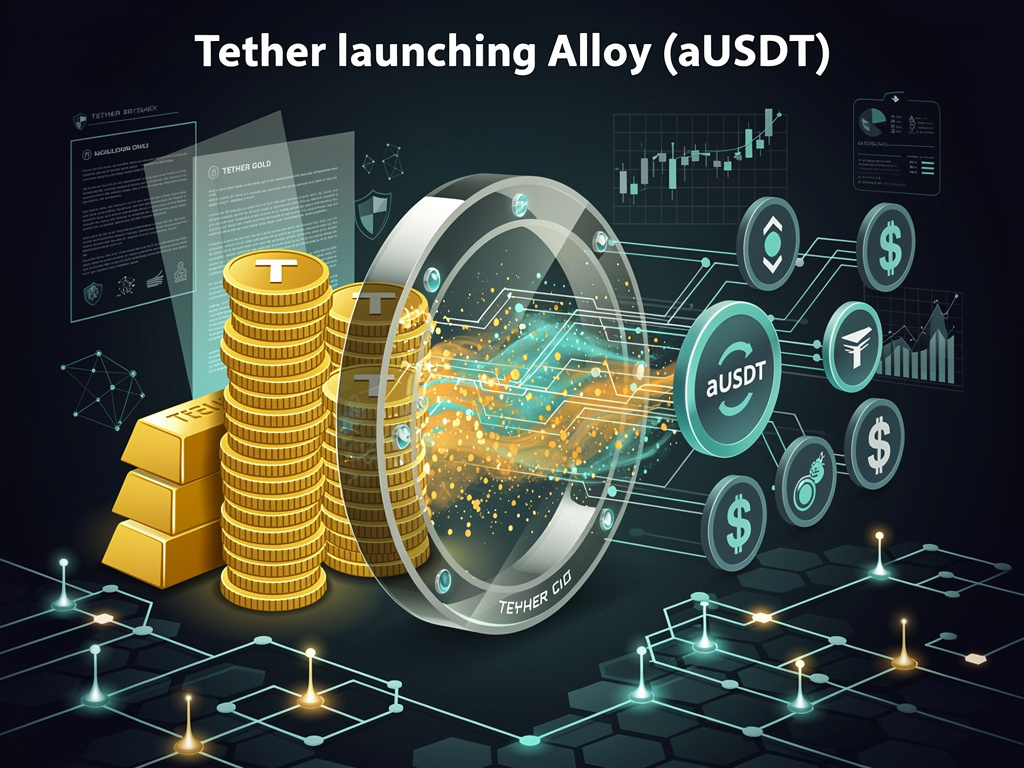
In a strategic maneuver that signals a departure from traditional fiat-pegged mechanics, Tether has officially expanded its product suite with the introduction of Alloy by Tether, a new category of digital assets designed to track the U.S. dollar while maintaining collateral in physical gold. The launch of the first token in this series, aUSDT, represents a sophisticated evolution in the stablecoin sector, moving beyond the standard cash-reserve model that has defined the company’s dominance for the past decade. By allowing users to mint a U.S. dollar-denominated token by depositing Tether Gold (XAUT) as collateral, the company is effectively creating a synthetic dollar that allows investors to maintain exposure to hard assets while utilizing dollar liquidity for payments and remittances.
This development comes at a time when the broader digital asset market is grappling with heightened regulatory scrutiny and a demand for diversified collateral types. According to The Information, the newly launched aUSDT serves as the flagship asset for the Alloy platform, which is engineered to be an open platform allowing for the creation of various tethered assets. Unlike the ubiquitous USDT, which relies on a centralized reserve of Treasury bills and cash equivalents, Alloy operates on a mechanism more akin to decentralized finance (DeFi) protocols, where over-collateralization ensures stability even amidst the volatility of the underlying commodity markets.
Engineering the Synthetic Dollar
The mechanics underpinning aUSDT reveal Tether’s ambition to capture the intersection of traditional commodities trading and modern blockchain settlement. The system functions through over-collateralization, a method popularized by algorithmic and crypto-backed stablecoins like MakerDAO’s DAI. However, Tether has refined this by utilizing its own gold-backed token, XAUT, as the sole collateral. Users deposit XAUT into a smart contract and mint aUSDT up to a certain ratio. This structure allows the holder to retain ownership of the gold—and its potential upside—while unlocking liquidity in a dollar-denominated format for daily transactions or yield-bearing activities within the crypto economy.
Industry observers note that this dual-nature asset addresses a specific pain point for high-net-worth individuals and institutional treasuries: the opportunity cost of holding gold. Historically, gold is a sterile asset that yields no interest and is difficult to spend. As detailed in technical breakdowns by CoinDesk, the Alloy framework allows these entities to effectively borrow against their gold holdings without liquidating the position, thereby avoiding taxable events or the loss of long-term hedging benefits. The smart contracts governing these interactions are deployed on the Ethereum mainnet, providing transparency regarding the collateralization ratios in real-time, a feature often demanded by critics of opaque reserve reports.
The Role of Moon Gold and Moonara
The corporate structure facilitating this launch involves specific subsidiaries designed to handle the regulatory and operational nuances of synthetic assets. The Alloy platform is operated by Moon Gold NA and Moonara LLC, entities that manage the issuance and redemption processes. This separation is crucial for risk management, isolating the Alloy product line from the massive, systemic weight of the primary USDT treasury. It also reflects a maturing compliance strategy, ensuring that the experimental nature of a gold-backed synthetic dollar does not directly impact the redemption mechanics of the $130 billion USDT juggernaut.
By leveraging these subsidiaries, Tether can iterate on financial products that appeal to distinct market segments. While USDT is the lubricant of global crypto trading, aUSDT is positioned as a wealth preservation tool with transactional utility. The official announcement from Tether emphasizes that this is merely the first in a planned line of “tethered assets,” suggesting a future roadmap where energy, real estate, or other commodities could serve as collateral for new stable currencies. This aligns with CEO Paolo Ardoino’s broader vision of tokenizing real-world assets (RWA) to modernize financial infrastructure.
Regulatory Arbitrage and Market Timing
The timing of the Alloy launch is inextricably linked to the shifting regulatory terrain in major jurisdictions, particularly the European Union. With the Markets in Crypto-Assets (MiCA) regulation imposing strict caps and reserve requirements on non-Euro stablecoins, issuers are scrambling to adapt. While aUSDT is not explicitly a workaround for MiCA, its structure as a collateralized debt position against gold places it in a different asset classification than standard e-money tokens. This nuance could offer Tether a foothold in markets where fiat-backed stablecoins face headwinds, providing a compliant alternative for sophisticated traders seeking dollar exposure.
Furthermore, this move serves as a diversification hedge against the U.S. banking system. While Tether has successfully navigated the banking crisis that claimed Silicon Valley Bank and Signature Bank, the firm remains under constant pressure to prove the safety of its reserves. By anchoring a new product line to gold—a sovereign-neutral asset—Tether reduces its total reliance on U.S. Treasury bills for its future growth. Bloomberg reports that this strategy also capitalizes on the recent surge in gold prices, making the collateral highly attractive to macro investors who anticipate continued fiat debasement.
Integration with the Hadron Ecosystem
Alloy is not a standalone product but rather a component of Tether’s recently unveiled Hadron platform, a comprehensive ecosystem designed for the tokenization of everything from equity to debt. Hadron represents the infrastructure layer that allows institutions to issue their own digital assets using Tether’s technology stack. aUSDT serves as a proof-of-concept for this technology, demonstrating how complex collateral management and liquidation engines can operate seamlessly on-chain. This pivot from B2C stablecoin issuer to B2B infrastructure provider places Tether in direct competition with traditional fintech firms and investment banks exploring blockchain settlement.
The integration capabilities of Hadron suggest that aUSDT could eventually be used as collateral in other DeFi protocols or even traditional financial arrangements tokenized on the platform. The interoperability of EVM-compatible chains ensures that Alloy assets can flow across the decentralized exchange ecosystem, deepening liquidity. As noted in broader industry analysis, the ultimate goal is to create a circular economy where Tether provides the asset (gold), the currency (aUSDT), and the infrastructure (Hadron) for global trade.
Profitability and the Cantor Fitzgerald Connection
Underpinning these ambitious expansions is Tether’s extraordinary profitability, driven by high interest rates on its massive U.S. Treasury holdings. The firm’s financial might allows it to subsidize the development of products like Alloy without immediate pressure for them to generate revenue. This financial cushion is managed in close partnership with Cantor Fitzgerald, which custodies a significant portion of Tether’s assets. The endorsement from Cantor’s CEO Howard Lutnick has provided a layer of institutional credibility that empowers Tether to take risks on novel products like gold-backed synthetics.
However, the shift to gold backing introduces different economic variables than Treasury bills. While T-bills offer a predictable yield that Tether captures as profit, gold is a non-yielding asset. The revenue model for Alloy likely relies on minting fees and the spread on the XAUT tokens, as well as the ecosystem value of locking users into the Tether product suite. CNBC has previously highlighted how Tether’s massive capital reserves allow it to act as a lender of last resort and an innovator simultaneously, a dynamic that is clearly visible in this latest venture.
Systemic Risks and Smart Contract Vulnerabilities
Despite the robust design, the introduction of Alloy brings new risk vectors that industry insiders must scrutinize. Unlike the custodial risk of USDT, where the danger lies in the bank accounts, aUSDT introduces smart contract risk. If the liquidation engine fails during a flash crash in gold prices, the peg could be destabilized. Over-collateralization is the primary defense, but history in DeFi is littered with protocols that failed under extreme stress. Tether’s centralized control over the smart contracts mitigates some governance risks found in DAOs, but it also creates a single point of failure regarding contract upgrades and administrative keys.
Moreover, the liquidity of XAUT itself becomes a critical factor. For aUSDT to scale, the supply of Tether Gold must grow commensurately. If aUSDT adoption outpaces the physical acquisition of gold bars required to mint XAUT, the system could face liquidity crunches during redemption periods. Tether has addressed this by ensuring XAUT is backed by physical gold in Switzerland, but the friction of physical redemption versus digital liquidation remains a complex variable that traders will watch closely.
The Future of Asset-Backed Stability
Tether’s launch of Alloy signals a maturation of the stablecoin sector, moving from simple fiat representations to complex, asset-backed derivatives. It challenges the hegemony of purely fiat-backed tokens like USDC and even Tether’s own USDT by offering a “hard money” alternative compatible with digital rails. If successful, aUSDT could pave the way for a resurgence of gold as a medium of exchange rather than just a store of value, effectively digitizing the gold standard for the modern era.
For the wider fintech industry, this move forces a re-evaluation of what constitutes a “stablecoin.” If stability can be achieved through over-collateralized commodities rather than fiat reserves, the reliance on the traditional banking sector diminishes further. As Tether continues to diversify into energy, data, and tokenization infrastructure, Alloy stands as a testament to the company’s strategy to vertically integrate the entire financial stack, insulating itself from regulatory shocks while expanding its influence over global capital flows.


 WebProNews is an iEntry Publication