
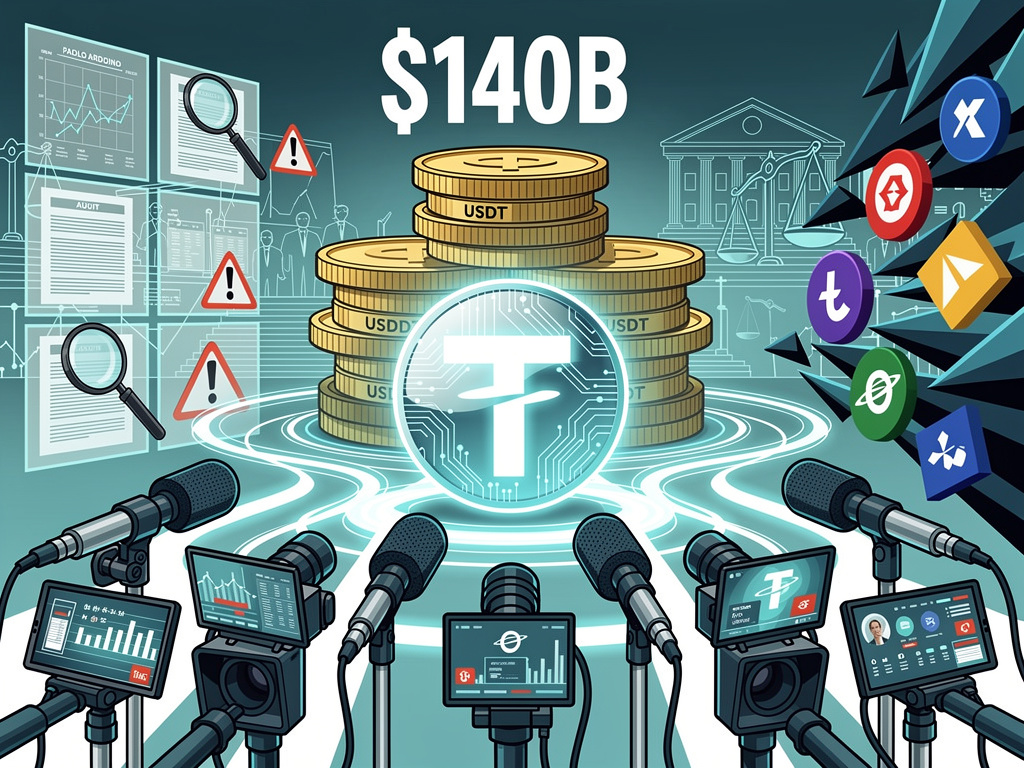
Paolo Ardoino, the chief executive of Tether, has emerged from the shadows of cryptocurrency’s most controversial company to become one of the industry’s most visible leaders. His sudden omnipresence across media platforms, industry conferences, and regulatory discussions marks a strategic shift for a company that has historically operated with opacity. This transformation comes at a critical juncture as Tether faces intensifying regulatory pressure while simultaneously pursuing aggressive expansion into new markets and financial products.
According to TechCrunch, Ardoino’s media blitz represents a calculated effort to reshape Tether’s public image and establish credibility with regulators, institutional investors, and the broader financial community. The company, which issues USDT, the world’s largest stablecoin by market capitalization, has long been dogged by questions about its reserves, transparency, and regulatory compliance. Ardoino’s visibility campaign appears designed to address these concerns head-on while positioning Tether as a legitimate player in the evolving digital asset ecosystem.
The timing of this public relations offensive is no coincidence. Tether currently maintains a market capitalization exceeding $140 billion, making it a systemically important institution in the cryptocurrency markets. Any loss of confidence in USDT could trigger cascading effects across digital asset markets, potentially destabilizing exchanges, decentralized finance protocols, and the broader crypto economy. Ardoino’s willingness to engage publicly represents an acknowledgment of this responsibility and the heightened scrutiny that comes with it.
Regulatory Pressures Mount as Stablecoin Legislation Advances
The regulatory environment surrounding stablecoins has evolved dramatically over the past year, with lawmakers in the United States and Europe advancing comprehensive frameworks for digital asset oversight. These developments have placed Tether squarely in the crosshairs of financial regulators who view stablecoins as systemically important payment instruments requiring robust oversight. Ardoino’s public engagement strategy appears calibrated to demonstrate Tether’s willingness to work within emerging regulatory frameworks while advocating for rules that preserve innovation in the sector.
European regulators have taken the lead with the Markets in Crypto-Assets (MiCA) regulation, which establishes stringent requirements for stablecoin issuers operating within the European Union. These rules mandate capital reserves, operational transparency, and regular audits—standards that Tether has historically struggled to meet. Ardoino has used his platform to argue that Tether is working toward compliance while cautioning against overly restrictive regulations that could stifle technological innovation and push crypto activity offshore.
In the United States, congressional efforts to establish a federal stablecoin framework have gained momentum, with bipartisan support for legislation that would require issuers to maintain one-to-one reserves and submit to regular examinations by banking regulators. Tether’s historical reluctance to provide comprehensive audits of its reserves has made it a focal point in these discussions. Ardoino’s media appearances have emphasized Tether’s commitment to transparency while highlighting the company’s quarterly attestations from accounting firms as evidence of its reserve backing.
Diversification Beyond Stablecoins Drives Strategic Repositioning
Beyond addressing regulatory concerns, Ardoino’s visibility campaign supports Tether’s ambitious diversification strategy. The company has announced investments in Bitcoin mining, artificial intelligence infrastructure, renewable energy projects, and venture capital initiatives. These moves represent an effort to transform Tether from a single-product stablecoin issuer into a diversified financial technology conglomerate with multiple revenue streams and strategic assets.
Tether’s profits from its stablecoin operations—generated primarily through interest earned on the reserves backing USDT—have provided substantial capital for these expansion efforts. The company reported profits exceeding $5 billion in recent quarters, creating a war chest for strategic investments. Ardoino has publicly discussed plans to deploy these resources into infrastructure projects that support the broader cryptocurrency ecosystem while generating returns independent of the stablecoin business.
The company’s investments in Bitcoin mining operations represent a particularly strategic move, aligning Tether with the foundational cryptocurrency while diversifying its business model. Similarly, Tether’s ventures into artificial intelligence and renewable energy position the company to capitalize on emerging technological trends while building goodwill with stakeholders concerned about cryptocurrency’s environmental impact. Ardoino’s public advocacy for these initiatives serves to reframe Tether as an innovative technology company rather than merely a stablecoin issuer facing regulatory challenges.
Competition Intensifies as Rivals Gain Ground
Tether’s dominant market position faces unprecedented challenges from competitors offering greater transparency and regulatory compliance. Circle’s USDC stablecoin has gained market share by emphasizing its full regulatory compliance, transparent reserve holdings, and partnerships with traditional financial institutions. PayPal’s entry into the stablecoin market with PYUSD has further validated the sector while introducing competition from a trusted brand with existing regulatory relationships.
Traditional financial institutions have also entered the stablecoin arena, with major banks exploring dollar-backed digital tokens that leverage their existing regulatory frameworks and customer relationships. These developments threaten Tether’s market dominance and create pressure for the company to enhance its transparency and regulatory standing. Ardoino’s public engagement can be understood partly as a competitive response, attempting to maintain Tether’s first-mover advantages while addressing the transparency gap that has allowed competitors to differentiate themselves.
The competitive dynamics extend beyond market share to include relationships with cryptocurrency exchanges, decentralized finance protocols, and institutional investors. As these stakeholders face their own regulatory pressures, many have expressed preferences for stablecoins with clearer compliance profiles. Tether’s historical opacity has become a liability in this environment, potentially limiting its growth prospects even as the overall stablecoin market expands. Ardoino’s visibility campaign aims to close this gap by demonstrating Tether’s evolution toward greater transparency and regulatory engagement.
Reserve Composition and Transparency Remain Central Issues
Despite Ardoino’s public assurances, questions about Tether’s reserve composition and the quality of its attestations persist. The company has faced criticism for holding significant portions of its reserves in commercial paper, secured loans, and other assets that critics argue lack the liquidity and safety required to back a stablecoin. While Tether has shifted toward holding more U.S. Treasury securities in response to these concerns, independent verification of its reserve holdings remains limited.
The company’s reliance on attestations rather than comprehensive audits has been a longstanding point of contention. Attestations provide a snapshot of reserves at a specific moment but do not examine the processes, controls, and risk management practices that ensure ongoing compliance with reserve requirements. Ardoino has acknowledged these concerns while citing the complexity and cost of obtaining full audits for a company operating across multiple jurisdictions with limited regulatory clarity.
Critics argue that Tether’s profitability provides ample resources to obtain comprehensive audits from major accounting firms, suggesting that other factors may explain the company’s reluctance to pursue this path. Some observers speculate that full audits might reveal reserve management practices or asset quality issues that would undermine confidence in USDT. Ardoino’s public statements have attempted to reframe this debate, emphasizing Tether’s track record of honoring redemptions and maintaining its peg to the dollar as evidence of its stability and reserve adequacy.
Geopolitical Considerations Shape Strategic Positioning
Tether’s global operations and the international nature of cryptocurrency markets introduce complex geopolitical considerations that factor into Ardoino’s public engagement strategy. The company’s historical connections to executives and entities in various jurisdictions have raised questions about its governance and operational independence. As tensions between major powers intensify and financial sanctions become increasingly important geopolitical tools, Tether’s role as a dollar-denominated instrument operating largely outside traditional banking channels has attracted attention from national security officials.
U.S. policymakers have expressed concerns about stablecoins potentially being used to circumvent sanctions or facilitate illicit finance. These concerns have informed regulatory proposals that would require stablecoin issuers to implement robust anti-money laundering controls and comply with sanctions screening requirements. Ardoino has used his platform to emphasize Tether’s cooperation with law enforcement agencies and its implementation of compliance measures, while also noting the challenges of applying traditional financial regulations to decentralized digital asset systems.
The geopolitical dimension extends to competition between different monetary systems and the role of the dollar in global finance. Some observers view stablecoins like USDT as extensions of dollar dominance into digital markets, while others see them as potential threats to traditional financial infrastructure and monetary sovereignty. Ardoino has navigated these tensions by emphasizing Tether’s role in expanding access to dollar-denominated instruments while maintaining that the company operates as a private entity rather than an extension of any government’s policy objectives.
The Path Forward Requires Balancing Growth and Governance
As Tether navigates this complex environment, Ardoino’s public visibility serves multiple strategic objectives. It demonstrates leadership accountability, signals willingness to engage with regulators and stakeholders, and attempts to reshape narratives around the company’s operations and intentions. However, visibility alone cannot resolve the fundamental tensions between Tether’s historical operating model and the regulatory expectations emerging globally.
The company faces critical decisions about its corporate structure, reserve management, transparency practices, and regulatory strategy. These choices will determine whether Tether can maintain its market leadership while adapting to a more regulated environment. Ardoino’s willingness to engage publicly creates opportunities for dialogue and negotiation, but also raises expectations for substantive changes in how Tether operates and reports on its activities.
The broader cryptocurrency industry watches these developments closely, recognizing that Tether’s fate has implications extending far beyond a single company. As the largest stablecoin and a critical piece of crypto market infrastructure, Tether’s ability to navigate regulatory challenges while maintaining market confidence will influence the trajectory of digital asset adoption and the shape of future financial systems. Ardoino’s emergence from the shadows represents a pivotal moment in this evolution, one that will test whether transparency and engagement can reconcile the tensions between cryptocurrency’s decentralized ethos and the regulatory requirements of systemically important financial institutions.


 WebProNews is an iEntry Publication