
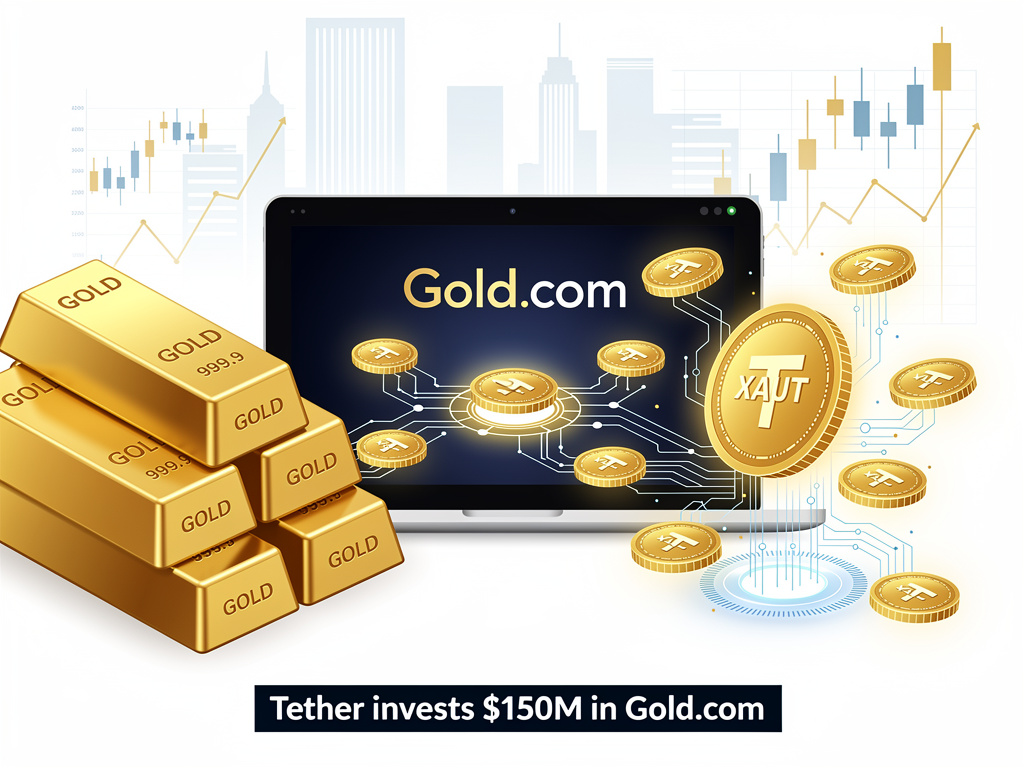
In a move that underscores the accelerating convergence of digital assets and traditional commodities, Tether — the company behind the world’s most widely used stablecoin, USDT — has acquired a 12% minority stake in Gold.com for $150 million. The deal, announced on February 5, 2026, positions Tether to dramatically expand the distribution of its gold-backed token, XAUT, while giving Gold.com a powerful financial backer as it seeks to modernize how retail and institutional investors access physical and tokenized gold.
The investment values Gold.com at approximately $1.25 billion, a striking figure for a platform that bridges the centuries-old gold market with blockchain-based tokenization. According to Tether’s official announcement, the strategic partnership will integrate Tether Gold (XAUT) directly into Gold.com’s platform, enabling users to seamlessly buy, sell, and hold tokenized gold alongside physical bullion. Each XAUT token represents ownership of one troy ounce of London Good Delivery gold, stored in secure Swiss vaults.
A Strategic Marriage of Digital Finance and Physical Commodities
Paolo Ardoino, CEO of Tether, framed the acquisition as a natural extension of the company’s broader diversification strategy. “Gold has been the ultimate store of value for thousands of years, and by combining it with the efficiency and transparency of blockchain technology, we can make it accessible to anyone, anywhere,” Ardoino said, as reported by CoinDesk. The deal reflects Tether’s growing appetite for investments beyond its core stablecoin business, following a string of acquisitions and strategic bets across artificial intelligence, bitcoin mining, and agricultural technology.
Gold.com, for its part, has been building a platform designed to serve as a one-stop destination for gold investors. The company offers direct access to physical gold purchases, storage solutions, and now, through the Tether partnership, tokenized gold products. According to GlobeNewsWire, Gold.com CEO Thomas Cormier described the investment as “transformative,” stating that Tether’s backing would allow the platform to “scale rapidly and bring gold ownership into the digital age for millions of new investors worldwide.” Cormier emphasized that the partnership would not replace physical gold offerings but rather augment them with blockchain-based alternatives that offer fractional ownership and 24/7 trading capability.
Why Tokenized Gold Is Gaining Serious Traction
The timing of Tether’s investment is far from coincidental. Gold prices have been on a sustained upward trajectory, with spot prices hovering near record highs amid persistent geopolitical uncertainty, central bank buying, and inflationary pressures. Against this backdrop, tokenized gold has emerged as one of the fastest-growing segments in the digital asset industry. Tether Gold (XAUT) and its chief rival, Paxos Gold (PAXG), have collectively seen their combined market capitalization swell past $1.5 billion, as investors seek the inflation-hedging properties of gold with the portability and programmability of blockchain tokens.
As Crypto News reported, Tether has been steadily deepening its tokenized gold strategy over the past year. XAUT has gained significant traction among crypto-native investors who want exposure to gold without the friction of dealing with physical storage, insurance, and transportation. The token can be traded on major cryptocurrency exchanges around the clock, settled in minutes rather than days, and divided into fractions — making gold accessible to investors who might not be able to afford a full ounce. The Gold.com partnership gives XAUT something it has lacked: a direct distribution channel to traditional gold buyers who may be unfamiliar with cryptocurrency but are open to digital innovation in how they purchase and hold precious metals.
Tether’s Expanding Empire Beyond Stablecoins
Tether’s $150 million outlay on Gold.com is the latest in a series of aggressive investments that have transformed the company from a single-product stablecoin issuer into a diversified financial technology conglomerate. In recent years, Tether has invested in bitcoin mining operations, acquired stakes in AI companies, backed agricultural ventures in Latin America, and even invested in brain-computer interface startups. The company reported a net profit of over $13 billion in 2024, driven primarily by the interest income generated from the U.S. Treasury securities that back USDT’s more than $140 billion in circulation. That enormous cash flow has given Tether the financial firepower to pursue an investment strategy that would be ambitious even by the standards of traditional financial institutions.
According to The Block, the Gold.com investment also deepens Tether’s exposure to the metals market more broadly. Analysts noted that the deal could be a precursor to Tether exploring tokenized versions of other precious metals, such as silver or platinum, leveraging Gold.com’s infrastructure and supply chain relationships. The Block reported that industry observers view the move as Tether’s attempt to build a “parallel financial system” that offers digital alternatives to traditional asset classes, all anchored by the liquidity and network effects of the USDT ecosystem.
How the Deal Restructures Gold.com’s Ambitions
For Gold.com, the $150 million infusion represents a massive acceleration of its growth plans. The platform, which had been operating at a relatively modest scale compared to established gold dealers like APMEX or JM Bullion, now has the capital to invest in technology, marketing, and global expansion. As reported by Bitcoin Insider, the investment is expected to fund the development of new product offerings, including gold-backed savings accounts, institutional custody solutions, and API integrations that would allow fintech platforms and neobanks to offer gold products to their own customers under a white-label arrangement.
The partnership also raises important questions about regulatory oversight. Tokenized gold exists in a gray area between securities regulation and commodity trading rules in many jurisdictions. In the United States, the Commodity Futures Trading Commission (CFTC) has jurisdiction over gold as a commodity, while the Securities and Exchange Commission (SEC) could potentially assert authority over tokenized gold products if they are deemed investment contracts. Tether, which is incorporated in the British Virgin Islands and has historically operated with limited regulatory oversight, has faced scrutiny from U.S. authorities in the past — most notably a 2021 settlement with the New York Attorney General over misrepresentations about USDT’s reserves. The Gold.com deal will likely attract additional regulatory attention, particularly if XAUT is marketed aggressively to U.S. retail investors through the platform.
The Competitive Dynamics of Tokenized Precious Metals
Tether is not alone in recognizing the potential of tokenized gold. Paxos, the New York-regulated fintech firm behind PAXG, has been a formidable competitor in the space, offering a token that is also backed one-to-one by physical gold stored in London vaults. Other players, including Aurus and Meld Gold, have been developing their own tokenized gold products for institutional and retail markets. What distinguishes Tether’s approach with the Gold.com deal is the emphasis on bridging the gap between crypto-native and traditional gold markets. By embedding XAUT into a platform that also sells physical gold bars and coins, Tether is betting that it can capture customers at every point along the spectrum — from the crypto enthusiast who wants gold exposure in their DeFi portfolio to the retiree who simply wants to buy a gold bar and have it shipped to their home.
The deal also has implications for the broader stablecoin market. As CoinDesk noted, Tether’s investment in a gold-related business reinforces the narrative that stablecoin issuers are evolving into full-spectrum financial services companies. Circle, the issuer of USDC, has been pursuing its own diversification strategy, including a confidential filing for an initial public offering. The race to build the most comprehensive digital financial ecosystem is intensifying, and Tether’s Gold.com stake suggests that the company views commodities — and gold in particular — as a critical pillar of that vision.
What This Means for Investors and the Future of Gold Ownership
For investors, the Tether-Gold.com partnership could meaningfully lower the barriers to gold ownership. Tokenized gold eliminates many of the frictions that have historically made gold a cumbersome asset to hold: storage costs, insurance premiums, assay fees, and the logistical challenges of buying and selling physical metal. With XAUT integrated into Gold.com, a new investor could potentially open an account, purchase fractional gold exposure for as little as a few dollars, and trade it instantly on secondary markets — all while maintaining a claim on physical gold held in audited Swiss vaults.
Yet skeptics caution that the tokenized gold market still faces significant hurdles. Counterparty risk remains a concern: investors must trust that the issuer — in this case, Tether — actually holds the physical gold it claims to back each token. While Tether has published periodic attestations of XAUT reserves, critics argue that these fall short of the full, independent audits that would provide definitive assurance. The Gold.com deal, however ambitious, does not resolve these underlying trust questions. What it does accomplish is to dramatically expand the potential audience for tokenized gold, placing it alongside physical bullion on a mainstream platform and daring the market to embrace a future where the line between digital and physical gold becomes increasingly blurred.
As Ardoino told CoinDesk, “We believe the future of finance is one where traditional assets and digital innovation coexist seamlessly. Gold is the perfect starting point.” Whether that vision materializes will depend on execution, regulation, and the willingness of gold’s most traditional buyers to trust a stablecoin company with their oldest and most trusted store of value.


 WebProNews is an iEntry Publication