
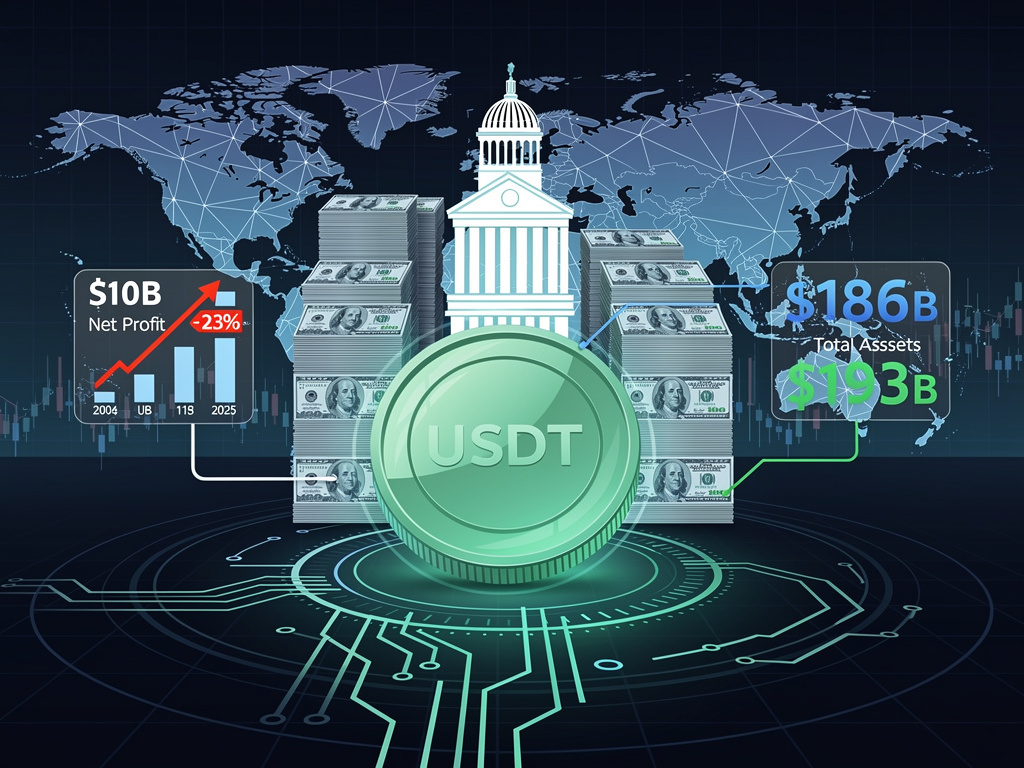
The world’s largest stablecoin issuer has quietly built one of the most profitable financial operations in the digital asset industry. Tether Holdings Limited reported $10 billion in net profits for 2025, a figure that would place it among the most lucrative financial technology companies globally, yet the 23% decline from 2024’s record $13 billion haul signals shifting dynamics in the stablecoin market. The company now holds $193 billion in assets backing the $186 billion USDT tokens in circulation, with excess reserves reaching $6.3 billion, according to Tether’s official announcement.
The profit decline comes despite USDT’s continued dominance in cryptocurrency markets, where it serves as the primary medium of exchange for traders worldwide. The stablecoin’s market capitalization reached record levels during 2025, yet the company’s profitability decreased, raising questions about the sustainability of Tether’s business model amid changing interest rate environments and increasing competition. The company’s treasury holdings have grown to unprecedented levels, with Crypto Times reporting that U.S. Treasury exposure hit a record $141 billion, making Tether one of the largest holders of U.S. government debt globally.
The Federal Reserve’s Invisible Hand on Stablecoin Profits
Tether’s profitability is intrinsically linked to interest rates on U.S. Treasury securities, the primary asset backing USDT. During 2024, the Federal Reserve maintained elevated interest rates to combat inflation, allowing Tether to earn substantial yields on its massive Treasury portfolio. As rates began moderating in late 2024 and into 2025, the income generated from these holdings naturally declined, directly impacting the company’s bottom line. This connection between monetary policy and stablecoin issuer profits represents an underappreciated dynamic in the cryptocurrency ecosystem, where supposedly decentralized digital assets depend heavily on traditional financial system mechanics.
The $3 billion year-over-year profit decline reflects this interest rate sensitivity more than any operational challenges. According to The Block’s analysis, the company’s excess reserves grew to $6.3 billion, demonstrating that Tether continues to maintain a cushion above the 1:1 backing ratio it promises token holders. This overcollateralization strategy provides a buffer against potential asset value fluctuations, though critics have long questioned the quality and liquidity of Tether’s reserve composition.
Treasury Holdings Position Tether Among Nation-State Investors
With $141 billion in U.S. Treasury holdings, Tether now ranks among the top 20 holders of U.S. government debt worldwide, surpassing many sovereign nations. This positioning carries significant implications for both the cryptocurrency industry and traditional financial markets. The company’s appetite for Treasuries provides consistent demand for U.S. government securities, effectively making Tether a material participant in funding the American government’s operations. CryptoNews noted discrepancies in reported Treasury figures, with some sources citing $122 billion, highlighting the ongoing transparency challenges that have followed Tether throughout its existence.
The scale of these holdings raises systemic risk questions that regulators worldwide continue to grapple with. If Tether were forced to liquidate significant portions of its Treasury portfolio rapidly—whether due to regulatory action, a bank run on USDT, or operational challenges—the impact on Treasury markets could be substantial. Conversely, Tether’s stability and continued growth arguably contribute to Treasury market liquidity and demand, creating a complex interdependency between the crypto sector and traditional government finance.
Record Token Supply Masks Competitive Pressures
USDT’s supply reached $186 billion during 2025, representing continued growth in adoption despite intensifying competition from Circle’s USDC, PayPal’s PYUSD, and emerging regulatory-compliant alternatives. Coinpedia reported that the record supply demonstrates Tether’s entrenched position in cryptocurrency trading, particularly in offshore exchanges and emerging markets where USDT serves as a dollar proxy. The token’s utility extends beyond crypto speculation, functioning as a store of value and medium of exchange in countries experiencing currency instability or capital controls.
However, the profit decline relative to supply growth suggests margin compression in Tether’s business model. As the company scales, maintaining the same profit-to-supply ratio becomes challenging, particularly as interest rates normalize and operational costs increase. The company faces mounting pressure to demonstrate transparency and regulatory compliance, investments that don’t directly contribute to profitability but are increasingly necessary for long-term viability. BeInCrypto highlighted that despite the profit decline, the $10 billion figure still represents record profitability for any stablecoin issuer, underscoring the lucrative nature of the business model.
Regulatory Scrutiny Intensifies as Profits Mount
Tether’s extraordinary profitability has attracted increased attention from regulators worldwide, who question whether stablecoin issuers should be subject to banking regulations given their quasi-banking functions. The company operates in a regulatory gray area, issuing dollar-denominated instruments backed by reserves but without the oversight applied to traditional banks or money market funds. This regulatory arbitrage has enabled Tether to retain all interest earned on its reserves rather than passing it to token holders, a practice that would be unusual in traditional finance where depositors typically receive interest on their holdings.
The European Union’s Markets in Crypto-Assets (MiCA) regulation and proposed U.S. stablecoin legislation could fundamentally alter Tether’s business model. These frameworks may require stablecoin issuers to obtain banking licenses, maintain higher reserve ratios, or share interest income with token holders. According to Bloomberg, Tether’s profit decline occurred amid fundraising efforts, suggesting the company may be preparing for a regulatory environment that requires additional capital buffers or operational investments. The timing of these fundraising activities indicates strategic positioning ahead of anticipated regulatory changes that could impact profitability.
The Opacity Problem That Won’t Disappear
Despite years of criticism regarding transparency, Tether continues to operate with limited disclosure compared to traditional financial institutions. The company releases quarterly attestation reports prepared by accounting firm BDO Italia, but these fall short of full audits that would provide deeper insight into reserve composition, counterparty risks, and operational practices. Critics argue that a company holding nearly $200 billion in assets and generating $10 billion in annual profits should be subject to the same disclosure standards as publicly traded financial institutions.
Tether has consistently defended its transparency practices, pointing to its attestation reports and the fact that USDT has maintained its peg through multiple market crises, including the 2022 Terra/Luna collapse that destroyed competing algorithmic stablecoins. The company argues that its track record speaks louder than additional disclosures, and that excessive transparency could compromise competitive positioning or expose the company to security risks. This tension between privacy and accountability remains unresolved, with implications for the broader stablecoin industry as it seeks mainstream acceptance.
Diversification Beyond Dollar Backing
While U.S. Treasuries dominate Tether’s reserves, the company has diversified into other assets, including Bitcoin, gold, and secured loans. These alternative holdings represent both opportunity and risk, potentially generating higher returns than Treasuries but introducing volatility and counterparty exposure. The secured loan portfolio, in particular, has drawn scrutiny, with questions about borrower identity, collateral quality, and the terms of these arrangements. Tether maintains that all loans are overcollateralized and subject to rigorous risk management, but the lack of detailed disclosure makes independent verification impossible.
The company’s Bitcoin holdings have appreciated significantly, contributing to excess reserves and providing a hedge against dollar depreciation. This strategy positions Tether uniquely among stablecoin issuers, most of which maintain purely traditional financial assets. The Bitcoin allocation reflects founder Giancarlo Devasini’s conviction in cryptocurrency’s long-term value proposition, though it also introduces volatility that could theoretically threaten the 1:1 peg during severe market downturns. Balancing yield generation, capital preservation, and peg stability remains Tether’s central operational challenge as it manages assets exceeding those of many regional banks.
Competitive Dynamics Reshape Stablecoin Economics
Circle’s USDC has gained ground in regulated markets and among institutional users prioritizing compliance and transparency. While USDT maintains dominance in trading volume and offshore markets, USDC’s growth in decentralized finance protocols and U.S.-based exchanges represents a strategic threat to Tether’s market position. The competitive dynamics extend beyond market share to regulatory favor, with Circle positioning itself as the compliant alternative that regulators can support. This positioning could prove decisive as stablecoin legislation advances, potentially creating regulatory moats that favor transparent, U.S.-domiciled issuers.
PayPal’s entry into stablecoins, along with potential offerings from traditional financial institutions, further fragments the market. These new entrants bring regulatory relationships, technological infrastructure, and user bases that could rapidly scale stablecoin adoption in mainstream commerce. Tether’s response has been to expand into emerging markets and maintain its position as the most liquid trading pair on global exchanges. The company’s profitability provides resources to invest in partnerships, technology, and market expansion, but the fundamental question remains whether Tether’s regulatory posture is sustainable as governments worldwide implement comprehensive digital asset frameworks.
The Geopolitical Dimension of Dollar Stablecoins
Tether’s global reach extends dollar access to regions where traditional banking infrastructure is limited or where local currencies are unstable. In countries like Argentina, Turkey, and Nigeria, USDT functions as a practical dollar substitute, enabling savings preservation and commerce in a stable unit of account. This utility has geopolitical implications, effectively extending dollar hegemony into the digital realm and providing an alternative to both local currencies and Chinese digital currency initiatives. U.S. policymakers increasingly recognize stablecoins as tools of dollar diplomacy, potentially explaining the relatively permissive regulatory approach despite concerns about Tether’s opacity.
However, this same global reach creates enforcement challenges and potential sanctions evasion risks. Tether’s tokens circulate in jurisdictions beyond U.S. regulatory reach, and the company’s limited know-your-customer procedures compared to traditional banks create potential for illicit use. Treasury Department officials have expressed concerns about stablecoin use in sanctions circumvention, particularly regarding Russia, Iran, and North Korea. Balancing the benefits of dollar digitization against financial crime risks represents a central policy challenge as stablecoin adoption accelerates.
Profitability as Both Strength and Vulnerability
Tether’s $10 billion profit demonstrates the extraordinary economics of stablecoin issuance under current regulatory conditions. The business model—collecting deposits that pay no interest, investing them in yield-generating assets, and retaining the spread—mirrors traditional banking but without the regulatory costs, capital requirements, or consumer protections. This arbitrage opportunity has created immense wealth for Tether’s owners while providing utility to cryptocurrency markets. Yet this same profitability attracts regulatory attention and competitive entry, potentially eroding the favorable conditions that enabled such returns.
The sustainability of Tether’s profits depends on several variables: interest rate levels, regulatory developments, competitive dynamics, and continued confidence in USDT’s peg. The 23% profit decline in 2025 may represent the beginning of margin normalization as these factors evolve. For an industry built on disrupting traditional finance, the irony is that Tether’s success depends heavily on traditional financial system stability and the yield curve of U.S. government debt. As stablecoins mature from crypto-native infrastructure to mainstream financial instruments, the business models, regulations, and economics that govern them will inevitably converge with traditional finance, potentially compressing the extraordinary profitability that characterized the industry’s early years.


 WebProNews is an iEntry Publication