
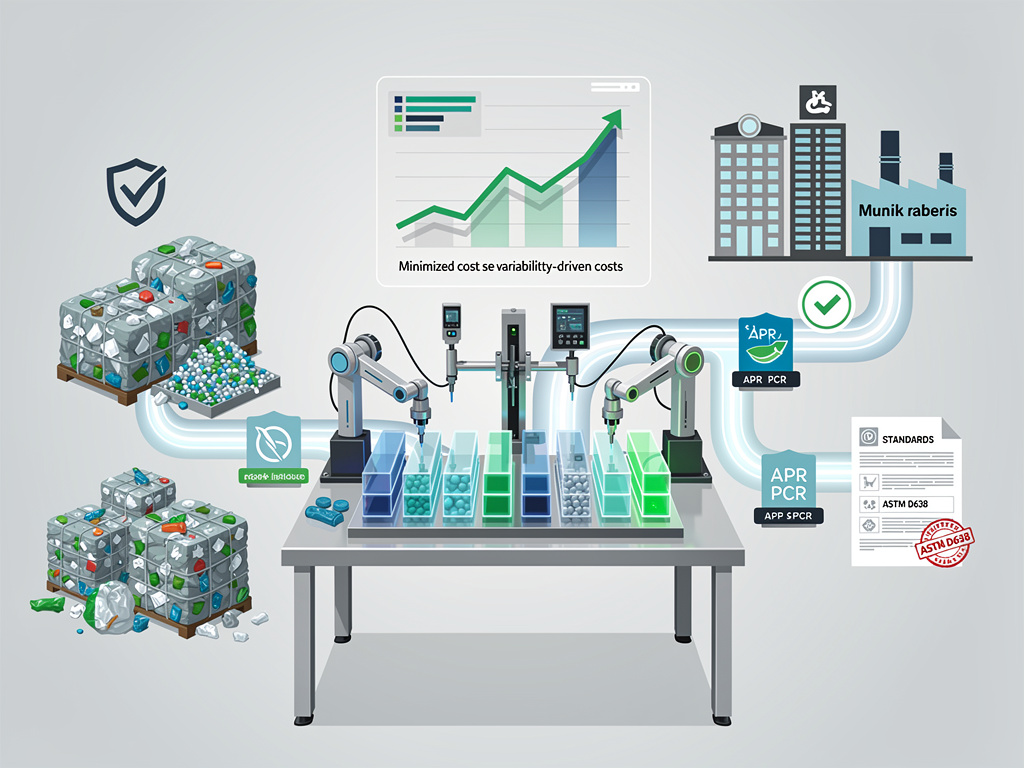
In the push for sustainability, municipalities and manufacturers increasingly turn to recycled plastics to meet regulatory mandates and corporate goals. Yet, beneath the green credentials lies a stark reality: performance variability that can inflate costs through scrap, downtime, and failures. Dr. Pradyumna Gupta, founder and chief scientist at Infinita Lab, argues that materials testing transforms procurement from a gamble into a precision strategy. “Testing is not limited to pass-or-fail decisions. When used strategically, it becomes a decision support system across procurement, design, and manufacturing,” writes Gupta in Resource Recycling.
Unlike virgin resins produced under controlled conditions, recycled streams suffer from feedstock inconsistencies, thermal degradation, contamination, and erratic additives. These factors erode mechanical strength, processing stability, and durability, exposing buyers to budget risks. Procurement teams, often fixated on recycled content percentages, overlook how a batch’s hidden flaws can trigger production halts or warranty payouts.
Performance Data Drives Supplier Choices
Benchmarking against standards like ASTM D638 for tensile properties and ASTM D790 for flexural behavior enables direct supplier comparisons. Gupta highlights how testing melt flow rate, tensile strength, and environmental stress cracking resistance predicts processing windows, averting issues like unexpected softness in blow-molded recycled HDPE. Municipalities specifying recycled-plastic benches for parks, for instance, use mechanical testing and accelerated aging to ensure longevity under thermal cycling, dodging frequent replacements.
In packaging, early thermal degradation tests on recycled polypropylene revealed tensile losses post-regrind; blend adjustments and stabilizers restored viability, sidestepping downstream failures. A transit authority’s impact and UV exposure tests on recycled traffic posts eliminated underperformers pre-deployment, as detailed by Gupta.
Certification Programs Build Procurement Confidence
The Association of Plastic Recyclers (APR) PCR Certification verifies post-consumer recycled content via third-party audits, covering PET, PP, HDPE, and more. Launched in late 2024 with RecyClass coordination, it demands chain-of-custody documentation and annual surveillance, aiding buyers in states like California under SB54. “PCR Certification will be a simple step for reclaimers that have robust Quality Assurance procedures,” states APR, urging procurement teams to require it in contracts.
Over 35 recyclers certified since 2021 stabilize supply for manufacturers facing EPR rules. Buyers access a directory of verified suppliers, reducing contamination risks and supporting pacts like the U.S. Plastics Pact.
Advanced Testing Mitigates Food-Contact Risks
Intertek’s CircularAssure program delivers chemical, mechanical, and migration testing for recycled polyesters and polyolefins, guiding processability and NIAS screening. UL Solutions certifies chemically recycled plastics to UL 94 flammability and UL 746A standards, with Yellow Card listings accelerating procurement. “Certifying plastic compounds containing chemically recycled content confirms sustainable plastics comply with fire, electrical and mechanical hazard requirements,” notes UL Solutions.
The Plastics Industry Association emphasizes continuous NIAS monitoring for food-contact, paired with AI sorting infrastructure. “Verification systems for non-intentionally added substances are essential to identify and mitigate residual chemicals,” per their September 2025 analysis in Plastics Industry Association.
Real-World Wins and Regulatory Pressures
Europe’s 25% recycled PET mandate by 2025 strains supply, per Mordor Intelligence, while U.S. states like Maine require producer reimbursements to municipalities starting 2027. APR and RecyClass protocols test packaging impacts on streams, ensuring innovations don’t degrade recyclate quality.
Procurement platforms like Circular sourced 35,000 tons of PCR in Q3 2023, highlighting data-driven matching. NETZSCH’s DSC analysis detects impurities in recycled feeds, enabling cost-efficient quality control.
Scaling Trust Through Traceability
Blockchain efforts, as in Plastiks’ verification of 9.9 million kg across 22 countries, answer procurement queries on audit-proof data. HPRC trials recovered 45% of healthcare rigid plastics via automated sorting, per Plastics World on X.
Global trade analyses reveal recycling gaps, with only 8-9% rates, underscoring testing’s role in viability. As mandates rise—Thailand’s rising thresholds, India’s 60% by 2029—buyers prioritizing tested, certified materials safeguard budgets while advancing circularity.
Investment Pays in Infrastructure and Standards
Upfront spends on infrared sorters and closed-loop washing yield premium recyclate, notes Plastics Industry Association. Harmonized standards cut cross-border friction, positioning tested recycled plastics as virgin rivals.


 WebProNews is an iEntry Publication