
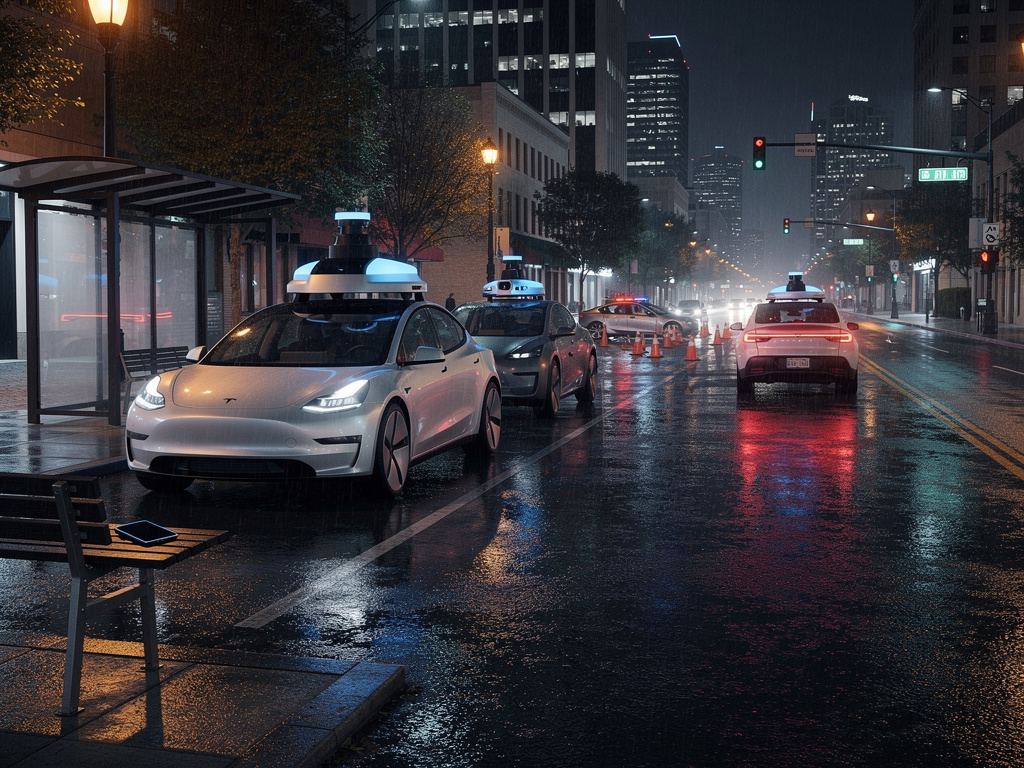
Tesla Inc. has edged into a new phase of its long-promised autonomous ride-hailing service, launching public Robotaxi rides in Austin, Texas, without safety monitors inside the vehicles. CEO Elon Musk announced the development on X on January 22, 2026, posting: “Just started Tesla Robotaxi drives in Austin with no safety monitor in the car. Congrats to the @Tesla_AI team!” The move marks a shift from the program’s June 2025 debut, when human monitors occupied the front passenger seats of Model Y vehicles.
Ashok Elluswamy, Tesla’s senior vice president of AI and Autopilot, elaborated on the cautious rollout in a post on the same platform: “Robotaxi rides without any safety monitors are now publicly available in Austin. Starting with a few unsupervised vehicles mixed in with the broader robotaxi fleet with safety monitors, and the ratio will increase over time.” This mixed-fleet strategy prioritizes safety amid Tesla’s push toward full autonomy, relying on its camera-based Full Self-Driving (FSD) software, specifically advanced versions of FSD v14.
While the vehicles arrive empty for pickups—allowing passengers to sit upfront for the first time—the scarcity of unsupervised units has frustrated riders. David Moss, known for logging over 12,961 miles on FSD v14 with zero interventions across 30 states, traveled to Austin and documented 38 failed attempts over four days to hail one. In a January 24 X video, Moss stated: “Zero success, 35 attempts. Doing as many Tesla Robotaxi rides as it takes to get an unsupervised.” His efforts highlight the operational challenges of scaling even a limited unsupervised service.
Controlled Rollout Amid Past Promises
Tesla’s Austin fleet, estimated at around 32 Model Ys with fewer than 10 typically active, operates within a geofenced area. The company secured Texas permits for driverless operations effective September 1, 2025, but self-imposed safeguards persist. Early videos from riders like Joe Tegtmeyer showed smooth trips, but reports indicate trailing chase cars with monitors for some unsupervised rides, as noted in InsideEVs. Remote monitoring from Tesla’s operations center, equipped with override consoles, adds another layer, with Musk emphasizing during the Q4 2025 earnings call on January 28: “We can’t screw up.”
Prior to public access, Tesla tested unsupervised rides with employees in late 2025, removing intervention capabilities. Musk reiterated during the earnings call that as of January 27, 2026, “unsupervised Robotaxis no longer have any chase cars.” Yet, the fleet’s small size and deliberate ramp-up reflect lessons from earlier incidents: Tesla reported at least eight crashes in Austin since June 2025 over 250,000 miles, a rate of one every 60,000 miles—eight times the human average of 500,000 miles—per NHTSA data analyzed by Electrek.
These setbacks echo Tesla’s history of ambitious timelines. Musk predicted one million robotaxis by 2020 at Autonomy Day 2019, a goal unmet as the service launched supervised in Austin last June. Production delays pushed safety monitor removal from end-2025 to January, with Musk admitting in July 2025 the company would cover “half the U.S. population” by year-end—a target revised amid sluggish fleet growth.
Rider Frustrations Meet Technical Realities
Moss’s saga, culminating in 38 supervised rides without an unsupervised one, underscores availability issues. Posting progressively—”0 for 33 now here in Austin trying to get full unsupervised Tesla Robotaxi” on January 24—he captured the fleet’s dynamics on X. Tesla Robotaxi vehicles feature unique hardware like camera washers, absent in consumer Model Ys, essential for vision-only autonomy in varied weather, as detailed in Teslarati.
Successful riders, including early influencer reports, praised FSD’s performance on simple routes with minimal turns. A January 22 video from Tegtmeyer depicted a 14-minute trip, backing claims of reliability in controlled settings. However, Reddit discussions on r/SelfDrivingCars and r/TeslaFSD question full unsupervised status, citing chase vehicles and geofencing limitations that avoid complex scenarios like highways initially.
Bay Area operations, with a larger fleet, retain safety drivers at the wheel—akin to supervised FSD rides—contrasting Austin’s progress. Tesla plans highway inclusion cautiously, previously placing monitors in driver seats for such trips as a “self-imposed first step,” per official X posts in September 2025.
Safety Data and Rival Benchmarks
Tesla’s crash rate, even supervised, trails competitors. Alphabet’s Waymo, operating fully driverless in six cities including Austin and newly Miami, logged over 125 million unsupervised miles with incidents every 98,600 miles and 450,000 weekly paid rides—an 80% rise in six months—according to its reports cited in Electrek. Waymo’s multi-sensor approach (lidar, radar) contrasts Tesla’s cameras-only bet, which Musk deems superior for scalability.
NHTSA probes continue, with Tesla redacting incident narratives. California regulators flagged deceptive marketing on driverless claims late 2025. Musk countered at Davos: “I think self-driving cars is essentially a solved problem at this point,” eyeing widespread U.S. coverage by end-2026.
Stock reactions were muted; shares rose over 4% post-announcement but faced pressure from Q4 deliveries of 1.63 million vehicles, flat year-over-year. Analysts like Morgan Stanley see safety driver removal as a catalyst, per Yahoo Finance.
Path to Cybercab and Beyond
Tesla eyes expansion via Cybercab production starting April 2026—no wheel, pedals, or fallback—aiming to outproduce all other models combined. Owners may soon add vehicles to the network, fueling growth. Fremont lines shift from Model S/X (ending Q2 2026) to Optimus robots, targeting one million annually, as Musk stated: “It’s part of our overall shift to an autonomous future.”
Unsupervised FSD targets a quarter to half of U.S. roads by year-end, blending ride-hailing with robotics for “universal high income.” Yet, scaling hinges on data from these initial rides, with Moss’s persistence symbolizing the gap between hype and everyday access. As Elluswamy’s ratio increases, Austin serves as proving ground for Tesla’s autonomy ambitions.


 WebProNews is an iEntry Publication