
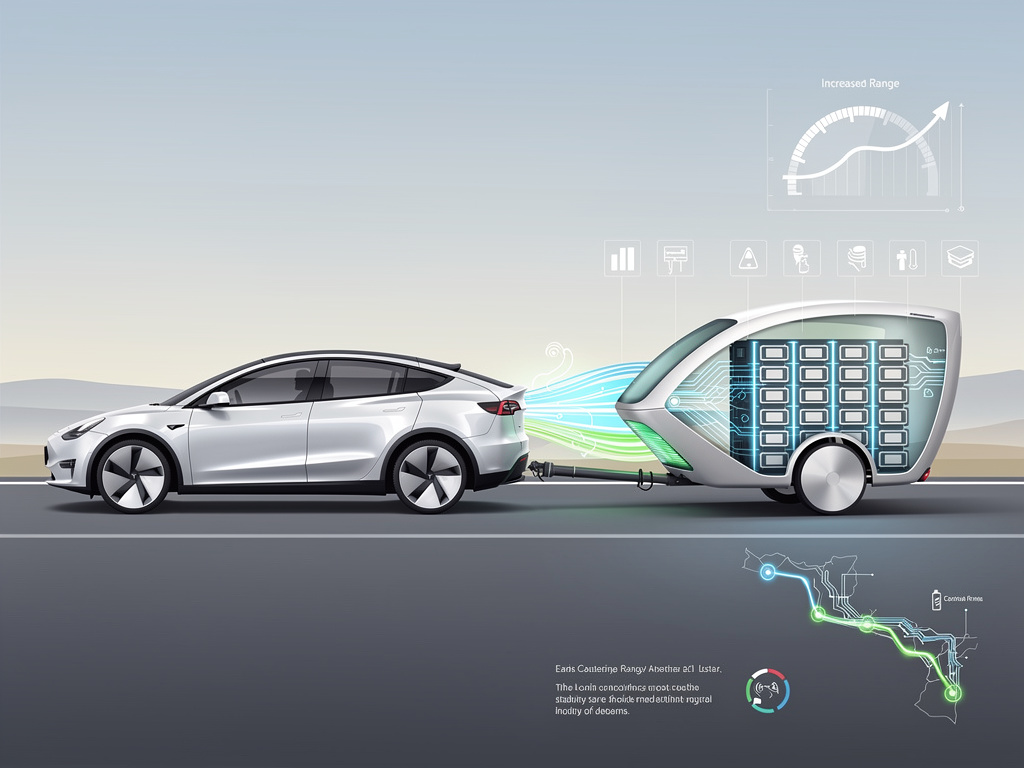
Tesla has filed a patent for a towable extended-range battery system equipped with a real-time control mechanism, a development that could fundamentally reshape how electric vehicle owners think about long-distance travel. The patent, which details a trailer-mounted supplemental battery pack that communicates dynamically with the host vehicle, represents one of the most pragmatic engineering solutions to emerge from the automaker’s R&D pipeline in recent years.
The filing describes a system in which a battery-laden trailer connects to a Tesla vehicle not just mechanically via a tow hitch, but electronically through an integrated control system. This control system would manage power distribution between the vehicle’s onboard battery and the trailer-mounted pack in real time, optimizing energy use based on driving conditions, terrain, speed, and destination requirements. According to MSN, the patent outlines a sophisticated communication protocol between the trailer and the vehicle’s existing battery management system, ensuring that energy flows efficiently between both power sources.
A Practical Answer to the Persistent Range Question
Range anxiety remains the single most cited barrier to EV adoption among American consumers. Despite Tesla’s flagship Model S Long Range offering an EPA-estimated range of over 400 miles on a single charge, many potential buyers — particularly those in rural areas or those who regularly tow recreational equipment — remain skeptical that current battery technology can meet their needs. A towable battery trailer addresses this concern directly, offering a modular solution that doesn’t require permanent modifications to the vehicle or a larger, heavier onboard battery pack.
The concept of a range-extending trailer is not entirely new. Several startups and aftermarket companies have explored similar ideas. But Tesla’s patent distinguishes itself through the sophistication of its proposed control system. Rather than simply dumping extra power into the vehicle’s drivetrain, the system described in the patent would actively monitor and adjust power delivery based on a host of variables. The trailer’s battery management system would communicate with the vehicle’s main computer, sharing data on state of charge, temperature, and discharge rates. This two-way data exchange would allow the vehicle to treat the trailer battery as a fully integrated extension of its own power system, rather than an external add-on.
Engineering Details Reveal Tesla’s Ambition Beyond the Cybertruck
The patent’s technical drawings and descriptions suggest that the system could be particularly well-suited for Tesla’s Cybertruck, which already features a tow hitch and was designed with towing capability as a core selling point. The Cybertruck’s estimated towing capacity of up to 11,000 pounds leaves substantial headroom for a battery trailer, which, depending on the energy density of the cells used, could weigh significantly less than a typical travel trailer or boat.
Industry analysts have noted that towing is one of the most energy-intensive activities for any vehicle, electric or otherwise. When a Tesla Cybertruck or Model X tows a conventional trailer, its range can drop by 30% to 50% or more, depending on the load and driving conditions. A battery trailer flips this calculus on its head: instead of draining range, the trailer would add to it. The net effect could be a vehicle that actually has more range while towing than it does driving unburdened — a counterintuitive but potentially transformative outcome for EV owners who need to haul cargo or equipment over long distances.
The Real-Time Control System Is the Key Innovation
What sets Tesla’s patent apart from earlier range-extender concepts is the real-time control architecture. As reported by MSN, the system would include sensors and processors on the trailer itself, capable of independently monitoring battery health, thermal conditions, and charge levels. This data would be transmitted to the vehicle’s central computer, which would then make decisions about when to draw power from the trailer, when to rely on the onboard pack, and how to balance loads to maximize total system efficiency and longevity.
This kind of intelligent power management is critical because lithium-ion batteries degrade faster under certain conditions — high temperatures, rapid discharge cycles, and deep discharges all accelerate wear. By distributing the load between two battery systems, the control architecture could extend the useful life of both the vehicle’s built-in pack and the trailer-mounted cells. Tesla’s patent language suggests the system could also incorporate regenerative braking from the trailer’s own axle, capturing kinetic energy during deceleration and feeding it back into the trailer’s battery. This would further improve overall system efficiency, particularly on hilly or mountainous routes.
Market Implications for Tesla and the Broader EV Industry
If Tesla brings this technology to market, it could open up entirely new use cases for electric vehicles. Contractors who need to drive long distances to job sites, recreational vehicle enthusiasts who want to tow campers without range penalties, and fleet operators managing delivery routes in regions with sparse charging infrastructure could all benefit from a modular, towable range extender.
The financial implications are significant as well. Tesla could sell or rent these battery trailers as accessories, creating a new recurring revenue stream. A rental model would be particularly appealing for consumers who only occasionally need extra range — for a cross-country road trip or a weekend camping excursion, for example. This approach would mirror the way some automakers and third-party companies already rent roof-mounted cargo carriers and other accessories, but with far higher per-unit revenue potential given the cost of battery cells.
Competition and Prior Art in the Range-Extender Space
Tesla is not operating in a vacuum. Companies like Nomad Battery Solutions and EP Tender have been developing towable battery trailers for several years. EP Tender, a French startup, demonstrated a working prototype as early as 2019, and Nomad has marketed its products specifically to the overlanding and off-grid camping community. However, none of these competitors have the scale, brand recognition, or vertical integration that Tesla commands. Tesla manufactures its own battery cells at its Gigafactories, designs its own battery management software, and controls the vehicle platform end-to-end. This gives the company a structural advantage in designing a trailer that works as a true extension of the vehicle rather than a bolted-on afterthought.
There are also regulatory considerations. Towable battery systems would need to meet federal safety standards for both trailers and battery storage. The National Highway Traffic Safety Administration (NHTSA) does not currently have specific regulations governing high-voltage battery trailers, which means Tesla and any competitors would likely need to work with regulators to establish new safety frameworks. This could slow commercialization, but it also means that whoever gets to market first could help shape the rules in their favor — a position Tesla has occupied before, most notably with its Supercharger network, which has become the de facto standard for EV fast charging in North America.
What the Patent Tells Us About Tesla’s Strategic Direction
Patent filings are not product announcements, and Tesla has a long history of patenting technologies that never make it into production vehicles. The company’s patent portfolio includes everything from laser windshield wipers to electromagnetic pulse protection systems, neither of which has appeared on a shipping vehicle. Still, the towable battery trailer patent is notable for its specificity and practical orientation. The filing includes detailed descriptions of connector types, communication protocols, and thermal management strategies — the kind of granular engineering detail that suggests the concept has progressed beyond the brainstorming phase.
CEO Elon Musk has not publicly commented on the patent, and Tesla’s communications team, which was effectively disbanded in 2020, did not respond to inquiries. But the filing aligns with Musk’s broader stated goal of making electric vehicles viable for every use case, not just urban commuting. In a 2023 earnings call, Musk emphasized that the Cybertruck was designed to be a “true work truck” capable of replacing gasoline-powered pickups in demanding applications. A towable range extender would bolster that claim considerably.
The Road from Patent to Product Remains Uncertain but Promising
For now, the towable extended-range battery remains a patent filing — a statement of intent rather than a product roadmap. But the underlying logic is sound. Battery costs continue to decline, energy density continues to improve, and consumer demand for longer-range EVs shows no signs of abating. If Tesla can deliver a well-engineered, reasonably priced battery trailer that integrates with its vehicles as described in the patent, it would address one of the most persistent criticisms of electric vehicles while creating a lucrative new product category.
The broader industry is watching closely. As EV adoption accelerates and automakers compete for buyers in the truck and SUV segments — where range and towing capability are paramount — the company that solves the range-while-towing problem will hold a significant competitive advantage. Tesla’s patent suggests it intends to be that company, and the engineering detail in the filing indicates the work is already well underway.


 WebProNews is an iEntry Publication