
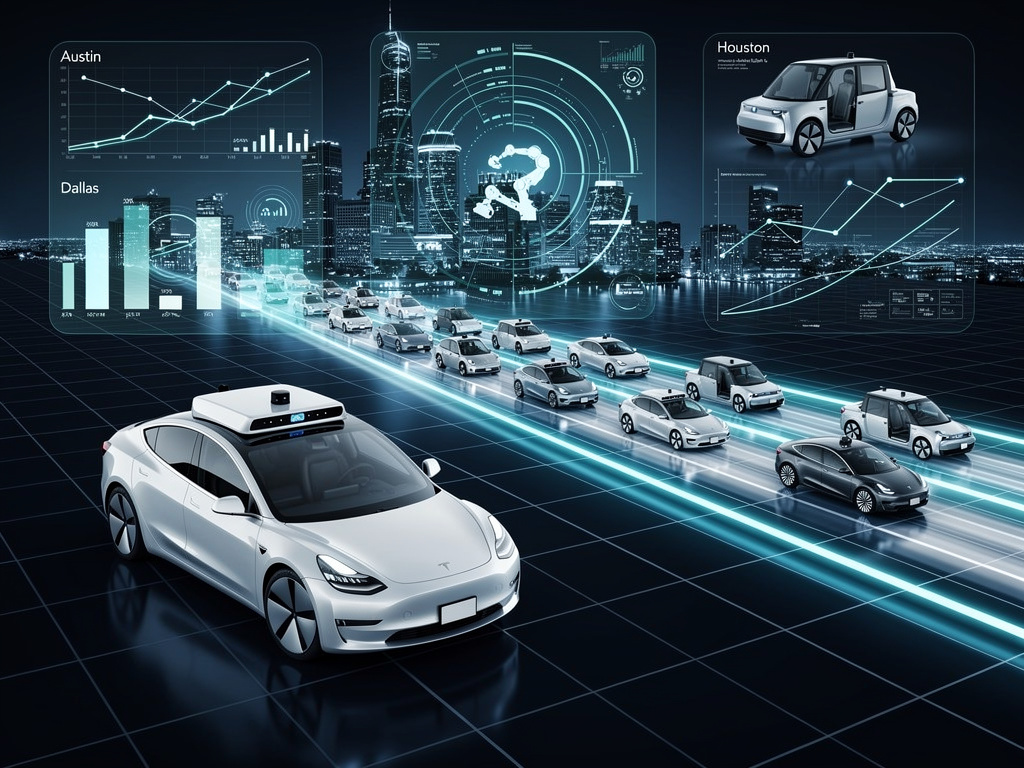
Elon Musk once talked of thousands of robotaxis on Texas roads within months of launch. New state data tells another story. As of mid-June, Tesla operates just 69 such vehicles statewide. That’s according to Texas Department of Motor Vehicles records analyzed by Bank of America and reported by Yahoo Finance.
Competitors dwarf that presence. Waymo runs 620. AVRide fields 317. Even smaller players like Nuro and Zoox post 47 and 35 vehicles respectively. The contrast hits harder when viewed against earlier projections. Last year Musk spoke of reaching 1,000 robotaxis in Texas quickly. Progress has been slower. Much slower.
But cheap. Tesla’s average ride costs about 20% less than rivals. One analysis pegged it at $10.90 versus $13.70 for competitors across sample routes. Wait times average 10 minutes. Not bad. Yet rivals often deliver in two to three. Operational friction remains.
Tesla began its Texas robotaxi service in Austin nearly a year ago. Initial deployments used 10 to 20 Model Y vehicles, many with safety drivers. By January 2026 the company removed those monitors in Austin. One car handled unsupervised rides at first. The fleet grew. Roughly 30 unsupervised vehicles now work Austin streets. Another dozen split between Dallas and Houston. Figures drawn from third-party tracking and confirmed in filings.
Reuters tests in those cities uncovered problems. Long waits. Limited vehicle availability. Navigation hiccups that left passengers blocks from intended drop-offs. The news agency documented these issues during expansion to Dallas and Houston. Tesla offered no comment at the time.
Regulatory changes add pressure. Texas lawmakers passed new rules signed by Governor Greg Abbott last year. Operators must secure permits and provide safety assurances starting September. The measures tighten oversight precisely as Tesla seeks scale. Earlier this month the company updated its authorization to 69 unsupervised vehicles. Up from 42 in May. A modest increase. Still far from the hundreds of thousands Musk has floated for broader self-driving deployment by year-end.
And the numbers fluctuate. Robotaxi Tracker data shows active unsupervised vehicles sometimes dipping recently despite publicized growth. Permission to operate does not guarantee constant service. Weather restrictions apply. Hours run from 6 a.m. to midnight or slightly later in some reports. The service remains invite-only in places. Influencers and select shareholders took early paid rides last summer. Public access has expanded unevenly.
Safety records draw mixed views. Tesla logged 18 minor incidents over its miles. That works out to one per 101,000 miles. Waymo shows one per 108,000. Yet Waymo reported injuries and a fatality in its larger operation. Tesla’s tally shows no such outcomes so far. Public trust lags. Surveys indicate 47% still express distrust in the technology. Figures from AlphaRoc tracking.
Bank of America analysts see method in the modest pace. “Tesla is sacrificing margin to accumulate data,” their note stated. The strategy prioritizes real-world miles over immediate profit. Early monetization remains limited. A sum-of-the-parts valuation model projects far into the 2040s before robotaxi contributions dominate. The bank maintains a buy rating with a $460 price target.
Meanwhile production of the dedicated Cybercab vehicle has begun. Musk confirmed output started at Giga Texas in recent months. Initial runs follow the familiar S-curve. Slow at first. Then exponential. The two-seater lacks steering wheel and pedals. EPA certification cleared the way for interstate commerce. Yet volume manufacturing will take time. Older Model Ys and 3s fill the current fleet. Retrofitting them for full autonomy requires hardware changes. Plans for micro factories surfaced but lack firm timelines.
China offers a different picture. Local firms like Baidu, Pony.ai and WeRide deploy at larger scales across multiple cities. Their progress highlights execution speed as much as technology. U.S. players excel in certain AI capabilities. Real-world density tells another tale. Tesla’s camera-only approach avoids lidar costs. That helps pricing. It also invites scrutiny when edge cases arise.
Recent weeks brought fresh coverage. InsideEVs detailed how the Texas fleet stayed under 50 cars for much of the past year. The outlet tracked the transition from supervised to unsupervised runs. It noted Musk’s earlier CNBC remarks promising rapid ramp-up that never fully materialized. Bloomberg first broke the 42-vehicle DMV disclosure in late May.
Regulatory filings now provide the clearest snapshot. Before new Texas rules took effect such counts stayed opaque. Tesla submitted its operator data under the updated law. The transparency helps observers. It also spotlights the distance left to travel.
Expansion continues. Four Texas cities host live service. Five more sit in pending status. San Francisco operations still include safety drivers. The mixed approach reflects caution. Musk has called the company “super paranoid about safety” when setting timelines. That mindset delayed the initial Austin public rides from tentative June 2025 targets. Service eventually rolled out in lower-key fashion.
Investors watch closely. Robotaxis form a pillar of Tesla’s long-term valuation. Optimistic models talk of billions in annual revenue once fleets reach hundreds of thousands or millions. Conservative views stress costs. Energy. Maintenance. Cleaning. Insurance. Utilization rates determine much of the math. Early Texas data offers limited insight. Demand appears steady among early users. Supply constrains growth.
So what comes next. Cybercab volume should accelerate later this year. Unsupervised miles will pile up. Data from those operations could sharpen the software. Regulators in other states eye Texas results. Success here might open doors. Setbacks could slow them.
Tesla’s bet rests on software scale. One update reaches every compatible vehicle. Rivals often build purpose-designed fleets with expensive sensors. The cost advantage is real. Yet reliability must match. Public confidence must follow. The 69 cars in Texas mark a beginning. Not the explosion many anticipated. The coming months will test whether that modest base can support the ambitious roadmap ahead.
Recent X discussions echo the surprise. Users noted few expected such limited unsupervised paid rides a full year after launch. Others point to China’s faster commercial deployments. The gap between promise and deployment persists. Tesla insists the foundation is solid. Data collection continues. Pricing stays aggressive. The question is whether patience among investors and riders holds until scale arrives.


 WebProNews is an iEntry Publication