
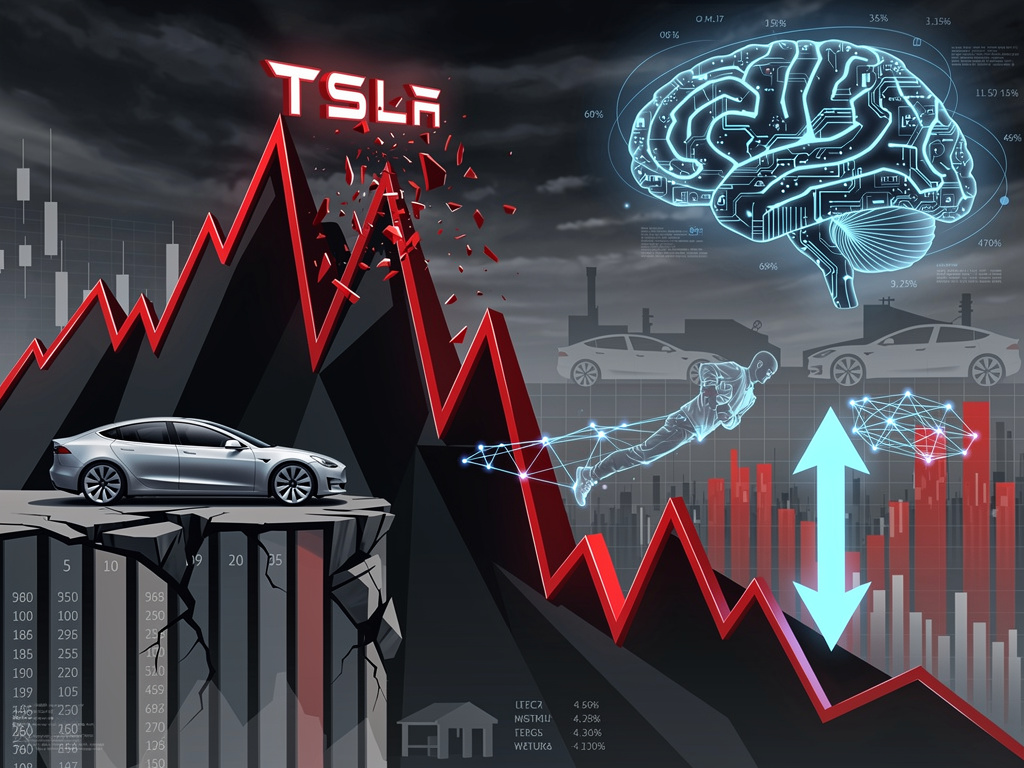
For years, Tesla Inc. has defied financial gravity, its soaring valuation a testament to a narrative of technological disruption and a future dominated by electric vehicles and artificial intelligence. But a growing chorus of skeptics argues the clock is about to strike midnight, with one market veteran forecasting a cataclysmic collapse that would wipe out nearly all of its market value. George Noble, a former fund manager with decades of experience, has laid out a starkly bearish case, predicting Tesla’s stock will plummet over 90% to just $12 a share, a level unseen in over a decade.
This dire forecast frames the central conflict roiling investors: Is Tesla a revolutionary AI and robotics company on the cusp of its next growth phase, or is it merely a “no-growth auto company” wrapped in the Emperor’s new clothes of a tech valuation? As Noble told Business Insider, he sees the electric vehicle maker as the “poster child” of an “epic bubble,” one whose deflation is not a matter of if, but when. The divergence between the company’s fundamentals and its stock price, he argues, has reached an unsustainable extreme.
The Anatomy of a Valuation Disconnect
At the heart of the bear thesis lies a fundamental valuation problem. Tesla currently trades at a forward price-to-earnings ratio of more than 50, a multiple typically reserved for high-growth software firms, not capital-intensive manufacturers. This valuation stands in stark contrast to automotive titans like Toyota, which trades at roughly 10 times forward earnings, and General Motors, at a modest 5 times. For critics, this premium is unjustifiable, particularly as Tesla’s once-explosive growth has ground to a halt. The company’s own performance metrics appear to bolster this argument, with its invincibility showing visible cracks.
The numbers have become difficult for even the most ardent bulls to ignore. In the first quarter of 2024, Tesla reported its first year-over-year decline in vehicle deliveries since the pandemic’s early days, with a drop of 8.5%, according to a report from Reuters. While deliveries ticked up in the second quarter, they still registered a slight year-over-year decline, as noted by CNBC. This stagnation directly challenges the narrative of a company in hyper-growth mode and raises questions about whether its valuation can withstand a transition to a more mature, and slower, phase of its life cycle.
A Rising Tide of Competition Floods the Market
For years, Tesla enjoyed a near-monopoly in the premium EV space, allowing it to command high prices and impressive profit margins. That era is definitively over. The most formidable challenge comes from China, where a legion of domestic manufacturers has emerged. Most notably, BYD, backed by Warren Buffett’s Berkshire Hathaway, surpassed Tesla as the world’s top seller of electric vehicles in the final quarter of 2023, a symbolic shift detailed by the Financial Times. This intense competition has ignited brutal price wars globally, forcing Tesla to slash prices and sacrifice the once-enviable margins that set it apart from legacy automakers.
The competitive pressure is not limited to a single rival. Legacy giants like Ford, Volkswagen, and Hyundai, alongside a host of other Chinese startups, are flooding the market with new EV models at various price points. While many of these competitors face their own profitability and production challenges, their collective presence is fundamentally altering the market. The electric vehicle is becoming commoditized, making it increasingly difficult for any single player, including Tesla, to maintain a technological or brand premium that justifies a valuation an order of magnitude higher than its peers.
Cracks in the Electric Dream
Beyond company-specific issues, the entire EV sector is navigating significant headwinds. The initial wave of enthusiastic early adopters has been largely saturated, and winning over the more pragmatic mainstream consumer is proving to be a tougher sell. Concerns over charging infrastructure, range anxiety, and higher upfront costs persist, while the resale value of used EVs has also come under pressure. This has led to a noticeable cooling of demand in key markets across North America and Europe, forcing automakers to recalibrate their ambitious production targets.
This slowdown in macro demand creates a perilous environment for a company valued on perpetual growth. Government subsidies, which helped supercharge the initial EV boom, are being scaled back in several countries, removing a crucial purchasing incentive. For Tesla, this means fighting for a slice of a pie that is not growing as quickly as once forecast, all while fending off an ever-increasing number of competitors. It is this challenging new reality that has bears like Noble convinced the company is on a collision course with its underlying fundamentals.
The Musk Factor: Visionary or Liability?
No discussion of Tesla is complete without addressing the role of its chief executive, Elon Musk. For bulls, he is the visionary genius whose ambition drives the company’s innovation. For bears, he represents an increasingly volatile “key man risk.” Critics argue that his acquisition of and subsequent focus on X (formerly Twitter), coupled with his polarizing political commentary, have become significant distractions that not only divert his attention but also alienate a segment of potential Tesla customers. This adds a layer of brand and governance risk that is difficult to quantify but impossible to ignore.
Shareholders recently delivered a vote of confidence by re-approving his controversial $56 billion compensation package, a move bulls hailed as a clear mandate for his continued leadership, as reported by The Wall Street Journal. Yet, the narrative from Mr. Musk himself has pivoted sharply. Less emphasis is placed on vehicle delivery targets and more on a future defined by artificial intelligence, humanoid robots, and, most imminently, a self-driving Robotaxi. To skeptics, this shift seems like a convenient attempt to divert attention from the deteriorating performance of the core auto business and re-anchor the company’s valuation to a speculative, unproven future.
Echoes of Bubbles Past
The parallels to previous market manias are a recurring theme in the bearish camp. Mr. Noble explicitly compares Tesla’s situation to that of tech darlings during the dot-com bubble of the late 1990s, such as Cisco and Qualcomm. Those were real companies with real products and revenues, but their stock prices were bid up to astronomical levels based on projections of market dominance that never fully materialized. When the bubble burst, their stocks crashed, taking years to recover, if they ever did. The fear is that Tesla is following a similar script.
The broader economic environment further complicates the picture. The era of near-zero interest rates that fueled a decade of speculation in high-growth, long-duration assets is over. In a world of higher capital costs, investors are demanding profitability and tangible cash flow now, not promises of a distant, autonomous future. This macro shift makes companies like Tesla, whose valuation is heavily weighted toward future earnings, particularly vulnerable to a severe correction if they fail to deliver on their ambitious promises.
The Path Forward and the Bull’s Defense
Despite the litany of concerns, dismissing Tesla would be a mistake. The bull case has simply evolved. It is no longer about selling 20 million cars a year; it is about monetizing a fleet of vehicles through autonomous software, creating a ride-hailing network that renders car ownership obsolete, and leveraging its AI expertise to build humanoid robots like Optimus. The company’s upcoming “Robotaxi Day” on August 8 is being positioned as a pivotal moment, a chance for Mr. Musk to prove that the next chapter of the Tesla story is even more revolutionary than the first.
Ultimately, Tesla’s future trajectory hinges on a single, crucial question: Can it successfully execute a transformation from a car company facing slowing growth and fierce competition into a dominant AI and robotics platform? If it succeeds, the current valuation might one day look reasonable. But if the Robotaxi future proves to be a mirage and Tesla is judged solely on its merits as an automaker, the brutal valuation reset predicted by investors like George Noble may no longer seem like a fringe theory, but an inevitable reckoning.


 WebProNews is an iEntry Publication