
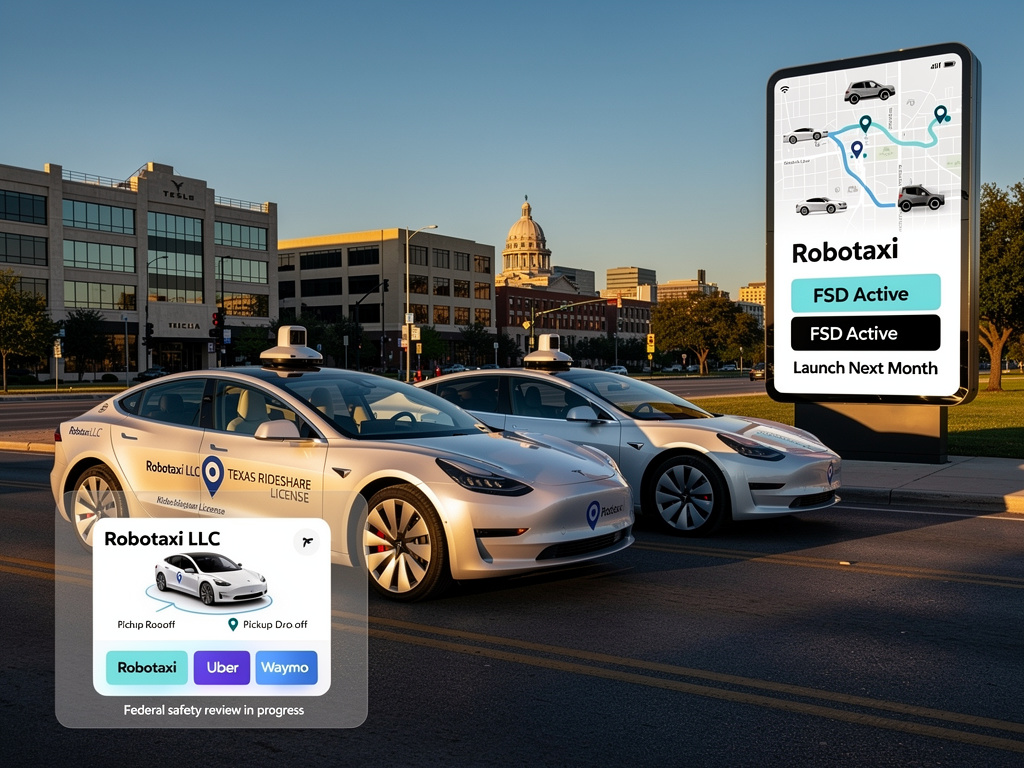
Tesla Inc. has cleared a major regulatory hurdle in its drive toward autonomous ride-hailing dominance, securing a rideshare license in Texas that paves the way for opening its Robotaxi service to the general public next month. Through its newly formed subsidiary, Tesla Robotaxi LLC, the electric-vehicle maker is now listed as a licensed transportation network company by the Texas Department of Licensing and Regulation, placing it alongside Uber Technologies Inc. and Lyft Inc. The permit, valid until August 6, 2026, aligns with a new state law effective September 1, 2025, that subjects autonomous rideshare operations to the same rules as human-driven services.
Elon Musk, Tesla’s chief executive, announced on X that the company will expand access in Austin to anyone starting in September 2025. “It will be open access next month,” Mr. Musk posted on August 11, 2025, as reported by Not a Tesla App. This move follows a limited beta launch in June 2025, where Model Y vehicles equipped with supervised Full Self-Driving software ferried invited guests around Austin, marking Tesla’s first foray into paid autonomous rides.
Regulatory Framework Levels the Field
The Texas law mandates compliance with state traffic laws, installation of recording devices, adherence to federal motor vehicle safety standards, capability to reach a ‘minimal risk condition’ if the automated system fails, and proper vehicle registration, titling, and insurance. Tesla had preemptively integrated these features into its Robotaxi Network, allowing seamless transition to public operations, according to Not a Tesla App. Prior to the law’s enactment, some Democratic state lawmakers urged Tesla to delay its Austin rollout until compliance was formalized, as noted by Business Insider.
The license does not yet explicitly classify Tesla’s vehicles as fully autonomous without human oversight, requiring potential additional approvals from the Texas Department of Motor Vehicles for unsupervised operations. Still, it enables statewide expansion beyond Austin’s geofenced zones, where testing has already extended to areas like Georgetown, 30 miles north, per TeslaNorth.com.
Rapid Iterations Build Momentum
Since its June launch, Tesla has rolled out swift updates to the Robotaxi app, initially available only via Apple’s TestFlight for iPhones to invited users. Milestones include adding pickup adjustments on day 13, doubling the service area on day 14—surpassing Waymo’s footprint—introducing destination editing and walking directions, raising fares from $4.20 to $6.90, implementing smarter pickups by day 21, and launching dynamic pricing on day 31 that remains cheaper than rivals, as detailed by Not a Tesla App. By day 32, the service debuted in the San Francisco Bay Area with safety drivers and higher fares.
Mr. Musk highlighted that the Full Self-Driving software on Robotaxis is ‘about six months more advanced’ than versions on consumer vehicles, with a major update featuring a 10x parameter increase slated for September. Recent software release 2025.45.9 brought FSD v14.2.2.4, refining smoothness, navigation, lane discipline, and decision-making at stop signs.
Federal Scrutiny Shadows State Wins
The National Highway Traffic Safety Administration contacted Tesla in July 2025 to request a ride in its Austin Robotaxi service, receiving confidential information in response, according to Eletric-Vehicles.com. Videos have captured Robotaxis occasionally disobeying traffic rules, drawing federal attention amid broader probes into Tesla’s autonomy claims, as reported by CNBC.
In Texas, the permit positions Tesla to challenge Waymo, which operates in Austin via Uber, and traditional players. Early data shows Tesla’s per-mile rates at about 50% below Uber’s, potentially disrupting pricing dynamics, per WebProNews. Expansion plans target a 10x service area increase in Austin and rollouts to cities like Houston, with Cybercab production eyed for 2026 to bolster fleets.
Strategic Edge in Autonomy Race
Tesla’s approach relies on camera-only vision and vast real-world data from its vehicle fleet, contrasting with lidar-dependent rivals. Mr. Musk envisions Robotaxi serving half the U.S. population by year-end, framing it as a high-margin core business. Analysts see the Texas approval as incremental progress toward $330 share targets, though execution on safety and scale remains key, as per WebProNews.
Legal challenges persist, including a $200 million verdict in a fatal Autopilot crash and shareholder suits over self-driving hype, noted by NotebookCheck. Yet, Texas’s innovation-friendly rules could influence other states, accelerating Tesla’s national push amid a projected $230 billion ride-hailing market by 2030.
Path to Nationwide Dominance
With the app poised for App Store release and Android support, public access could begin within weeks. Sightings of Robotaxis navigating busy Austin traffic demonstrate growing reliability. As Tesla bridges beta to broad deployment, industry watchers anticipate intensified competition and regulatory evolution, cementing Texas as ground zero for the driverless revolution.


 WebProNews is an iEntry Publication