
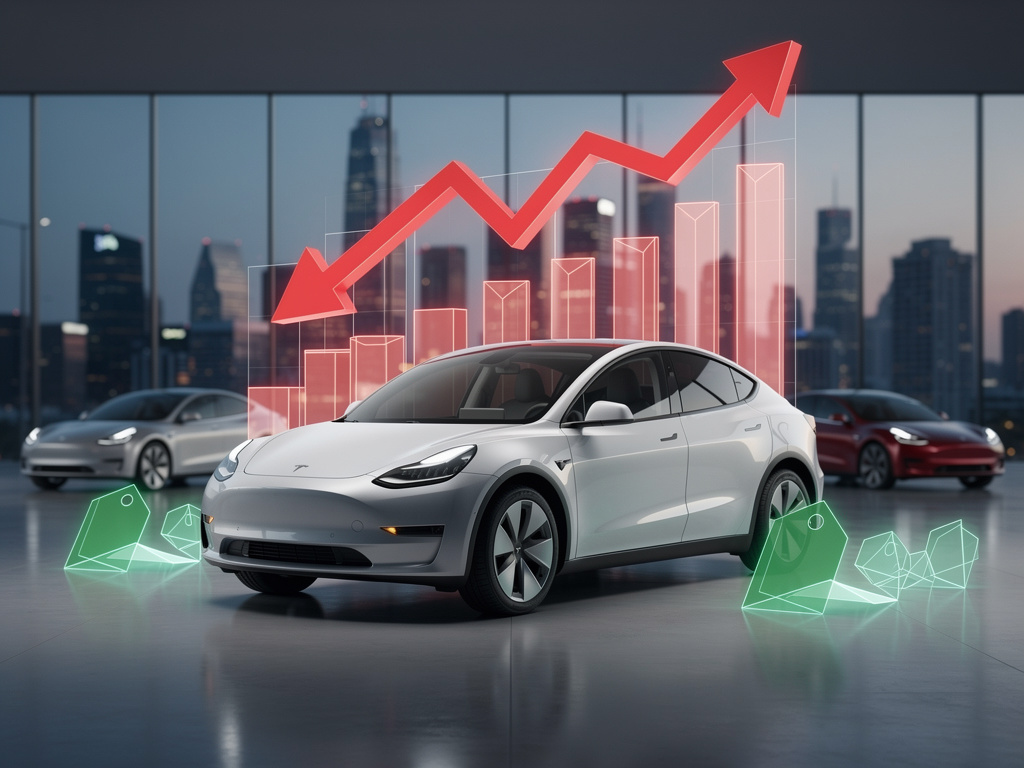
Tesla Inc. finds itself at a critical juncture as the electric vehicle manufacturer confronts its most significant sales challenge in years. The company’s response—introducing a more affordable all-wheel-drive Model Y variant in the United States—represents a calculated gamble to recapture momentum in an increasingly competitive market where traditional automakers and new entrants alike are eroding its once-dominant position.
According to TechRadar, Tesla’s sales figures have experienced a notable decline, prompting the automaker to take decisive action. The new all-wheel-drive Model Y configuration arrives at a lower price point than previous AWD offerings, a move that signals Tesla’s willingness to compress margins in exchange for volume—a strategy that would have seemed unthinkable during the company’s supply-constrained years when vehicles commanded premium prices and waiting lists stretched for months.
The timing of this strategic shift reflects broader challenges facing the electric vehicle sector. While Tesla maintained its position as the world’s leading EV manufacturer, its market share has steadily eroded as competitors from both legacy automakers and emerging Chinese manufacturers have flooded the market with compelling alternatives. The company’s first-quarter 2024 delivery numbers revealed a year-over-year decline, the first such drop in nearly four years, sending shockwaves through investor communities and raising questions about whether Tesla’s growth trajectory has permanently shifted.
The Price War Intensifies Across Global Markets
Tesla’s pricing strategy has undergone radical transformation over the past eighteen months. The company has implemented multiple price reductions across its entire lineup, with some models seeing cuts exceeding 20% from their peak prices. This aggressive pricing approach has drawn criticism from existing Tesla owners who watched their vehicles’ resale values plummet, while simultaneously failing to generate the sales surge company leadership anticipated. The introduction of the cheaper AWD Model Y represents the latest iteration of this price-focused strategy, targeting consumers who desire the performance and safety benefits of all-wheel drive without the premium traditionally associated with such configurations.
Industry analysts have noted that Tesla’s pricing power—once considered one of its most formidable competitive advantages—has diminished considerably. Where the company previously commanded premium pricing based on technological superiority, brand cachet, and limited competition, today’s market presents consumers with numerous viable alternatives. Ford’s Mustang Mach-E, Hyundai’s Ioniq 5, and Volkswagen’s ID.4 all compete directly with the Model Y, while luxury offerings from Mercedes-Benz, BMW, and Audi target the premium segment Tesla once dominated unchallenged.
Manufacturing Efficiency Meets Market Reality
Tesla’s ability to reduce prices while maintaining profitability stems largely from manufacturing innovations that have dramatically reduced production costs. The company’s implementation of large-scale casting processes, elimination of numerous parts through design simplification, and vertical integration of battery production have created cost structures that traditional automakers struggle to match. However, these efficiency gains have not translated into sustained sales growth, suggesting that price alone cannot overcome the headwinds the company currently faces.
The new AWD Model Y variant leverages these manufacturing efficiencies to deliver a product that would have been economically unfeasible just years ago. By optimizing the powertrain configuration and streamlining options packages, Tesla has created a vehicle that offers dual-motor performance at a price point previously reserved for single-motor variants. This approach mirrors strategies employed by traditional automakers who have long used packaging and trim level manipulation to capture different market segments, a practice Tesla historically eschewed in favor of simplified product offerings.
Brand Perception and Political Headwinds
Beyond pricing and competition, Tesla confronts challenges related to brand perception and its CEO’s increasingly polarizing public profile. Elon Musk’s acquisition of Twitter, now rebranded as X, and his subsequent political commentary have alienated portions of Tesla’s traditionally progressive customer base. Consumer sentiment surveys have revealed declining purchase intent among demographics that previously formed Tesla’s core market, with some potential buyers explicitly citing Musk’s public statements as factors in their decision to consider alternative brands.
This reputational challenge compounds the company’s sales difficulties in ways that pricing adjustments alone cannot address. While Tesla’s vehicles remain technologically competitive and increasingly affordable, the emotional connection that once drove brand loyalty has frayed for some consumers. The company’s direct-sales model, which eliminates traditional dealership networks, means Tesla cannot rely on local dealer relationships to buffer against corporate-level brand concerns, making it particularly vulnerable to shifts in consumer sentiment toward the company and its leadership.
The Chinese Market Conundrum
Tesla’s challenges extend beyond North American borders, with particularly acute difficulties emerging in China, the world’s largest automotive market. Chinese manufacturers including BYD, Nio, and Xpeng have rapidly advanced their technological capabilities while leveraging domestic supply chains to achieve price points that undercut Tesla’s offerings. BYD, in particular, has emerged as a formidable competitor, surpassing Tesla in quarterly EV sales and demonstrating that Chinese manufacturers can compete on quality and innovation, not merely price.
The competitive intensity in China has forced Tesla to implement even more aggressive pricing strategies in that market, with some models selling for substantially less than their U.S. equivalents. However, these price reductions have failed to stem market share losses, as Chinese consumers increasingly view domestic brands as equally sophisticated alternatives that better understand local preferences and offer superior customer service through extensive dealer networks. The Shanghai Gigafactory, once viewed as Tesla’s strategic masterstroke for accessing the Chinese market, now operates in an environment far more challenging than company planners anticipated when construction began.
Technological Innovation and Product Pipeline Questions
As Tesla battles immediate sales challenges through pricing strategies, questions persist about its longer-term product pipeline and technological roadmap. The company’s promised Cybertruck has finally entered limited production, years behind original timelines, while the long-anticipated affordable Model 2 or Model Q remains in development limbo. Meanwhile, competitors have accelerated their product cadences, introducing new models and refreshing existing ones at rates that make Tesla’s lineup appear increasingly dated despite over-the-air software updates that provide continuous improvements to existing vehicles.
The company’s focus on autonomous driving technology and robotaxi ambitions, while potentially transformative, has diverted resources and attention from core product development at a time when market conditions demand fresh offerings. Tesla’s Full Self-Driving software, despite years of development and premium pricing, remains a Level 2 driver assistance system requiring constant human supervision, falling short of the revolutionary capabilities Musk has repeatedly promised. This gap between promise and delivery has contributed to skepticism among some investors and consumers about whether Tesla can maintain its innovation edge.
Financial Implications and Investor Sentiment
The introduction of a cheaper AWD Model Y carries significant implications for Tesla’s financial performance. While increased sales volumes could offset reduced per-unit margins, the strategy risks establishing a lower pricing baseline that becomes difficult to reverse. Tesla’s industry-leading profit margins, which have historically justified its premium valuation multiples, face compression as the company prioritizes volume over pricing power. Investors have responded with concern, as evidenced by stock price volatility and analyst downgrades that question whether Tesla can sustain both its growth rates and profitability simultaneously.
The company’s valuation remains predicated largely on expectations of exponential growth and eventual dominance of autonomous vehicle technology, rather than its current position as a profitable but slowing automotive manufacturer. As sales growth decelerates and margins compress, this valuation framework faces increasing scrutiny. Traditional automotive companies trade at single-digit price-to-earnings multiples, while Tesla’s ratio, despite recent declines, remains substantially elevated based on future growth assumptions that appear increasingly optimistic given current market dynamics.
Strategic Options and Path Forward
Tesla’s introduction of the more affordable AWD Model Y represents a tactical response to immediate sales pressures, but the company’s longer-term strategic direction remains uncertain. The automaker must balance multiple competing priorities: maintaining technological leadership, expanding production capacity, developing new models, advancing autonomous driving capabilities, and defending market share across diverse global markets. Each of these objectives requires substantial capital investment and management attention, creating resource allocation challenges that will define the company’s trajectory.
The success of the pricing strategy will ultimately depend on whether lower prices can generate sufficient volume increases to offset margin compression while simultaneously not training consumers to expect continuous price reductions. Tesla’s brand, built on premium positioning and technological superiority, risks dilution if the company becomes perceived primarily as a value-oriented manufacturer. Conversely, maintaining premium pricing in the face of intensifying competition could accelerate market share losses to competitors offering comparable technology at lower prices. This tension between volume and margin, familiar to every automotive manufacturer, now confronts Tesla as it transitions from disruptive upstart to established industry player facing the challenges inherent to mature market competition.


 WebProNews is an iEntry Publication