
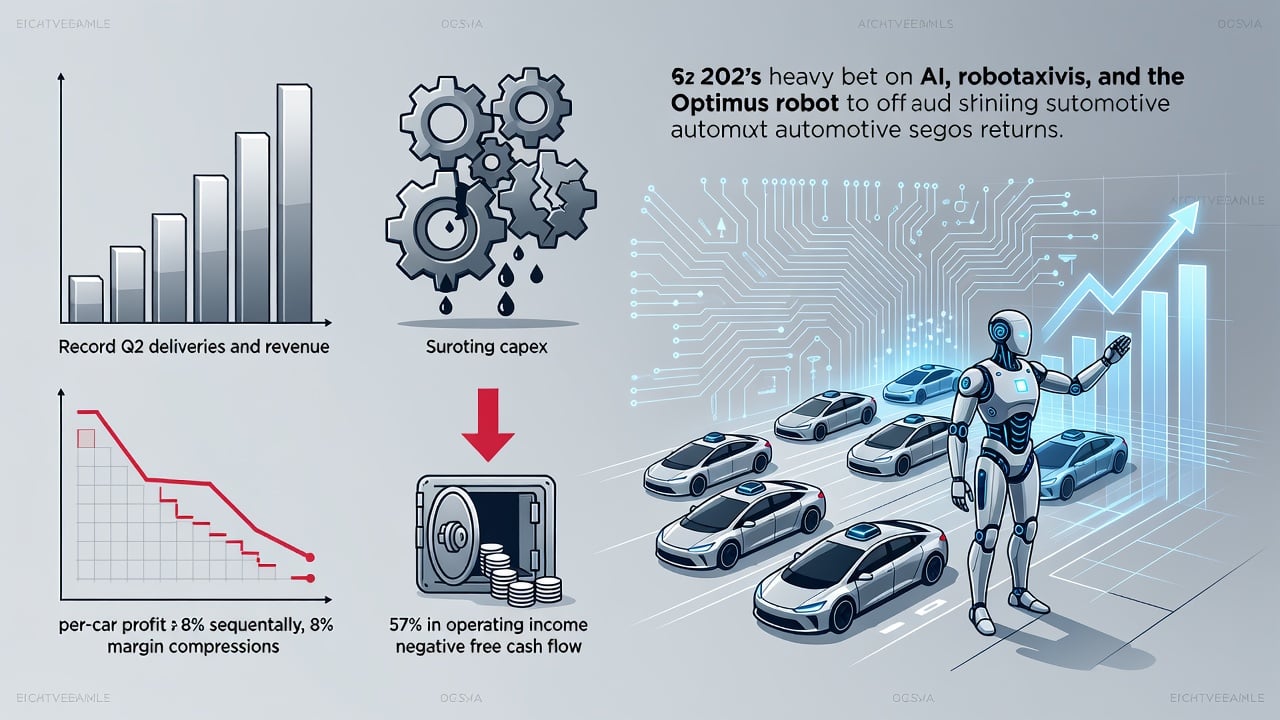
Tesla delivered a record 480,126 vehicles in the second quarter. Revenue climbed 26 percent to $28.24 billion, beating Wall Street forecasts. Yet operating income plunged 57 percent to $398 million. The operating margin contracted to 1.4 percent. And free cash flow swung negative by $1.1 billion.
Those numbers tell two stories. One of volume strength in a tough market. Another of profitability under siege. The Motley Fool reported that per-car profit fell another 8 percent last quarter. Average revenue per vehicle dropped. Production costs climbed. The result? Less money made on each car sold. Motley Fool.
But why? Tesla’s official Q2 2026 update pins part of the blame on lower average selling prices. Regulatory credit sales shrank to $146 million from $439 million a year earlier. Operating expenses jumped 47 percent to $4.35 billion. Much of that surge went to artificial intelligence projects, stock-based compensation, and general costs. Tesla Q2 2026 Update.
Automotive gross margin excluding regulatory credits landed at 16.3 percent. That’s down from 19.2 percent in the first quarter. Management noted a $230 million benefit from the prior period that didn’t repeat. Energy warranty charges rose too because of a vendor cell issue. The core car business still grew. Services and energy segments posted records. Yet the math no longer adds up the way it once did.
CNBC detailed the earnings miss in stark terms. Adjusted earnings per share came in at 33 cents. Analysts expected 51 cents. Net income fell 5 percent to $1.11 billion. Shares dropped nearly 4 percent in after-hours trading. Investors didn’t buy the narrative of future upside. Not when capital spending keeps accelerating. CNBC.
Elon Musk and chief financial officer Vaibhav Taneja spent much of the earnings call talking about the shift. Tesla has entered its largest investment phase yet. Capital expenditures hit $5.79 billion in the quarter alone. The company now guides for more than $25 billion for the full year. That money builds AI compute clusters, advances Optimus humanoid robots, and scales Cybercab production.
Cybercab output began at Giga Texas. Unsupervised robotaxi rides launched in additional Florida cities. Full Self-Driving subscriptions reached 1.48 million. More than 55 percent of North American deliveries now include them. Paid robotaxi miles topped 2.5 million. These metrics show progress. They don’t yet offset the cash burn.
Yahoo Finance captured the tension. Record deliveries of 480,126 vehicles drove the revenue beat. But free cash flow turned negative for the first time in two years. Operating margin compression reflected aggressive pricing and higher research costs. The unrealized $1 billion gain on a SpaceX investment helped GAAP net income. Tesla stripped it out for non-GAAP results. Yahoo Finance.
NDTV highlighted the 12 percent drop in quarterly profit. Research and development spending rose 49 percent. Musk’s focus on robotaxis and AI infrastructure explains much of the redirection. Energy storage deployments reached 13.5 gigawatt-hours. Services gross profit hit records at 14 percent margin. These bright spots exist. The car segment carries the weight.
InsideEVs calculated the per-vehicle pressure directly. Average revenue per vehicle fell to roughly $42,730. That’s down from $45,345 the year before. Regulatory credits contributed far less. Automotive gross margin ex-credits slid to 16.3 percent. The publication noted that higher volumes should have improved efficiency. Instead price cuts passed savings to buyers. InsideEVs.
Investing.com reported similar compression. GAAP operating income fell 57 percent. The margin narrowed by 269 basis points. Stock-based compensation tied to the 2025 CEO performance award added to the expense line. Tesla’s balance sheet still shows $43.5 billion in cash and equivalents. Liquidity remains ample. The question is how long that cushion lasts under sustained negative free cash flow.
Recent commentary on X reflects the split in sentiment. One user noted that car sales rose yet net profit declined because of huge capital expenditures for robotaxis and Optimus. Another pointed to Waymo’s ride economics as a benchmark. Tesla bulls speak of $20,000 annual profit per robotaxi at scale. Skeptics highlight current subsidies and uncertain utilization. Those debates played out in real time as the stock reacted.
The Guardian observed that profits slid despite growing revenue as the company pivots harder toward autonomy. Shares fell over 3 percent after the release. Last year’s second quarter looked shaky too. This time the scale of investment feels different. Taneja told analysts that operating expenses would continue to grow. Commodity costs and interest rates added further pressure.
TT News flagged the first negative free cash flow quarter in more than two years. The $1.09 billion burn came as capital expenditures more than doubled. Automotive margins suffered from lower average selling prices. Energy storage continues its ramp. Megapack production at new facilities should help later. Near term the spending outweighs the gains.
Seeking Alpha’s preview proved prescient. The firm warned of deteriorating demand quality amid heavy incentives. Negative free cash flow projections for 2026 and 2027 looked realistic. Tesla’s valuation still prices in success for robotaxis, Optimus, and supervised-to-unsupervised full self-driving. Execution risk remains high. Competition from Chinese makers like BYD adds another layer. BYD delivered 557,000 battery electric vehicles in the quarter while expanding into Europe.
Tesla’s update strikes an optimistic tone anyway. “We are in our largest and most exciting period of investment,” it states. “Scaling will be non-linear.” Management expects hardware profits to pair with accelerating AI, software, and fleet-based earnings over time. Optimus production lines are installed at Fremont. Semiconductor work advances. The portfolio focuses on using existing factories before adding new ones.
Yet history shows these transitions take longer than hoped. Full self-driving has faced repeated delays. Robotaxi events have slipped. Regulatory approvals vary by region. Energy and services provide genuine diversification. They generated record margins this quarter. Services gross profit rose sequentially by $302 million. Energy deployments grew 41 percent.
The per-car profit trend worries industry watchers most. An 8 percent sequential drop follows prior declines. If pricing pressure from competitors persists, the automotive foundation weakens. Tesla once commanded premium margins through technology and brand. Now it discounts to move volume. That strategy lifts deliveries. It squeezes the bottom line.
ARK Invest bought roughly $51 million of shares after the selloff. Cathie Wood’s firm maintains strong conviction in the AI bet. Other investors sold. The stock closed down nearly 2 percent the day after earnings amid broader technology weakness. Treasury yields rose. Nasdaq felt the pinch.
So what happens next? Tesla plans to launch a three-row Model Y variant in 2027. It continues to refine the lineup for cost and scale. Cybercab volume production aims for meaningful output in 2027. Optimus targets limited production later this year. Each initiative carries substantial spending before any payoff.
Analysts remain divided. Some see the current valuation as dependent on unproven autonomy revenue. Others argue the cash burn funds a once-in-a-generation opportunity. Tesla generated over $100 billion in trailing twelve-month revenue. Its vehicle fleet grows. Data from that fleet improves AI models daily.
The coming quarters will test whether those investments deliver. Margin recovery depends on cost discipline, regulatory credit stabilization, and successful monetization of software. Free cash flow must turn positive again to fund the roadmap without dilution or debt spikes. For now the numbers show a company sacrificing today’s car profits for tomorrow’s potential. The market’s reaction suggests many doubt the payoff will arrive soon enough.
Recent coverage from Reuters echoes older concerns about tariffs and fading credits. Though focused on prior periods, the themes persist. Lower-cost variants of Model Y and Model 3 aim to boost volume further. Those moves risk additional margin erosion if not managed tightly. Reuters.
Brad Munchen’s Substack analysis went further. It described Tesla as close to generating losses once the SpaceX gain and minimal credits are stripped away. Operating margin hit just 0.7 percent on that basis. Quarterly sales stood near record levels. The compression looks structural rather than temporary.
Electrek summarized the results cleanly. Revenue beat comfortably. Non-GAAP earnings missed badly. The gap between top-line success and bottom-line disappointment has rarely looked wider. Musk’s vision pulls the company toward an AI and robotics future. Wall Street still wants evidence that the car business can fund the journey without bleeding out.


 WebProNews is an iEntry Publication