
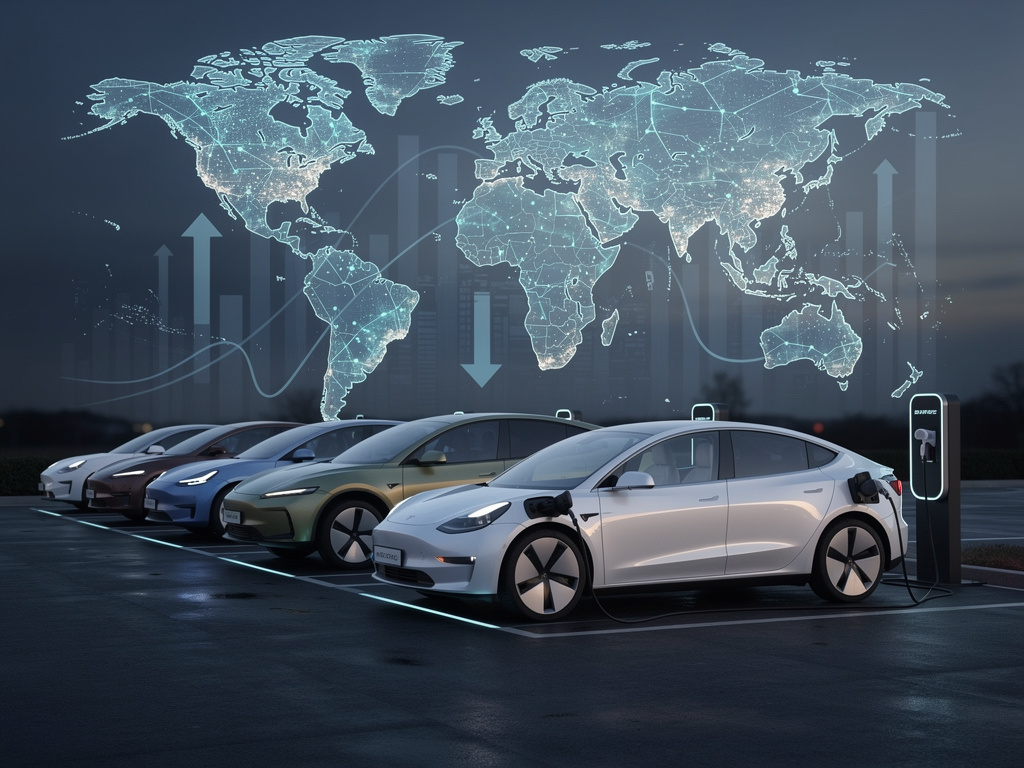
Tesla appears to be developing a smaller, more affordable electric SUV — a vehicle that could reshape its product lineup and answer mounting competitive pressure from Chinese automakers, particularly BYD, whose global expansion has begun to eat into Tesla’s dominance in key markets.
The evidence is circumstantial but growing. According to Engadget, references to a previously unknown vehicle code-named “Model Q” have surfaced in Tesla’s own data, suggesting the company is working on a compact crossover positioned below the Model Y in both size and price. The vehicle would reportedly target a price point around $30,000 — a threshold Tesla has long promised but never delivered.
That number matters enormously. It’s the price range where most Americans actually buy cars.
Tesla’s cheapest current offering, the Model 3, starts at roughly $38,990 before any federal tax credits. The Model Y, which became the best-selling vehicle on Earth in 2023 regardless of powertrain, begins at around $44,990. Both vehicles have drifted upward in price over the past two years, even as Elon Musk has repeatedly talked about making EVs accessible to the mass market. A $30,000 compact SUV would represent the first genuine attempt to fulfill that promise — and it couldn’t come at a more critical time for the company.
Tesla’s sales have been under pressure. First-quarter 2025 deliveries fell sharply compared to the same period last year, a decline the company attributed to factory retooling for a refreshed Model Y but that analysts also linked to brand damage from Musk’s polarizing political activities and the broader slowdown in EV adoption growth rates across North America and Europe. The stock, while still commanding a premium valuation that baffles traditional auto analysts, has been volatile. Investors want a growth story. A cheaper vehicle could provide one.
The compact SUV segment is where the volume lives. Americans have spent the past decade abandoning sedans in favor of crossovers and small SUVs, and that preference shows no sign of reversing. Vehicles like the Toyota RAV4, Honda CR-V, and Hyundai Tucson consistently rank among the top sellers in the country. An electric competitor priced at $30,000 — or effectively around $22,500 after the full $7,500 federal tax credit, if Tesla can structure the vehicle’s battery sourcing to qualify — would undercut nearly every comparable gasoline-powered crossover on the market.
That’s the kind of math that could accelerate EV adoption far faster than any government mandate.
But Tesla faces a formidable obstacle it didn’t have five years ago: BYD. The Shenzhen-based automaker has surged past Tesla in total vehicle sales (including hybrids) and is now aggressively expanding beyond China into Southeast Asia, Europe, Latin America, and even making exploratory moves toward the United States. BYD’s Seagull, a compact electric hatchback, sells for as little as $10,000 in China. Even with the steep tariffs currently imposed on Chinese EVs entering the U.S. — tariffs that the Biden administration raised to 100% and the Trump administration has maintained — BYD’s cost advantage is staggering. The company manufactures its own batteries, controls vast portions of its supply chain, and operates in a domestic market where brutal price competition has driven margins razor-thin for everyone except BYD itself.
Tesla’s answer, at least in part, seems to be this compact SUV. The company has been investing heavily in manufacturing efficiency. Its “unboxed” production process, first discussed at the 2023 Investor Day, promises to dramatically reduce the complexity and cost of assembling vehicles by building sub-assemblies separately and combining them late in the process, rather than welding a traditional body-in-white and then stuffing components inside. If Tesla can apply this method to a smaller, simpler vehicle, the cost savings could be substantial enough to make a $30,000 price tag profitable — something that would be nearly impossible using the company’s current manufacturing approach.
The timing of any launch remains unclear. Tesla has not officially confirmed the Model Q or whatever the compact SUV will ultimately be called. Musk has a well-documented history of announcing ambitious timelines and missing them by years. The Cybertruck was unveiled in 2019 and didn’t reach customers until late 2023. The Tesla Semi, first shown in 2017, is still not in volume production. The Roadster, promised for 2020, doesn’t exist yet. So any projections about when a sub-$30,000 Tesla might actually reach driveways should be treated with healthy skepticism.
Still, the strategic logic is sound. Tesla’s current lineup has a gap at the bottom. The Model 3 and Model Y compete in the mid-market, the Model S and Model X serve the luxury tier, and the Cybertruck occupies its own peculiar niche. There’s nothing for the buyer who wants an EV but can’t or won’t spend $40,000. That buyer currently has limited options — the Chevrolet Equinox EV, starting around $33,000, is the most notable — and Tesla has brand cachet that could pull enormous demand if the price is right.
The Supercharger network is another advantage. Despite Musk’s controversial decision to lay off much of the Supercharger team in 2024 — a move that temporarily spooked the industry and rival automakers who had adopted Tesla’s NACS charging standard — the network remains the most extensive and reliable fast-charging infrastructure in North America. For a first-time EV buyer considering a $30,000 compact SUV, the knowledge that Tesla’s charging network exists and works is a powerful sales tool. It removes one of the last major objections.
Competition won’t stand still. Hyundai and Kia have been aggressive with their electric offerings, and the Hyundai Ioniq 5 has earned widespread praise. General Motors is pushing hard on affordable EVs, with the Equinox EV and a forthcoming electric Bolt. Ford, despite scaling back some of its EV ambitions, remains committed to an electric future for its most popular models. And then there are the Chinese automakers — not just BYD, but also NIO, Xpeng, and others — who are building vehicles that are technologically sophisticated and astonishingly cheap by Western standards.
The tariff wall around the U.S. market provides Tesla with some protection. For now. But tariffs are political instruments, subject to change with administrations and trade negotiations. Tesla can’t assume that wall will hold forever, and the company’s leadership knows it. Building a vehicle that can compete on price and desirability — not just on the absence of foreign competition — is the smarter long-term play.
There’s also the question of what a compact Tesla SUV means for the company’s energy and autonomy ambitions. Every Tesla sold is a potential node in the company’s planned autonomous ride-hailing network, a data source for its Full Self-Driving software, and a potential customer for Tesla Energy products like the Powerwall. More vehicles at lower prices means a larger installed base, which strengthens all of these adjacent businesses. Musk has argued repeatedly that Tesla’s value lies not in the cars themselves but in the software and services layered on top. A $30,000 vehicle that sells in massive volume would accelerate that thesis considerably.
But execution is everything. Tesla has struggled with quality control as it has scaled production, and a cheaper vehicle with tighter margins leaves even less room for error. Fit and finish problems that buyers might tolerate on a $50,000 Model Y become far less acceptable when the competition at $30,000 includes well-built vehicles from Korean and Japanese manufacturers with decades of experience in that segment. Tesla would need to hit not just a price target but a quality standard — and do it at scale, from day one.
The market is watching. Analysts at firms including Morgan Stanley and Wedbush have long pointed to an affordable Tesla as the catalyst that could reignite the company’s growth trajectory. Dan Ives of Wedbush, one of Tesla’s most vocal bulls on Wall Street, has argued that a lower-priced vehicle is essential to Tesla hitting its target of 20 million vehicles per year by 2030 — a goal that looks increasingly ambitious given current production rates of roughly 1.8 million annually.
Whether the compact SUV materializes in 2025, 2026, or later, its mere existence in Tesla’s development pipeline signals something important about where the EV market is headed. The era of electric vehicles as premium-only products is ending. The battle for the mass market — the segment where hundreds of millions of car buyers actually live — is just beginning. And Tesla, for all its controversies and contradictions, clearly intends to fight for it.
The $30,000 question is whether it can win.


 WebProNews is an iEntry Publication