
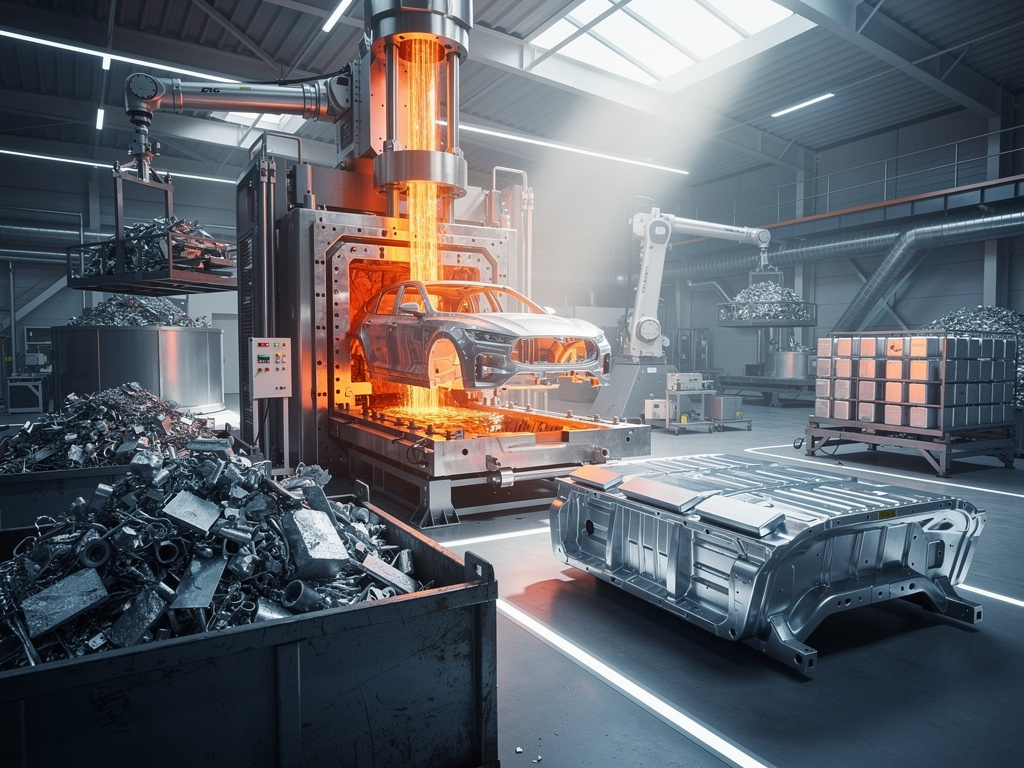
Tesla Inc. has unveiled a metallurgy breakthrough that could reshape automotive manufacturing, transforming low-grade scrap aluminum into high-strength alloys suitable for massive vehicle castings. Detailed in international patent WO 2025/259916 A1, published December 18, 2025, the innovation tackles longstanding impurities in recycled metal, enabling the company to produce safety-critical components without relying on expensive virgin materials. This development, first highlighted in a post on X by industry analyst Ming (@tslaming), promises to slash costs and boost sustainability at Tesla’s gigafactories.
The patent addresses a core challenge: scrap metal from shredded cars, old wheels, and radiators contains iron, copper, and zinc that typically make alloys brittle. Tesla’s approach embraces these ‘post-consumer’ sources—such as ‘twitch’ from auto shredders and ‘taint/tabor’ sheet metal—mixing them in ratios like 30% wheels, 30% twitch, and 15% radiators to yield premium melts. By adding manganese, magnesium, vanadium, strontium, and silicon, engineers neutralize impurities without costly purification.
Impurity Metrics Redefine Alloy Design
Central to the patent are two proprietary metrics: the ‘Hard Factor,’ which balances yield strength and ductility via magnesium, copper, and zinc percentages, and the ‘Advanced Sludge Factor,’ preventing iron-manganese precipitates that clog casting equipment. These allow precise control over the melt’s chemistry, fostering microstructures with globular AlFeSi and Mg2Si phases that enhance performance.
The resulting alloy hits yield strengths of 110-190 megapascals with bend angles of 15-32 degrees, matching or exceeding virgin aluminum for crash energy absorption. As noted in Foundry Management & Technology, Tesla’s prior aluminum-nickel work laid groundwork, but this patent scales it for recycling.
Gigacasting’s Flow Breakthrough
Optimized for high-pressure die casting, the alloy boasts a ‘casting flow length’ of 1-5 meters, filling enormous Giga Press molds for Model Y and Cybertruck underbodies in one shot. This fluidity prevents premature freezing in intricate dies, a hurdle for rivals. Elon Musk’s team achieves these properties ‘as-cast,’ skipping heat treatment that warps large parts and hikes energy use.
Eliminating post-casting processing saves time and scrap losses, aligning with Tesla’s unboxed manufacturing push. A related Teslarati report on the unboxed process underscores efficiency gains, while this patent secures the material foundation.
Closed-Loop Supply Chain Armor
By sourcing from end-of-life vehicles and market scrap, Tesla decouples from bauxite price swings. The patent validates ‘dirty’ streams like used radiators, enabling self-supplied recycling—melting old Teslas for new ones. This resilience contrasts with competitors’ virgin-metal dependence, per analysis in Torque News on Tesla’s cost strategies.
Safety integration is key: high bend angles allow casting crumple zones and crash rails into single-piece frames, protecting batteries without welds. The alloy suits future 3D printing, hinting at next-gen parts. Ming’s X thread details examples, emphasizing mid-2024 origins now public.
Industry Echoes and Precedents
Prior Tesla patents, like the 2021 aluminum alloy filing covered by Teslarati, hinted at toughness gains, but WO 2025/259916 A1 specifies scrap handling. Foundry Management & Technology noted early nickel-aluminum progress in 2020, evolving into this recycling focus. Recent X posts from Ming link it to unboxed patents like US 2025/0368284 A1.
Web searches reveal complementary advances: The Cool Down reported RidgeAlloy’s scrap innovations, though Tesla’s targets gigacasting scale. No direct competitors match this impurity tolerance, per patent claims.
Strategic Manufacturing Edge
For gigafactories, this means dimensional accuracy without T6 heat treatment, cutting defects in 6,000-ton presses. Contechs detailed Tesla’s gigacasting push, now materially enabled. Supply independence bolsters margins amid aluminum volatility.
The patent’s timing, post-Cybercab unveil, supports robotaxi production ramps. Ming notes RF-transparent roofs in EP 4657656, but metallurgy underpins structural integrity. Tesla’s Shanghai localization exceeds 95%, per Weibo, amplifying scrap use.
Broader Recycling Implications
This ‘alchemist’s recipe’ could recycle ICE-era scrap into EV parts, closing loops. Quartz covered Musk’s gigacasting pivot, refined here. Performance data—yield strength, elongation—positions it for regulatory nods on safety.
As Tesla scales, rivals face catch-up: BMW and Toyota experiment with recycling, but Tesla’s metrics lead. Patent’s additive manufacturing nod eyes Cybercab intricacies. Industry insiders see this as pivotal for $25,000 EV affordability.


 WebProNews is an iEntry Publication