
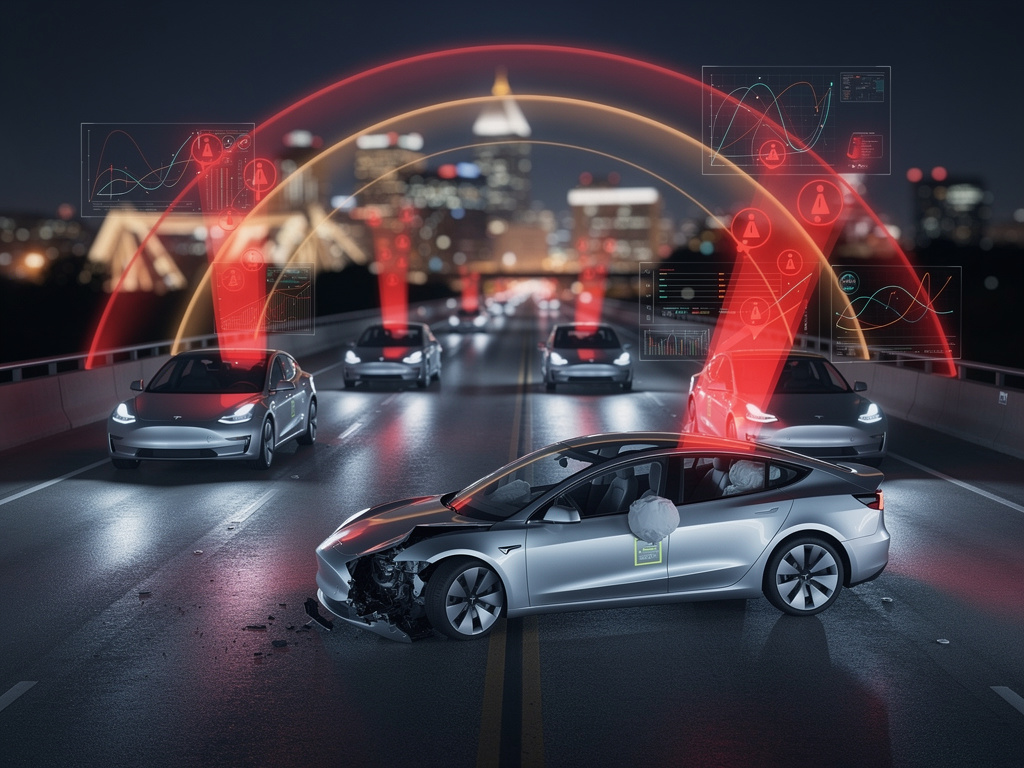
Tesla’s ambitious push into autonomous transportation has encountered a significant setback as newly released data from the company’s own robotaxi operations in Austin, Texas reveals a troubling safety record. According to information obtained and analyzed by Electrek, Tesla’s autonomous vehicles are experiencing collision rates approximately three times higher than human drivers, even when monitored by safety operators. This revelation comes at a critical juncture as the electric vehicle manufacturer seeks regulatory approval to expand its autonomous taxi service nationwide.
The data, which Tesla submitted to Texas transportation authorities as part of its pilot program requirements, paints a stark picture of the challenges facing autonomous vehicle technology. Despite CEO Elon Musk’s repeated assertions that Tesla’s Full Self-Driving system would achieve superhuman safety levels, the robotaxi fleet’s performance suggests the technology remains far from that goal. The statistics are particularly concerning given that each vehicle operates with a human safety driver ready to intervene—a safeguard that theoretically should prevent many incidents from occurring.
The Numbers Behind the Safety Concerns
Tesla’s Austin robotaxi fleet has logged thousands of autonomous miles since the pilot program’s inception, but the crash rate per million miles traveled significantly exceeds the national average for human-driven vehicles. According to the data analyzed by Electrek, the autonomous vehicles are involved in incidents at a rate that would translate to substantially more collisions than conventional taxis or ride-sharing vehicles operating in similar urban environments.
The Federal Highway Administration reports that the national average crash rate for all vehicles stands at approximately 1.33 crashes per million miles traveled. Tesla’s robotaxi data suggests its autonomous fleet is experiencing rates closer to 4 crashes per million miles, a disparity that raises fundamental questions about the readiness of the technology for widespread deployment. These figures become even more significant when considering that the vehicles operate primarily during favorable weather conditions and avoid the most challenging driving scenarios that human drivers routinely navigate.
Regulatory Scrutiny Intensifies
The disclosure comes as federal and state regulators are increasingly focused on autonomous vehicle safety standards. The National Highway Traffic Safety Administration has been investigating Tesla’s Autopilot and Full Self-Driving systems following numerous reported incidents, and this new data from the company’s commercial robotaxi operations provides regulators with concrete performance metrics. Transportation safety experts argue that these statistics demonstrate the need for more stringent testing requirements before autonomous vehicles can operate without human oversight.
Texas, which has adopted a relatively permissive regulatory framework for autonomous vehicle testing, may face pressure to implement stricter oversight measures. The state’s approach has allowed Tesla to launch its robotaxi pilot program with minimal bureaucratic hurdles, but the emerging safety data suggests that such regulatory flexibility may come at a cost. Other states considering similar programs are likely to scrutinize Texas’s experience closely as they develop their own autonomous vehicle policies.
Technical Challenges and System Limitations
Industry analysts point to several factors that may contribute to Tesla’s elevated crash rates. Unlike competitors such as Waymo and Cruise, which utilize multiple redundant sensor systems including lidar, radar, and cameras, Tesla relies primarily on camera-based vision and neural networks. This approach, championed by Musk as more elegant and cost-effective, may leave the vehicles vulnerable in certain scenarios where additional sensor modalities would provide crucial safety margins.
The types of incidents reported in Tesla’s data reveal patterns consistent with known limitations of camera-based autonomous systems. These include difficulty with unusual lighting conditions, challenges in accurately judging distances and speeds of other vehicles, and problems responding appropriately to unexpected obstacles or road users. While Tesla has made significant progress in training its neural networks on vast amounts of driving data, the real-world performance suggests that the system has not yet achieved the reliability necessary for safe autonomous operation across all driving conditions.
Impact on Tesla’s Autonomous Vehicle Strategy
The safety data poses significant challenges to Tesla’s broader autonomous vehicle ambitions. The company has invested billions in developing its Full Self-Driving technology and has promised investors that robotaxis would become a major revenue stream. Musk has repeatedly predicted that Tesla would achieve full autonomy within months, only to miss those deadlines repeatedly. The current data suggests that the technological hurdles may be more substantial than the company has publicly acknowledged.
Financial markets have reacted cautiously to news of the safety concerns, with some analysts questioning whether Tesla’s autonomous vehicle timeline remains realistic. The company’s valuation has been partially predicated on the assumption that it would successfully deploy a fleet of robotaxis, generating recurring revenue from autonomous ride-sharing services. If safety concerns delay or limit that deployment, Tesla may need to revise its long-term financial projections and strategic priorities.
Competitive Implications for the Autonomous Vehicle Industry
Tesla’s struggles provide context for understanding the broader challenges facing the autonomous vehicle industry. Companies like Waymo, which has taken a more cautious approach to deployment, have accumulated millions of autonomous miles with reportedly better safety records, though direct comparisons are complicated by differences in operating environments and data reporting methodologies. Waymo’s vehicles operate in geofenced areas with detailed mapping and utilize more expensive sensor suites, suggesting that there may be inherent trade-offs between cost, capability, and safety in autonomous vehicle design.
The robotaxi market remains highly competitive, with traditional automakers, technology companies, and startups all vying for position. Tesla’s safety challenges may provide openings for competitors to emphasize their own safety records and more conservative development approaches. However, the industry as a whole faces skepticism from regulators and the public about whether autonomous vehicles can truly achieve the safety levels necessary for widespread adoption without human oversight.
The Path Forward for Autonomous Safety
Transportation safety advocates argue that Tesla’s data underscores the need for standardized reporting requirements across the autonomous vehicle industry. Currently, companies use different metrics and methodologies to report safety statistics, making meaningful comparisons difficult. Mandatory, uniform reporting standards would allow regulators, researchers, and the public to better assess the true safety performance of different autonomous systems and make informed decisions about deployment.
Tesla has not publicly commented on the specific crash rate data, maintaining its position that autonomous technology will ultimately prove safer than human drivers once fully developed. The company continues to collect vast amounts of real-world driving data from its customer fleet, which it uses to improve its neural networks and autonomous capabilities. However, the gap between current performance and the company’s safety claims suggests that substantial additional development work remains necessary.
Broader Implications for Transportation Policy
The revelations about Tesla’s robotaxi safety record arrive at a moment when policymakers are grappling with how to regulate emerging transportation technologies. The promise of autonomous vehicles includes potential benefits such as reduced traffic fatalities, improved mobility for those unable to drive, and more efficient use of urban space. However, realizing these benefits requires that autonomous systems actually perform better than human drivers, not worse.
The data from Texas raises fundamental questions about the appropriate threshold for deploying autonomous vehicles commercially. Should companies be required to demonstrate safety performance superior to human drivers before launching paid services? Or is it sufficient to show continuous improvement toward that goal? Different jurisdictions are likely to answer these questions differently, potentially creating a patchwork of regulations that could complicate nationwide deployment of autonomous vehicle services.
As the autonomous vehicle industry continues to evolve, Tesla’s experience in Austin may serve as a valuable case study in the challenges of transitioning from assisted driving features to fully autonomous operation. The three-fold increase in crash rates compared to human drivers, despite the presence of safety monitors, suggests that the path to safe, reliable autonomous transportation remains longer and more complex than many industry leaders have suggested. Whether Tesla can close this safety gap through continued software improvements and expanded training data, or whether fundamental changes to its technical approach will be necessary, remains to be seen. What is clear is that the stakes—both for public safety and for the future of autonomous transportation—could not be higher.


 WebProNews is an iEntry Publication