
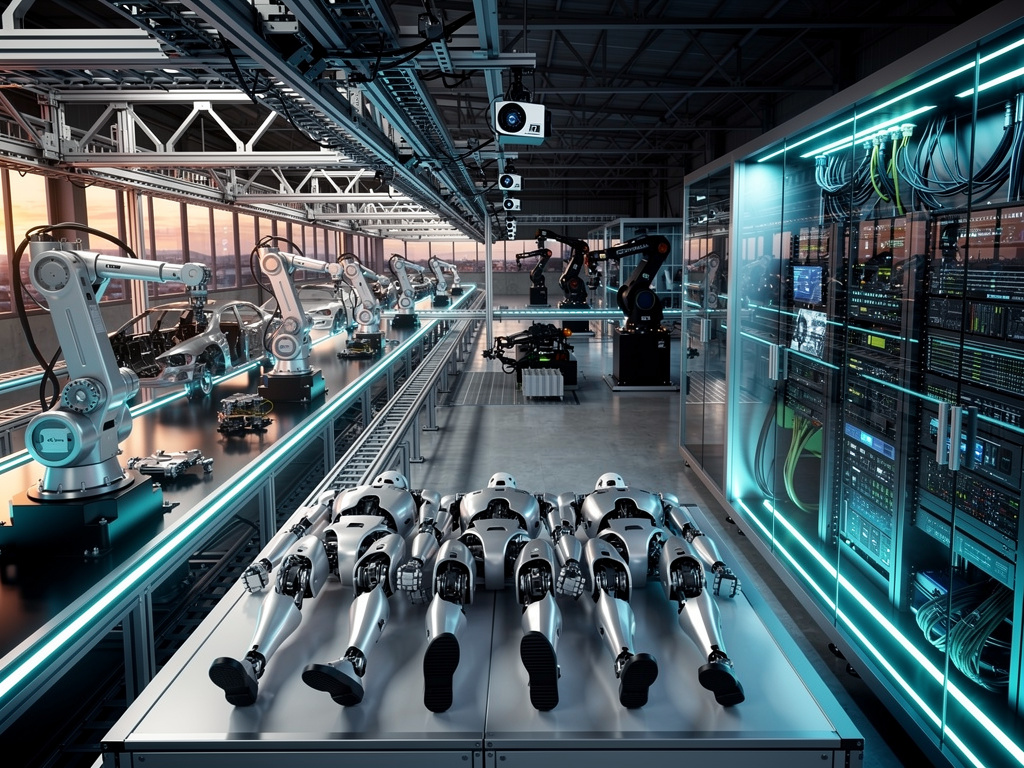
AUSTIN, Texas – In a corner of Tesla Inc.’s sprawling Gigafactory, a new kind of worker is learning the ropes. It stands just over five feet eight inches tall, weighs 130 pounds, and possesses five-fingered hands with delicate tactile sensors. This is Optimus, Tesla’s humanoid robot, and its recent promotion from a laboratory curiosity to a trainee on the factory floor represents one of the most audacious gambles in modern manufacturing.
Chief Executive Elon Musk is pushing to have “thousands” of these robots working in Tesla’s factories by next year, a timeline that is characteristically aggressive. Recent videos posted by Mr. Musk show the latest generation of the robot, known as Gen 2, autonomously sorting 4680 battery cells and taking tentative, yet stable, steps through the facility. The tasks are simple, but the message is clear: the trial has begun, and Tesla is using its own production lines as the ultimate proving ground for a technology that could redefine industrial labor.
The company’s goal, as outlined by Mr. Musk during a recent earnings call, is to have a limited number of Optimus units performing useful factory tasks by the end of this year, with an eye toward selling them to outside companies by the end of 2026. This strategy, as detailed by Business Insider, positions Tesla not just as a car company, but as a robotics and artificial intelligence powerhouse, testing its most ambitious product in the crucible of its own high-stakes manufacturing environment.
From Prototype to Production Line
The transition of Optimus from stage presentations to the factory floor is a critical milestone. While early prototypes were often tethered and showcased basic movements, the current iteration seen in a recent demonstration on X (formerly Twitter) operates untethered, navigating a real-world space and manipulating objects with increasing dexterity. The task of sorting battery cells, while mundane, is a perfect test case. It requires visual perception to identify the cells, precision to handle them without damage, and the logic to place them correctly in a tray—all powered by the same AI that Tesla is developing for its vehicles.
Unlike traditional industrial robots, which are bolted to the floor and programmed for a single, repetitive task, Optimus is designed for generality. Its human-like form is a deliberate choice, intended to allow it to operate in spaces and with tools designed for people. This means it could, in theory, be deployed to various workstations along an assembly line with minimal reconfiguration, offering a flexibility that fixed automation lacks.
This adaptability is central to Tesla’s bet. The company envisions a future where Optimus can be trained to do almost any task a human can, from complex assembly to logistics and material handling. By deploying them in its own factories first, Tesla gains an invaluable feedback loop, allowing its engineers to rapidly iterate on both the hardware and the software in a controlled, yet demanding, setting before attempting to sell a finished product to the world.
The Ghost in the Machine Is a Neural Network
At the heart of Optimus is a radical departure from conventional robotics. Instead of being explicitly programmed for every possible action and contingency, the robot is being trained via an “end-to-end” neural network. This means the AI learns tasks by observing human demonstrations and then develops its own understanding of how to translate sensory input—what it “sees” through its cameras—directly into motor control for its hands and limbs. It is learning by watching, much like a human apprentice.
This approach leverages Tesla’s immense expertise in AI developed for its Full Self-Driving (FSD) program. The same principles of processing vast amounts of video data to make real-time decisions in a complex environment are being applied to the robot. As highlighted during company presentations, this method allows for much faster learning and greater adaptability compared to older robotic systems. As noted by TechCrunch following a 2023 investor event, this AI-centric strategy is what Tesla believes will allow it to scale the robot’s capabilities far more quickly than its competitors.
This software-first philosophy contrasts sharply with rivals like Boston Dynamics, whose Atlas robot is famous for its stunning acrobatic feats. While mechanically sophisticated, Atlas has historically relied more on heavily engineered, pre-programmed routines. Tesla is betting that a less agile robot with a more powerful, generalizable AI brain will ultimately prove more commercially viable for the endless variety of tasks required in logistics and manufacturing.
A Familiar Refrain of Audacious Timelines
For industry veterans and Tesla watchers, Mr. Musk’s timeline for Optimus—thousands of robots in factories in 2025—invites a healthy dose of skepticism. The CEO has a well-documented history of setting ambitious deadlines for projects like coast-to-coast autonomous driving, the Tesla Semi, and the next-generation Roadster, many of which have been subject to significant delays. The technical challenges of creating a truly useful, general-purpose humanoid robot are immense, spanning everything from battery life and heat management to the fiendishly complex problem of dexterous manipulation.
Achieving reliability and safety in a dynamic factory environment is a far greater challenge than a scripted demonstration. A robot that fails 1% of the time is a research success, but a liability on a fast-moving production line. Scaling that reliability to a fleet of thousands of robots performing a variety of tasks is an exponential problem that no company has yet solved.
Nevertheless, the declaration serves as a powerful forcing function within the company, driving rapid progress. Mr. Musk’s public pronouncements create immense pressure to deliver, and even if the 2025 target is missed, the progress made in pursuit of it could still place Tesla years ahead of its rivals. The real test will be whether Optimus can move beyond simple, repetitive tasks to handle the variability and unpredictability inherent in real-world work.
A Crowded Field Chasing the Robotic Prize
While Tesla commands the spotlight, it is not operating in a vacuum. A new generation of robotics companies is attracting enormous investment and forging strategic alliances. Startup Figure AI, for instance, recently signed a deal to deploy its humanoids in a U.S. automotive plant, as Reuters reported, putting it in direct competition for the same industrial clients Tesla may one day court. Figure also boasts a partnership with OpenAI, giving it access to some of the world’s most advanced large-language models to power its robots’ reasoning.
The investment world has taken notice, pouring capital into the sector. According to Bloomberg, startups like Figure and Canada’s Sanctuary AI have raised hundreds of millions of dollars from tech giants including Microsoft Corp., Nvidia Corp., and Amazon.com Inc. founder Jeff Bezos. This influx of capital and brainpower is accelerating development across the board, creating a competitive environment where progress is measured in months, not years.
Each company is taking a slightly different approach to hardware, software, and market strategy. Some are focusing on logistics and warehouse work, while others target manufacturing or elder care. This diverse ecosystem ensures that multiple solutions to the humanoid challenge are being explored simultaneously, increasing the odds of a breakthrough, whether it comes from Tesla or a competitor.
Recalculating the Future of Labor and Value
The ultimate prize for Tesla is far greater than simply improving its own factory efficiency. Mr. Musk has stated he believes the market for humanoid robots could eventually be worth trillions of dollars, and that the Optimus business could one day be more valuable than Tesla’s car division. In his view, a world with fleets of capable humanoid robots would fundamentally break the constraints of labor, leading to an “age of abundance.”
The economic argument is compelling. A robot that can work 24/7 for a fraction of the cost of a human employee, without risk of injury, would be a revolutionary product. For an economy facing demographic shifts and labor shortages in key sectors, autonomous humanoid workers could fill critical gaps and unlock massive productivity gains. This is the long-term vision that underpins Tesla’s massive investment in the project.
If Tesla can successfully build, train, and deploy Optimus at scale, it would possess an almost unimaginable competitive advantage. The company would not only lower its own manufacturing costs but would also be the sole supplier of the world’s first truly scalable robotic workforce. It’s a binary bet: the project could end as a costly distraction or it could secure Tesla’s position as one of the most important companies of the 21st century.
The coming months will be telling. As more Optimus units begin their apprenticeships in Austin and beyond, the world will be watching to see if they can learn their jobs. The journey from sorting battery cells to assembling a car door is long and fraught with difficulty. But on the floor of the Gigafactory, the first steps of that journey are now being taken, marking a quiet but potentially momentous shift in the relationship between humans, machines, and work itself.


 WebProNews is an iEntry Publication