
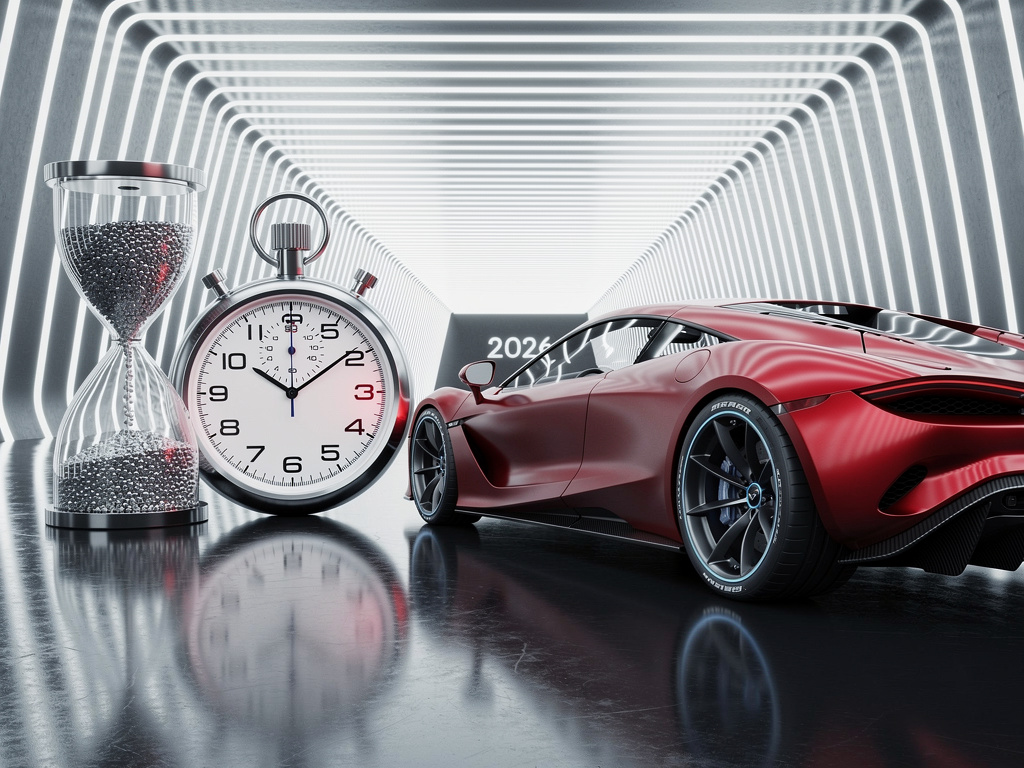
After nearly a decade of anticipation and repeated delays, Tesla appears to be positioning its long-promised next-generation Roadster for an actual market debut. Recent trademark filings discovered by industry observers suggest the electric vehicle manufacturer is taking concrete steps toward commercializing what Elon Musk has called “the smackdown” to gasoline sports cars. The developments mark a potential turning point for a vehicle that has become emblematic of both Tesla’s ambitious vision and its tendency to overpromise on timelines.
According to Business Insider, Tesla has filed new trademark applications for Roadster-related logos and branding elements, with filing dates suggesting preparation for a 2026 market introduction. These administrative moves, while seemingly mundane, represent the kind of pre-production groundwork that typically precedes vehicle launches by 12 to 18 months. For an automotive industry that has watched the Roadster concept evolve from a 2017 prototype to a perpetually delayed promise, these filings carry significance beyond their bureaucratic nature.
The trademark applications encompass various design elements and nomenclature associated with the Roadster brand, indicating Tesla’s intent to establish comprehensive intellectual property protection before the vehicle reaches customers. Industry veterans recognize such filings as standard operating procedure in the months leading up to a production vehicle’s unveiling, suggesting that Tesla may finally be ready to deliver on commitments made when the second-generation Roadster was first announced during a semi-truck reveal event in November 2017.
From Prototype to Production Purgatory
The original timeline promised by Musk positioned the new Roadster for a 2020 release, a deadline that came and went without ceremony as Tesla focused resources on ramping production of the Model 3 sedan and establishing new manufacturing facilities in Shanghai, Berlin, and Texas. Subsequent updates pushed expected delivery dates to 2021, then 2022, and eventually into an indefinite future that led many reservation holders to question whether the vehicle would materialize at all.
The specifications promised for the Roadster have remained consistently extraordinary throughout these delays: zero-to-60 mph acceleration in 1.9 seconds, a top speed exceeding 250 mph, and a 620-mile range on a single charge. These figures, if achieved, would represent quantum leaps beyond current production electric vehicles and challenge the performance envelope of internal combustion supercars costing several times the Roadster’s projected $200,000 base price. A promised SpaceX package, incorporating cold-gas thrusters for enhanced acceleration and handling, added an almost science-fiction element to the vehicle’s mythology.
The extended development timeline has allowed competitors to narrow what was once a commanding technological gap. Rimac’s Nevera, Lotus’s Evija, and Pininfarina’s Battista have all entered limited production with performance specifications that approach or exceed Tesla’s original Roadster promises, albeit at price points well above Tesla’s target. Meanwhile, Porsche’s Taycan and various high-performance offerings from Lucid Motors have demonstrated that electric performance vehicles can successfully transition from concept to customer deliveries, making Tesla’s continued delays increasingly conspicuous.
Strategic Imperatives Behind the Timing
The apparent acceleration of Roadster development comes at a moment when Tesla faces intensifying competition across its entire product portfolio and questions about its growth trajectory. The company’s stock price has experienced volatility as investors weigh the potential of new products against execution risks and Musk’s divided attention across multiple ventures including SpaceX, X (formerly Twitter), and various artificial intelligence initiatives.
From a strategic perspective, the Roadster serves purposes beyond its direct revenue contribution. As a halo product, it reinforces Tesla’s technological leadership and engineering prowess at a time when traditional automakers have committed hundreds of billions of dollars to electric vehicle development. The vehicle also provides a testing ground for battery technology, thermal management systems, and power electronics that can eventually filter down to Tesla’s mass-market offerings, much as the original Roadster’s development informed the Model S engineering.
Financial analysts have long questioned the business case for a low-volume, high-performance vehicle that would consume engineering resources while contributing minimally to Tesla’s overall unit sales. However, the Roadster’s marketing value and its role in maintaining Tesla’s premium brand positioning may justify development costs that pure volume economics would not support. Additionally, the substantial deposits collected from reservation holders—reportedly $250,000 for the limited Founders Series—have provided Tesla with interest-free capital during the extended development period.
Manufacturing and Supply Chain Considerations
The trademark filings emerge against a backdrop of evolving manufacturing capabilities at Tesla. The company’s Gigafactory in Texas, which began Model Y production in 2022, represents the most advanced manufacturing facility in Tesla’s network, incorporating production techniques and automation that weren’t available when the Roadster was originally conceived. This facility could potentially serve as the production location for the Roadster, though Tesla has not confirmed manufacturing plans.
Battery technology has advanced considerably since 2017, with Tesla’s development of 4680 cells promising significant improvements in energy density, thermal performance, and manufacturing cost. The Roadster would likely incorporate these latest-generation cells, potentially in a configuration that pushes the boundaries of current battery pack design. The vehicle’s promised 200 kWh battery capacity would represent roughly double that of Tesla’s current longest-range vehicles, presenting substantial engineering challenges in packaging, thermal management, and charging infrastructure.
Supply chain dynamics have shifted dramatically in recent years, with semiconductor shortages, raw material price volatility, and geopolitical tensions affecting automotive production globally. Tesla’s vertical integration strategy, including its own battery cell production and in-house development of power electronics and drive units, positions the company to maintain better control over Roadster production than competitors relying on external suppliers for critical components.
Market Positioning and Competitive Dynamics
The electric supercar segment has evolved from a theoretical niche to an established, if small, market category since Tesla first unveiled the second-generation Roadster. Rimac’s success in delivering the Nevera to customers, despite its $2.4 million price tag, demonstrates viable demand for ultra-high-performance electric vehicles among collectors and enthusiasts. Lotus, now under Geely ownership and committed to an all-electric future, has positioned its Evija as a technology showcase that will inform future products.
Tesla’s competitive advantage in this segment rests not on exclusivity or hand-built craftsmanship—traditional supercar differentiators—but on the company’s ability to achieve exotic-car performance at a fraction of typical supercar pricing through manufacturing scale and vertical integration. This democratization of extreme performance aligns with Tesla’s broader mission while potentially opening the high-performance electric vehicle market beyond the ultra-wealthy collectors who typically purchase limited-production supercars.
The question of actual demand remains somewhat speculative, as Tesla has not disclosed the number of Roadster reservations or their geographic distribution. Industry observers estimate that several thousand customers have placed deposits, though the extended timeline has likely resulted in some cancellations and transfers to other Tesla products. The company’s challenge will be converting these years-old reservations into actual purchases while potentially attracting new customers who may have dismissed the Roadster as vaporware.
Technical Challenges and Innovation Opportunities
Achieving the Roadster’s promised performance specifications presents engineering challenges that extend beyond simply scaling up existing Tesla technology. The 1.9-second zero-to-60 time would require not only enormous power output but also sophisticated traction control, tire technology capable of transmitting that power to the road, and thermal management systems that can sustain repeated maximum-performance launches without degradation.
The optional SpaceX package, featuring compressed air thrusters for enhanced performance, represents perhaps the most audacious element of the Roadster’s specification. While Musk has suggested these thrusters could improve acceleration, braking, and cornering performance, the practical implementation raises questions about pressure vessel safety, refilling infrastructure, and regulatory approval. Some industry analysts view this feature as more marketing flourish than practical enhancement, though Tesla’s track record of achieving seemingly impossible technical goals counsels against dismissing the concept entirely.
Aerodynamics play a crucial role in achieving the Roadster’s promised 250+ mph top speed, requiring sophisticated active aero elements and extensive wind tunnel development. The vehicle’s removable glass roof panel, a design element showcased in the prototype, adds complexity to achieving the structural rigidity necessary for both performance and safety at extreme speeds. These technical challenges explain, in part, the extended development timeline and suggest that the production vehicle may incorporate solutions and technologies that weren’t available or fully developed in 2017.
Implications for Tesla’s Broader Strategy
The Roadster’s path to production reflects broader themes in Tesla’s evolution from disruptive startup to established automaker. The company’s ability to manage multiple complex vehicle programs simultaneously—including the Cybertruck, Semi, and next-generation platform for affordable vehicles—will determine whether the Roadster represents a triumphant demonstration of engineering prowess or a distraction from more commercially significant priorities.
Investor sentiment toward Tesla has increasingly focused on the company’s execution capabilities rather than its vision, with Wall Street analysts emphasizing the importance of delivering promised products on revised timelines. The Roadster, in this context, serves as a test case for whether Tesla can translate ambitious concepts into production reality without the serial delays that have characterized recent product launches. Success would reinforce confidence in the company’s ability to deliver on other promises, including the more affordable next-generation vehicle platform that many analysts view as critical to Tesla’s long-term growth.
The trademark filings, while not guaranteeing imminent production, suggest that Tesla is taking the administrative and legal steps necessary for a commercial launch. For the thousands of reservation holders who have waited years for their vehicles, and for the broader automotive industry watching Tesla’s every move, these mundane bureaucratic actions carry the weight of a promise that may finally be approaching fulfillment. Whether 2026 proves to be the year the Roadster actually reaches customers, or merely another waypoint in an extended development journey, will reveal much about Tesla’s priorities and capabilities as it navigates an increasingly competitive electric vehicle market.


 WebProNews is an iEntry Publication