
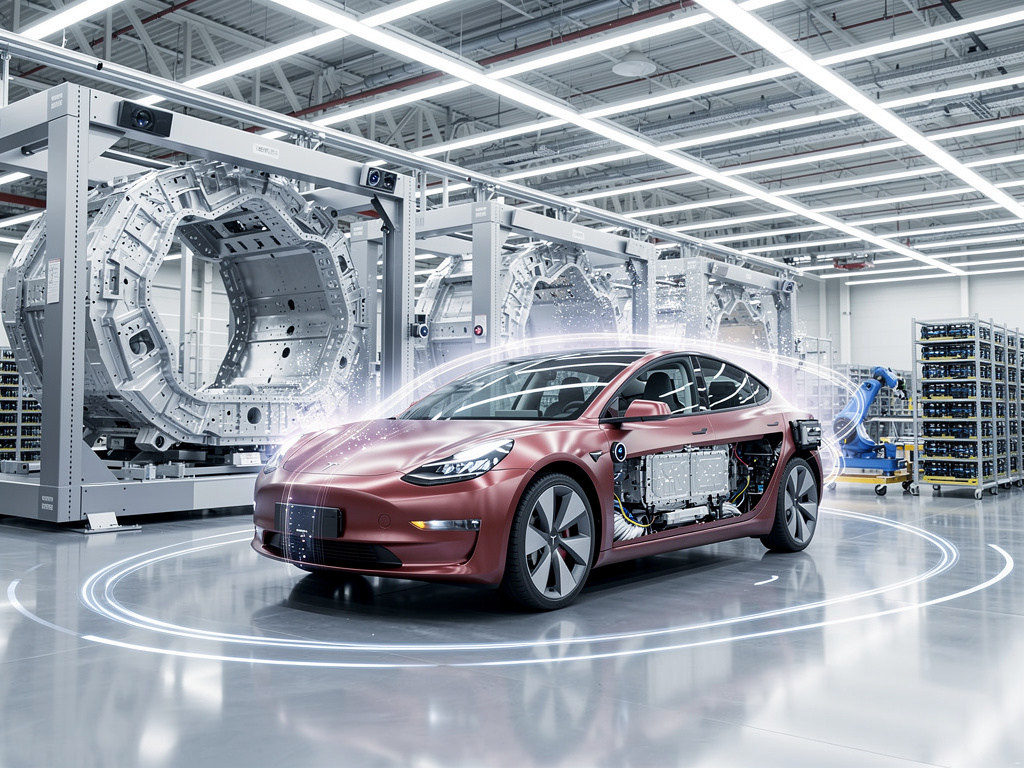
In the fast-evolving world of electric vehicles, Tesla Inc. continues to push boundaries with its next-generation prototypes, blending cutting-edge autonomy, efficient manufacturing, and bold design innovations. Recent insights from industry sources reveal that Tesla’s so-called “Redwood” project, a compact vehicle aimed at mass-market appeal, is already in pilot production at its Gigafactory in Texas. This development marks a pivotal step toward affordable electric mobility, with prototypes showcasing a streamlined body that echoes the minimalist aesthetics of the Cybercab robotaxi unveiled earlier this year. Engineers familiar with the project describe it as a bridge between current models like the Model 3 and a future where unsupervised full self-driving becomes commonplace.
Drawing from a detailed video analysis published by MSN Autos, the prototype features a unibody structure optimized for high-volume production, incorporating advanced giga-casting techniques that reduce assembly time by up to 50%. This method, pioneered in the Cybertruck, allows for larger single-piece components, minimizing welds and enhancing structural integrity. Insiders note that the vehicle’s interior prioritizes simplicity, with a central touchscreen dominating the dashboard and haptic feedback replacing traditional buttons, a design choice that aligns with Tesla’s software-first philosophy.
Beyond aesthetics, the prototype integrates Tesla’s latest Hardware 5 (HW5) suite, which includes upgraded cameras with micro-cone shields and enhanced heating elements to combat environmental challenges like fog or ice. Posts on X from Tesla enthusiasts highlight excitement around these features, with users speculating that HW5 could enable true end-to-end neural network processing for autonomy, potentially rolling out in software updates by mid-2026. This hardware evolution is crucial as Tesla ramps up trials for unsupervised Full Self-Driving (FSD) in select markets, starting with Austin, Texas, as reported in recent web updates.
Unveiling the Powertrain and Efficiency Breakthroughs
At the heart of the next-generation prototype is a revamped powertrain that promises to redefine efficiency standards. According to details from Top Electric SUV, the vehicle leverages a 48-volt electrical architecture, similar to the Cybertruck, which cuts down on wiring complexity and boosts energy distribution. This setup supports a new battery chemistry that achieves up to 1.7 kWh per mile efficiency, a metric that outpaces current models and positions the prototype as a leader in range-per-charge performance.
Battery innovations extend to cold-weather resilience, with a patented heating system embedded in the control electronics. This allows the pack to self-warm efficiently, preserving range in sub-zero conditions—a common pain point for EV owners. Web searches indicate that Tesla is testing these batteries in prototypes, aiming for a 500-mile range on a single charge, even in demanding scenarios. Such advancements are not just incremental; they address real-world usability, making the vehicle suitable for diverse climates and long-haul trips.
Manufacturing scalability is another cornerstone. The prototype’s design draws from lessons learned in the refreshed Tesla Semi, which features a redesigned front fascia with integrated horizontal light bars and a flatter frunk for better aerodynamics. As outlined in Tesla Oracle, production of this next-gen Semi is slated for mid-2026, with prototypes already demonstrating 800 kW drive power and 1.2 MW charging capabilities. These elements are being cross-pollinated into passenger vehicle prototypes, ensuring that Tesla’s ecosystem benefits from unified technological progress.
Autonomy and Software Integration Take Center Stage
Tesla’s ambition for full autonomy is vividly apparent in the prototype’s software stack. The latest FSD version 13/14, reliant on end-to-end neural networks, is being piloted in real-world conditions, with early feedback suggesting smoother navigation in complex urban settings. News from Predict Street emphasizes that this “great AI metamorphosis” is transforming prototypes into intelligent machines capable of unsupervised operation, a feat that could disrupt ride-hailing services.
Integration with emerging tech like satellite connectivity adds another layer. A recent patent detailed in Digital Trends describes a polymer-based roof that supports Starlink internet, enabling seamless over-the-air updates and real-time data streaming for autonomous fleets. This could mean prototypes equipped with built-in connectivity for navigation, entertainment, and even remote diagnostics, reducing downtime and enhancing user experience.
On X, discussions among Tesla followers underscore the potential for these features to extend beyond personal vehicles. Posts speculate on applications like food delivery or non-emergency transport via robotaxi networks, aligning with Elon Musk’s vision of a decentralized mobility future. Such sentiment reflects growing optimism, though it’s tempered by reminders that these are user-generated ideas, not official confirmations.
Design Philosophy and Market Positioning
The prototype’s exterior design follows Tesla’s updated language, seen in the Model Y Juniper refresh and Cybercab. Character lines are more prominent, with adaptive matrix headlights that adjust to road conditions, as noted in software update previews from Not a Tesla App. This not only improves visibility but also contributes to energy savings by optimizing light usage.
Interior innovations focus on modularity, allowing for easy upgrades like next-generation hands for the Optimus robot integration—though that’s more speculative for vehicle contexts. Pilot production details from X posts suggest that affordable models utilizing this platform could launch in the first half of 2025, blending aspects of next-gen tech with cost-effective builds to target a $25,000 price point.
Competitively, this positions Tesla against rivals in the affordable EV segment. While legacy automakers struggle with supply chains, Tesla’s vertical integration—from battery production to software—gives it an edge. Insights from Electrek highlight how the prototype’s specs, including blistering acceleration and top safety ratings, could make it the bestseller in its class, much like the Model Y’s global dominance.
Challenges and Regulatory Hurdles Ahead
Despite the promise, prototypes face significant hurdles. Regulatory approval for unsupervised FSD remains a bottleneck, with trials limited to specific regions. Web news from The Motley Fool predicts 2026 as the breakout year for robotaxis, but delays in hardware certification could push timelines.
Production scaling also poses risks. The shift to giga-castings requires massive investments in tooling, and any defects in prototypes could lead to costly recalls. Analysts point to past issues with the Cybertruck’s ramp-up as cautionary tales, emphasizing the need for rigorous testing.
Moreover, market dynamics add pressure. With over 10 million Teslas on roads by next year, as per X discussions, consumer expectations are high. The prototype must deliver on efficiency and autonomy without compromising affordability, or risk alienating budget-conscious buyers.
Future Implications for Tesla’s Ecosystem
Looking ahead, the next-generation prototype could catalyze broader ecosystem changes. Integration with Optimus bots for manufacturing might accelerate production rates, aiming for one vehicle every five seconds—a sevenfold increase over current Shanghai outputs, based on X posts.
Energy innovations, like unity generators or solid-state batteries offering 1,000 km ranges, are rumored in conceptual designs shared online. These could extend to off-road SUVs or electric aircraft, expanding Tesla’s portfolio beyond ground transport.
Ultimately, this prototype embodies Tesla’s ethos of relentless innovation. By addressing efficiency, autonomy, and scalability, it sets the stage for a new era in electric mobility, where vehicles are not just modes of transport but intelligent nodes in a connected network. As pilot builds progress, industry watchers will closely monitor how these developments unfold, potentially reshaping global transportation norms.


 WebProNews is an iEntry Publication