
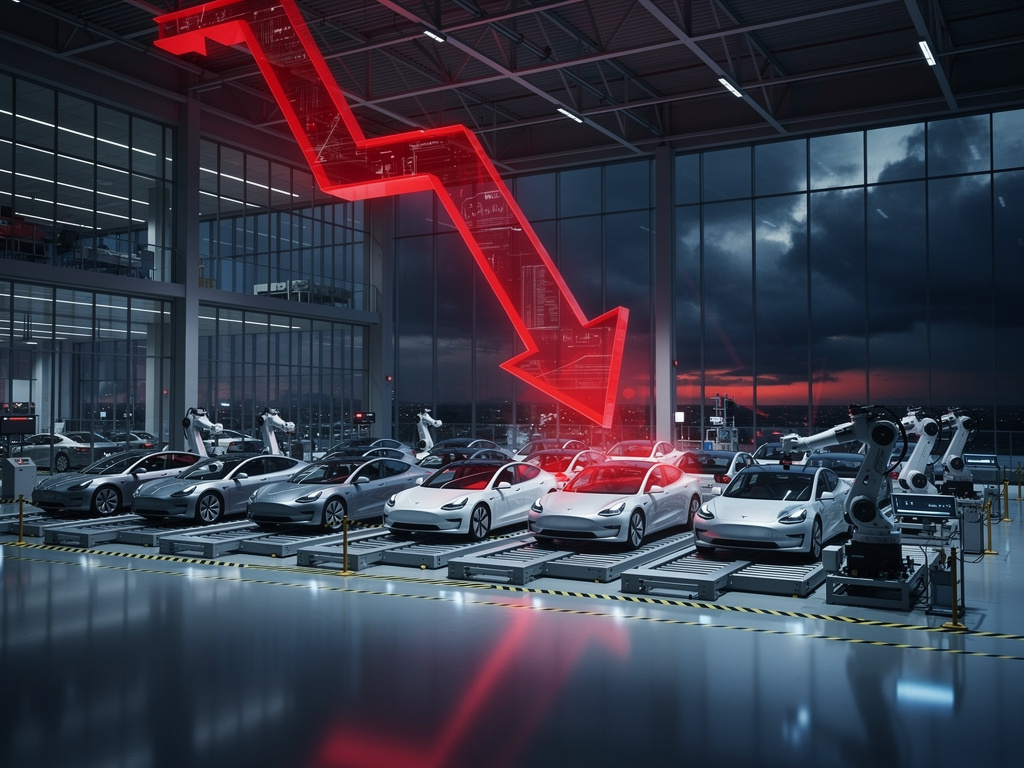
Tesla Inc. just posted its worst quarterly deliveries in nearly three years, and the reasons extend far beyond factory retooling or seasonal softness. The electric vehicle maker delivered approximately 336,681 vehicles in the first quarter of 2025 — a 13% decline from the same period a year ago and well below even the most pessimistic analyst estimates. The number landed beneath the consensus forecast of roughly 377,000 units, according to Yahoo Finance, marking a significant miss that sent shockwaves through a shareholder base already rattled by months of controversy.
The miss wasn’t close. It was a gap wide enough to force a fundamental reassessment of Tesla’s near-term trajectory.
Production came in at 362,615 vehicles for the quarter, itself a decline from 433,371 units produced in Q1 2024. That production-delivery gap — roughly 26,000 units sitting unsold — tells its own story about demand erosion. Tesla acknowledged that part of the production shortfall stemmed from the ongoing transition to an updated Model Y at its factories, a refresh the company has been rolling out across its global manufacturing footprint. But the Model Y changeover, while real, doesn’t fully explain the magnitude of the decline. Analysts had already baked the retooling disruption into their estimates, and Tesla still missed by a wide margin.
The Musk Factor: When a CEO Becomes the Brand’s Biggest Liability
What analysts and investors are grappling with is something harder to model: the growing consumer backlash against Elon Musk himself. His high-profile role leading the Department of Government Efficiency — the Trump administration’s cost-cutting initiative known as DOGE — has transformed Musk from a polarizing tech celebrity into an outright political lightning rod. Protests at Tesla showrooms and dealerships have become routine in cities across the United States and Europe. Vandalism incidents targeting Tesla vehicles have spiked. And a growing “Boycott Tesla” movement has gained traction on social media, particularly among the environmentally conscious, left-leaning consumers who once formed the core of Tesla’s buyer base.
This isn’t abstract brand damage. It’s showing up in the numbers.
In Europe, the damage has been particularly acute. Tesla’s registrations in Germany fell 76% year-over-year in January, according to data from the German Federal Motor Transport Authority. France, Norway, and the Netherlands have all reported sharp declines. The European market, where Musk’s political activities and his public commentary on European politics have generated intense backlash, appears to be rejecting the brand at an accelerating pace. Dan Ives of Wedbush Securities, one of Tesla’s most vocal bulls on Wall Street, described the quarter as a “disaster” and a “code red situation,” per Yahoo Finance.
Ives didn’t mince words. He said the political controversy around Musk has created a “brand crisis” that Tesla’s board needs to address urgently. His view is that Musk must step back from DOGE to refocus on Tesla — a sentiment increasingly shared across the analyst community.
And yet Musk has shown little inclination to retreat. In recent weeks, he has continued posting prolifically on X, the social media platform he owns, weighing in on everything from immigration policy to European elections. His public persona has become inseparable from partisan politics, and that fusion is proving toxic for a consumer brand that depends on broad market appeal. Tesla isn’t selling enterprise software. It’s selling cars to ordinary people who make purchasing decisions influenced by brand perception, social signaling, and personal values.
The stock tells the story in its own brutal way. Tesla shares have fallen roughly 35% year-to-date as of early April 2025, erasing hundreds of billions in market capitalization. The post-election rally that briefly pushed Tesla’s valuation past $1.5 trillion — fueled by hopes that Musk’s proximity to the White House would yield regulatory advantages — has completely unwound. Investors who bought the political-access thesis are now confronting its flip side: political entanglement carries enormous brand risk for a consumer-facing company.
Competition Closes In as Tesla Stumbles
The delivery miss arrives at the worst possible moment competitively. BYD, Tesla’s chief rival in China and increasingly in global markets, reported Q1 sales that surged past 1 million vehicles — including both battery-electric and plug-in hybrid models. BYD’s pure electric deliveries alone have been closing the gap with Tesla quarter after quarter. In China, the world’s largest EV market, Tesla faces relentless price competition from BYD, Nio, Xpeng, Li Auto, and a wave of newer entrants offering compelling products at lower price points.
Tesla’s aging lineup is part of the problem. The Model 3 and Model Y, while refreshed, are fundamentally the same vehicles that have been on the market for years. The Cybertruck, despite generating enormous buzz, has faced production challenges and remains a niche product. The long-promised affordable model — sometimes referred to internally as the Model 2 or the next-generation vehicle — has been subject to repeated delays and strategic pivots. Musk has increasingly redirected the company’s narrative toward robotaxis and autonomous driving, but those products remain pre-revenue and years from meaningful commercial deployment.
So what’s actually driving revenue right now? The same cars Tesla has been selling for years, to a buyer pool that appears to be shrinking.
The Q1 numbers also raise uncomfortable questions about Tesla’s inventory management. With production exceeding deliveries by roughly 26,000 units, Tesla is building cars faster than it can sell them. That’s a reversal from the supply-constrained dynamic that characterized Tesla’s pandemic-era boom, when wait lists stretched for months and the company could raise prices with impunity. Now, Tesla has been cutting prices repeatedly across markets — a strategy that boosts volume but compresses margins. The company’s automotive gross margin, once the envy of the industry at above 25%, has been trending downward and sat around 17-18% in recent quarters.
Price cuts in a rising-cost environment are a painful combination. Tesla’s energy storage business and services revenue have provided some offset, but the core automotive business is under genuine pressure.
Wall Street’s response has been a mix of alarm and recalibration. Several analysts cut their full-year delivery estimates following the Q1 report. The bear case — that Tesla is a maturing automaker trading at a tech-company valuation without the growth to justify it — has gained fresh ammunition. Bulls counter that Tesla’s long-term value lies in autonomy, AI, and energy, not just vehicle deliveries. But long-term optionality is cold comfort when the core business is contracting.
Tesla’s board faces a genuine governance dilemma. Musk is simultaneously the company’s CEO, its largest shareholder, and its most important asset — and now, arguably, its most significant liability. The board has historically been criticized for its deference to Musk, and the current crisis is testing whether independent directors will push back. Ives and other analysts have called for the board to intervene, but there’s little precedent for a Tesla board asserting itself against Musk’s wishes.
The broader EV market isn’t collapsing. Global electric vehicle sales continue to grow, driven by regulatory mandates, improving charging infrastructure, and increasingly competitive products from legacy automakers and Chinese manufacturers alike. Hyundai, Kia, BMW, and Mercedes-Benz have all gained EV market share in recent quarters. The problem is specific to Tesla — or more precisely, specific to the Musk-Tesla entanglement that has become impossible to separate.
Some Tesla loyalists argue the delivery miss is temporary. The Model Y refresh will ramp production through Q2 and Q3. New markets will open. The Cybertruck will scale. Autonomous driving breakthroughs will redefine the company’s value proposition. Maybe. But the Q1 numbers represent a data point that’s hard to explain away with factory transitions alone, and the brand damage from Musk’s political activities shows no signs of abating.
Here’s the uncomfortable truth for Tesla investors: the company’s valuation has always been predicated on Elon Musk’s singular vision and execution ability. That premium made sense when Musk was focused primarily on Tesla, pushing the company from a niche startup to the world’s most valuable automaker. But Musk now runs six companies — Tesla, SpaceX, X, xAI, Neuralink, and The Boring Company — while simultaneously serving in a senior government role. His attention is fractured across an empire that would overwhelm any executive, no matter how capable.
The Q1 delivery report isn’t just a bad quarter. It’s a stress test of the thesis that Elon Musk can do everything, everywhere, all at once. The results suggest he can’t — and that Tesla is paying the price.
Investors will get more clarity when Tesla reports full Q1 financial results later this month. Margins, revenue mix, and forward guidance will all be scrutinized intensely. But the delivery number has already delivered its verdict. Tesla is losing ground at the precise moment when it can least afford to, in a market that won’t wait for its CEO to refocus.


 WebProNews is an iEntry Publication