
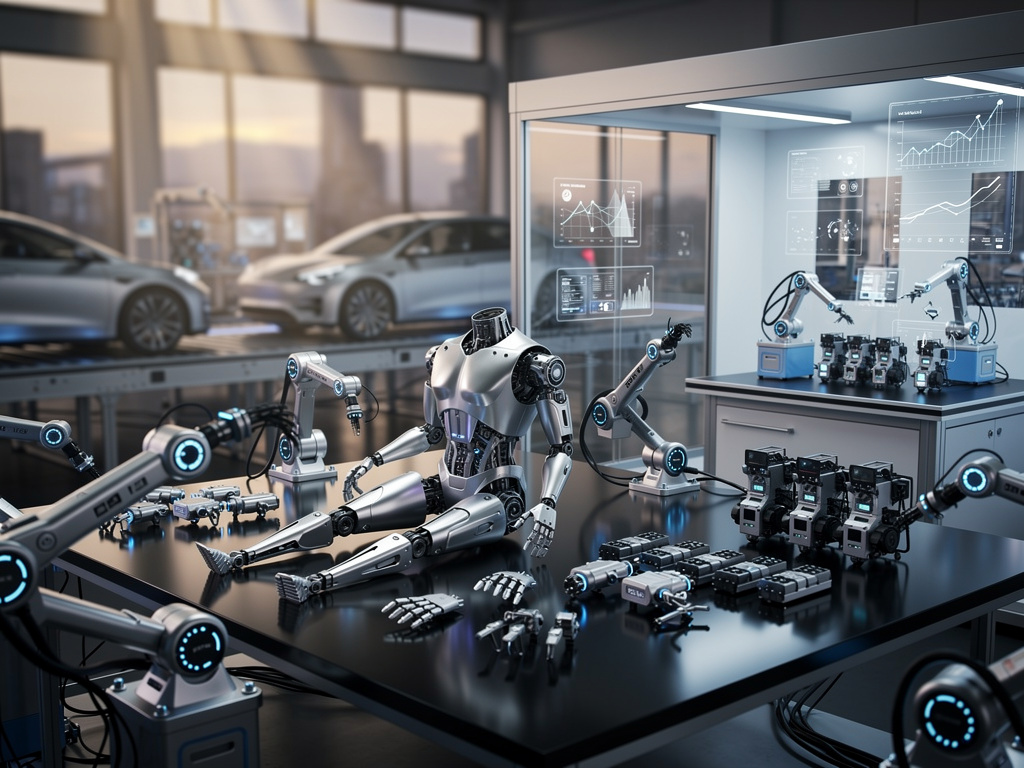
Tesla’s latest earnings call revealed what may become the company’s most significant strategic pivot since the launch of its electric vehicle business: the accelerated development and deployment of its Optimus humanoid robot. CEO Elon Musk announced that the third generation of the robot, dubbed Optimus Gen 3, is slated for deployment in Tesla factories by the first quarter of 2026, marking a dramatic acceleration in the company’s robotics ambitions and potentially reshaping the future of manufacturing automation.
According to The Verge, Musk positioned the humanoid robot as potentially more valuable than Tesla’s entire automotive business, claiming that Optimus could eventually account for the majority of Tesla’s long-term value. This bold assertion comes as the company faces increasing competition in the electric vehicle market and seeks new revenue streams to justify its premium valuation. The announcement sent ripples through both the automotive and robotics industries, with analysts scrambling to assess the feasibility and timeline of Tesla’s ambitious robotics roadmap.
The Optimus Gen 3 represents a significant evolution from its predecessors, with Musk detailing improvements in dexterity, walking speed, and overall functionality during the earnings presentation. The robot is designed to perform repetitive and dangerous tasks in Tesla’s manufacturing facilities, potentially addressing labor shortages while improving workplace safety. Tesla executives emphasized that the controlled environment of their own factories would serve as the perfect testing ground before any potential external commercialization, allowing the company to refine the technology under real-world conditions while maintaining tight control over the development process.
Manufacturing Integration and Economic Implications
The decision to deploy Optimus robots in Tesla’s own production facilities by Q1 2026 represents more than just a technological milestone—it signals a fundamental rethinking of manufacturing economics. Tesla has long positioned itself as a technology company that happens to make cars, and the integration of humanoid robots into its production lines could provide the proof of concept needed to convince skeptical investors and industrial customers of the technology’s viability. The company’s vertical integration strategy, which has served it well in battery production and software development, now extends into the realm of labor automation.
Industry observers note that Tesla’s timeline is aggressive, particularly given the complexity of deploying humanoid robots in dynamic factory environments. Unlike traditional industrial robots that operate in carefully controlled spaces with predictable tasks, humanoid robots must navigate human-designed workspaces, handle varied objects, and potentially collaborate with human workers. The technical challenges are substantial, requiring advances in computer vision, real-time decision-making, and physical manipulation that have eluded robotics companies for decades. Tesla’s advantage lies in its extensive experience with AI and sensor fusion from its autonomous driving program, technologies that translate directly to robotics applications.
Competitive Pressures and Market Context
Tesla’s robotics push comes at a time when the company faces mounting challenges in its core automotive business. Chinese competitors like BYD have overtaken Tesla in global EV sales, while traditional automakers have rapidly expanded their electric offerings. The company’s profit margins have compressed as it has cut prices to maintain market share, making the promise of a high-margin robotics business increasingly attractive to investors. Musk’s emphasis on Optimus during the earnings call can be seen as an attempt to redirect attention toward longer-term opportunities that could justify Tesla’s valuation premium over traditional automakers.
The humanoid robotics market is becoming increasingly crowded, with well-funded competitors including Boston Dynamics, Figure AI, and numerous Chinese startups racing to commercialize their own versions. However, Tesla possesses several unique advantages: its manufacturing expertise, AI development capabilities, and most importantly, its own factories as captive customers for early iterations of the technology. This vertical integration allows Tesla to iterate rapidly without the need to convince external customers to take risks on unproven technology, potentially accelerating the development cycle significantly compared to competitors who must sell to third parties from day one.
Technical Specifications and Capabilities
While Tesla has been characteristically sparse on detailed technical specifications, the company has revealed that Optimus Gen 3 features improved actuators, enhanced battery life, and more sophisticated AI-driven control systems compared to earlier prototypes. The robot stands approximately 5 feet 8 inches tall and weighs around 125 pounds, designed to navigate human-scale environments without requiring infrastructure modifications. Its hands feature multiple degrees of freedom, enabling it to manipulate tools and objects designed for human use—a critical capability for deployment in existing factory environments.
The AI systems powering Optimus leverage Tesla’s extensive experience with neural networks and real-time processing from its Full Self-Driving program. The company has suggested that many of the same visual processing capabilities that allow its vehicles to navigate complex road environments can be adapted for robotic manipulation tasks. This technology transfer represents a significant competitive advantage, as developing these AI systems from scratch would require years of effort and billions in investment. Tesla’s existing infrastructure for training neural networks on massive datasets positions it uniquely to accelerate robotics development in ways that traditional robotics companies cannot easily replicate.
Labor Market and Societal Implications
The deployment of humanoid robots in manufacturing facilities raises profound questions about the future of work and labor economics. While Tesla frames Optimus as a solution to labor shortages and a way to remove humans from dangerous or repetitive tasks, labor advocates have expressed concern about the long-term employment implications of widespread humanoid robot adoption. The technology, if successful, could fundamentally alter the economics of manufacturing, potentially accelerating the reshoring of production to high-wage countries by eliminating labor cost advantages that have driven decades of globalization.
Musk has suggested that Optimus could eventually be priced in the range of $20,000 to $30,000 per unit, positioning it as cost-competitive with human labor over multi-year timeframes when considering wages, benefits, and training costs. At scale, this pricing could make humanoid robots economically viable for a wide range of applications beyond manufacturing, including logistics, retail, and potentially even household tasks. However, achieving this price point will require massive production volumes and continued technological refinement, both of which remain uncertain despite Tesla’s optimistic projections.
Investor Reactions and Valuation Considerations
The market’s response to Tesla’s robotics announcements has been mixed, reflecting both enthusiasm for the technology’s potential and skepticism about the ambitious timeline. Some analysts have begun incorporating potential robotics revenue into their Tesla valuation models, with the most bullish projections suggesting that a successful Optimus program could eventually generate revenues exceeding the automotive business. However, these projections remain highly speculative, depending on numerous unproven assumptions about technological feasibility, production costs, and market adoption rates.
More conservative analysts caution that Tesla has a history of missing aggressive timelines, pointing to delays in Full Self-Driving capabilities, the Cybertruck launch, and the Semi truck program as evidence that the company’s projections should be viewed with skepticism. The Q1 2026 deployment target for Optimus Gen 3, while only months away from the announcement, represents an extraordinarily compressed timeline for deploying a complex new technology in production environments. Any delays could undermine investor confidence and raise questions about the company’s ability to execute on its robotics vision.
Strategic Positioning for the Next Decade
Tesla’s aggressive push into humanoid robotics represents a calculated bet that the company’s core competencies in AI, manufacturing, and vertical integration can be leveraged to create entirely new markets. By positioning Optimus as central to its long-term value proposition, Tesla is effectively arguing that it should be valued not as an automotive company but as a diversified technology conglomerate with leadership positions in multiple transformative industries. This narrative shift is crucial for maintaining the company’s premium valuation as the automotive market matures and competition intensifies.
The success or failure of the Optimus program will likely determine Tesla’s trajectory for the next decade. If the company can successfully deploy humanoid robots in its factories by 2026 and demonstrate clear economic advantages over human labor, it could open up massive new markets and justify current valuation levels. However, if the technology proves more difficult to implement than anticipated, or if the economics don’t work out as planned, Tesla could face a significant valuation reset as investors lose confidence in the company’s ability to generate growth beyond its maturing automotive business. The stakes could hardly be higher, making the next 18 months critical for Tesla’s long-term prospects and its position as one of the world’s most valuable companies.


 WebProNews is an iEntry Publication