
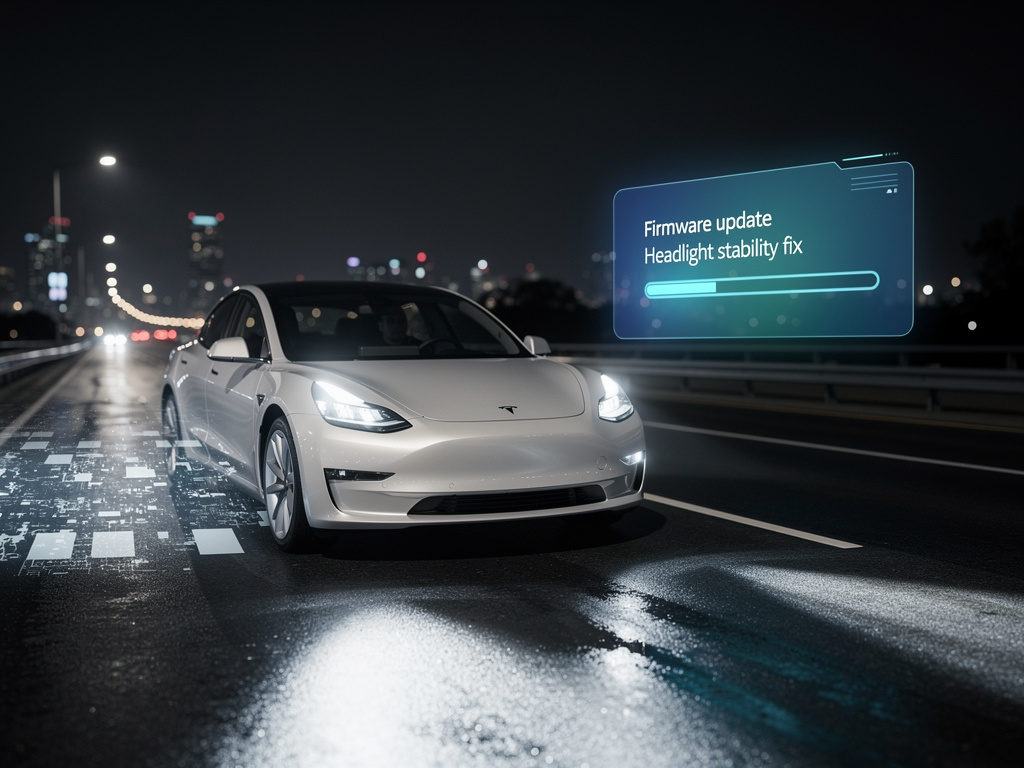
For more than two years, Tesla owners have endured one of the most persistent and aggravating software bugs in the automaker’s history: a matrix headlight malfunction that causes the adaptive lighting system to flicker, strobe, or shut off entirely during nighttime driving. Now, according to recent reports and firmware analysis, Tesla appears to be on the verge of deploying a fix — a development that has galvanized a community of frustrated drivers who have long complained that the issue poses a genuine safety hazard.
The problem centers on Tesla’s adaptive matrix LED headlights, a technology that debuted on the refreshed Model S and Model X in 2022 and later spread to the updated Model 3 (Highland) and Model Y (Juniper). These headlights are designed to selectively dim individual LED segments to avoid blinding oncoming traffic while maintaining maximum illumination elsewhere. In theory, the system offers superior nighttime visibility. In practice, a recurring software fault has turned the feature into a source of anxiety for thousands of Tesla owners.
A Bug That Blinks in the Dark
As reported by MSN, the matrix headlight bug manifests in several ways. Some owners report that the headlights flicker rapidly, creating a strobe-like effect that is disorienting for both the driver and oncoming motorists. Others describe instances where the adaptive beam pattern fails to activate at all, leaving the headlights in a static low-beam mode that significantly reduces forward visibility. In the worst cases, the headlights have been reported to shut off momentarily — a terrifying experience at highway speeds on unlit roads.
The issue has been extensively documented on Tesla forums, Reddit threads, and owner groups. Complaints span multiple vehicle models and firmware versions, suggesting that the root cause lies deep within Tesla’s headlight control software rather than in any particular hardware batch. Tesla’s own service centers have acknowledged the bug in numerous cases, but until recently, the standard response has been to advise owners to wait for a future over-the-air software update.
Why the Fix Took So Long
Part of the difficulty in resolving the matrix headlight bug stems from the complexity of the system itself. Matrix LED headlights rely on a camera-based detection system that identifies oncoming vehicles, pedestrians, and road signs in real time. The headlight control module then adjusts dozens of individual LED segments multiple times per second. The software must coordinate inputs from Tesla’s vision system, process them through the headlight controller, and execute beam adjustments — all without perceptible lag or error. When any link in that chain misfires, the result is the flickering or blackout behavior that owners have reported.
Tesla’s approach to vehicle software — shipping features quickly and iterating through over-the-air updates — has been both a strength and a vulnerability in this case. The company was able to roll out matrix headlights across its lineup faster than most legacy automakers, but the software clearly shipped before it was fully stable. For owners who purchased vehicles specifically expecting the advanced headlight functionality, the experience has been a lesson in the risks of being an early adopter of Tesla’s rapidly deployed features.
Firmware Clues Point to an Imminent Resolution
Recent firmware analysis by Tesla software trackers and enthusiast communities has uncovered changes in the headlight control code that suggest a comprehensive fix is in the pipeline. According to the MSN report, Tesla has been testing updated headlight firmware in limited deployments, with early recipients reporting significantly improved stability. The flickering behavior appears to be reduced or eliminated in the latest test builds, and the adaptive beam pattern is said to respond more reliably to oncoming traffic.
Tesla has not issued a formal public statement about the fix, which is consistent with the company’s general approach to software updates. Tesla dissolved its public relations department years ago and rarely comments on specific bugs or patch notes. Instead, owners typically learn about fixes through release notes that accompany over-the-air updates, or through the detective work of the enthusiast community that monitors firmware changes in real time.
The Safety Dimension
The headlight bug is not merely an inconvenience — it raises legitimate safety questions. Adaptive matrix headlights are subject to regulatory approval in multiple jurisdictions. In the United States, the National Highway Traffic Safety Administration (NHTSA) only authorized the use of adaptive driving beam (ADB) headlights in 2022, after years of lobbying by automakers. The technology was already standard in Europe, where UN Economic Commission for Europe regulations had permitted it for years. Tesla was among the first manufacturers to deploy ADB-compliant headlights in the U.S. market following the NHTSA’s rule change.
A malfunctioning adaptive headlight system could theoretically draw regulatory scrutiny if the failure mode is deemed to create an unreasonable safety risk. NHTSA maintains an active complaints database, and multiple entries related to Tesla’s matrix headlights have been filed by owners. While the agency has not opened a formal investigation into the issue as of this writing, a pattern of complaints — particularly those involving headlight blackouts — could trigger a preliminary evaluation. Tesla’s ability to fix the problem through an over-the-air update, rather than a physical recall, would likely be viewed favorably by regulators, but only if the fix is effective and deployed promptly.
Owner Frustration and Brand Loyalty Under Strain
The headlight saga has tested the patience of even Tesla’s most devoted customers. On forums like the Tesla Motors Club and the r/TeslaMotors subreddit, threads about the matrix headlight bug routinely attract hundreds of comments. Some owners have reported scheduling multiple service appointments only to be told that no hardware fault was found and that a software update would eventually resolve the issue. Others have expressed frustration that Tesla’s mobile app and service communication channels provide little transparency about known bugs and their expected resolution timelines.
For a company that has built its brand on the promise of continuous improvement through software, the prolonged headlight bug represents a reputational risk. Tesla owners have generally been willing to tolerate software quirks in exchange for the frequent feature additions and performance improvements that over-the-air updates deliver. But a safety-related bug that persists for months — or years — without resolution tests that social contract. If the forthcoming fix works as early testers suggest, it could restore confidence. If it doesn’t, Tesla may face mounting pressure from both customers and regulators.
The Broader Industry Context
Tesla is not the only automaker grappling with the complexities of matrix LED headlights. BMW, Mercedes-Benz, and Audi have all deployed their own versions of adaptive beam technology, and each has faced its own set of software calibration challenges. However, those manufacturers have generally had more time to refine their systems, having introduced matrix headlights in the European market years before the technology was permitted in the United States. Tesla’s rapid deployment, while impressive in its ambition, left less room for the kind of extended real-world testing that European automakers conducted over multiple model years.
The headlight issue also highlights a broader tension in the automotive industry’s shift toward software-defined vehicles. As more vehicle functions — from braking to steering to lighting — are controlled by software, the consequences of bugs become more significant. A glitch in an infotainment system is annoying; a glitch in a headlight system is potentially dangerous. Automakers that embrace the software-defined model will need to develop more rigorous testing and validation processes for safety-critical systems, even as they maintain the rapid update cadence that consumers have come to expect.
What Comes Next for Tesla Owners
For the thousands of Tesla owners affected by the matrix headlight bug, the immediate question is simple: when will the fix arrive? Based on the firmware analysis and early test reports cited by MSN, a broad rollout could come within weeks, likely bundled into a larger software update. Tesla’s over-the-air update infrastructure means that the fix, once finalized, can be pushed to affected vehicles without requiring a service visit — a significant advantage over traditional automakers that would need to issue a recall notice and schedule dealer appointments.
In the meantime, some owners have adopted workarounds, such as disabling the adaptive beam feature and relying on standard low beams, or manually toggling between high and low beams. These are imperfect solutions that sacrifice the very functionality that the matrix headlights were designed to provide. The hope — shared widely across Tesla’s online communities — is that the forthcoming update will finally deliver the reliable, high-performance adaptive lighting that was promised when these vehicles were sold. For Tesla, getting this right is about more than fixing a bug. It is about demonstrating that the software-defined vehicle model can be trusted with the systems that matter most.


 WebProNews is an iEntry Publication