
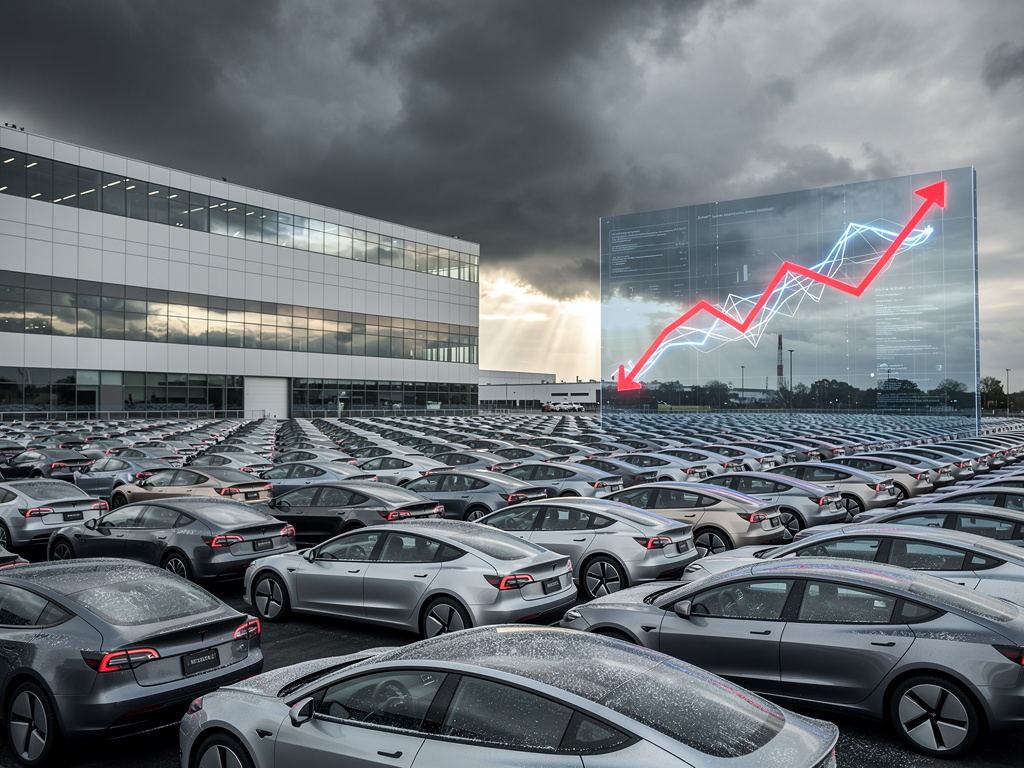
Tesla delivered 336,681 vehicles in the first quarter of 2025. That number, stark on its own, becomes alarming in context: it represents the company’s worst quarterly performance in nearly three years, a 13% decline from the same period last year, and a miss against already-lowered Wall Street expectations. The electric vehicle maker that once seemed to defy gravity is now contending with forces that even Elon Musk’s formidable cult of personality may not be able to overcome.
And the inventory keeps piling up.
According to Business Insider, Tesla’s days of supply — a standard measure of unsold vehicle inventory — climbed to 36 days at the end of Q1, the highest level on record for the company. JPMorgan analyst Ryan Brinkman flagged the figure in a note to clients, estimating that Tesla had roughly 151,000 unsold vehicles sitting on lots or in transit. That’s not a blip. That’s structural.
For years, Tesla operated with a demand problem most automakers would envy: it couldn’t build cars fast enough. Customers waited months. Inventory was essentially nonexistent. That era is over. The company now faces the same grinding reality that has defined the auto industry for a century — matching production to demand in a world where consumers have choices, budgets, and, increasingly, political opinions about the brands they buy.
The Musk Problem
No analysis of Tesla’s current predicament is complete without addressing the elephant in the boardroom. Elon Musk’s deepening involvement in politics — specifically his role leading the Department of Government Efficiency (DOGE) under President Trump — has become a material risk to the brand. Protests at Tesla dealerships and showrooms have become a recurring feature of the news cycle. Vandalism incidents have spiked. And in Europe, where Musk’s political affiliations clash sharply with prevailing consumer sentiment, sales have cratered.
European registrations for Tesla fell 45% year-over-year in March, according to data from the European Automobile Manufacturers’ Association cited by multiple outlets. In Germany, Tesla’s second-largest European market, the decline was even steeper. France, Sweden, and the Netherlands all posted dramatic drops.
This isn’t an abstract brand perception issue. It’s showing up in the numbers.
JPMorgan’s Brinkman, who has long been one of Tesla’s more skeptical analysts on Wall Street, maintained his underweight rating and a price target of $120 — roughly 55% below where the stock traded at the time. His thesis is straightforward: Tesla’s fundamentals don’t support its valuation, and the Q1 results only reinforce that view. He pointed to the inventory build as evidence that demand, not production constraints, is now the binding variable.
Business Insider reported that Brinkman also noted Tesla’s production of 362,615 vehicles in Q1 outpaced deliveries by roughly 26,000 units, widening the gap between what the company builds and what it sells. This is the kind of dynamic that, in traditional automaking, leads to painful production cuts, margin compression, and incentive spending that erodes profitability.
Tesla bulls counter that the company is in a transition period. The refreshed Model Y — codenamed “Juniper” — began production in January at Tesla’s Shanghai facility and has since started ramping at other plants. New model launches typically cause temporary delivery disruptions as logistics catch up and customers wait for the latest version rather than buying outgoing inventory. There’s truth to that argument. But it only goes so far.
The broader EV market is getting more competitive by the quarter. BYD, the Chinese manufacturer that overtook Tesla in global EV sales in Q4 2024, continues to gain ground. Its first-quarter deliveries surged past 400,000 battery-electric vehicles, not counting its massive plug-in hybrid business. In China, Tesla’s most important growth market, BYD’s dominance is becoming entrenched.
Meanwhile, legacy automakers are flooding the market with credible electric alternatives. Hyundai’s Ioniq lineup has won critical and consumer acclaim. BMW, Mercedes, and Volkswagen are all pushing harder into EVs despite mixed signals from some markets. Even in the United States, where Tesla still commands roughly half the EV market, share erosion is unmistakable. According to Cox Automotive data, Tesla’s U.S. EV market share fell below 50% in Q1 for the first time.
So where does that leave the stock?
Tesla shares have been volatile, which is nothing new. But the nature of the volatility has shifted. Previously, swings were driven by optimism about future products — the Cybertruck, full self-driving, the robotaxi. Now the swings are increasingly tied to present-tense fundamentals: deliveries, margins, inventory. The stock dropped sharply after the Q1 delivery miss, though it has partially recovered on broader market movements and speculation about upcoming product announcements.
The Valuation Disconnect
Here’s the core tension. Tesla trades at a price-to-earnings multiple that dwarfs every other automaker on the planet — and most tech companies, for that matter. That premium has historically been justified by the narrative that Tesla isn’t really a car company. It’s an AI company. A robotics company. An energy company. Pick your favorite story.
But the car business still accounts for the vast majority of Tesla’s revenue. And that car business just posted its weakest quarter since 2022. Energy storage deployments have been a bright spot, growing rapidly, but they remain a fraction of the overall business. The robotaxi initiative, which Musk has promised will transform Tesla’s economics, has yet to generate meaningful revenue. The Optimus humanoid robot is even further from commercialization.
JPMorgan’s $120 price target implies the market is dramatically overvaluing these future optionalities. Not every analyst agrees — several firms maintain buy ratings and targets above $300, arguing that the delivery miss is temporary and the product pipeline is strong. Dan Ives at Wedbush, a perennial Tesla bull, has acknowledged the brand damage from Musk’s political activities but maintains that the underlying technology and manufacturing advantages remain intact.
The inventory data complicates the bull case, though. A company with record unsold vehicles doesn’t typically command a growth premium. Tesla may need to cut prices further to clear inventory, which would pressure margins that have already declined significantly from their 2022 peaks. Automotive gross margins excluding regulatory credits fell to around 16% in recent quarters, down from above 25% at their zenith.
Price cuts have been Tesla’s go-to demand lever for the past two years. The Model 3 and Model Y have both seen substantial reductions in the U.S., China, and Europe. Each round of cuts boosts volume temporarily but compresses margins and arguably damages the brand’s pricing power long-term. It’s a treadmill. And the treadmill is speeding up.
There’s also the question of what happens when interest rates eventually come down. Lower rates would reduce monthly payments on new vehicles, potentially boosting demand across the industry. Tesla would benefit. But so would every competitor. The rising tide argument cuts both ways when you’re trying to justify a valuation that assumes market dominance for decades.
Musk himself has acknowledged, in characteristically indirect fashion, that 2025 would be a difficult year. On Tesla’s Q4 2024 earnings call, he said the company was “between two major growth waves” and that the current product lineup was mature while next-generation vehicles were still ramping. Wall Street heard that and mostly shrugged, choosing to focus on the promise of what’s next rather than the reality of what’s now.
The Q1 numbers made that harder to do.
What Comes Next
Tesla’s Q1 earnings report, expected in late April, will provide more granularity on margins, inventory management, and forward guidance. Analysts will be parsing every line for signs that the delivery weakness is transient or structural. The company’s commentary on the Model Y ramp will be particularly scrutinized — if Juniper demand is strong, bulls will argue the Q1 miss was a timing issue. If inventory continues to build, the narrative shifts decisively.
The political dimension isn’t going away either. Musk shows no signs of stepping back from DOGE or moderating his public persona. If anything, his activity on X (formerly Twitter) has become more provocative. For a consumer brand, this is uncharted territory. No major automaker CEO has ever been this politically polarizing while simultaneously serving as the face of the brand. The closest analog might be the Bud Light controversy that engulfed Anheuser-Busch InBev — but even that was a marketing decision, not the personal politics of the CEO.
Tesla’s board has been largely silent on the matter, which itself speaks volumes. The company’s corporate governance has long been a sore point for institutional investors. Musk’s dual role as CEO of Tesla and head of a government cost-cutting initiative raises obvious questions about time allocation, conflicts of interest, and fiduciary duty. None of these questions have been satisfactorily answered.
For now, the numbers tell the story. 336,681 deliveries. 36 days of supply. A 13% year-over-year decline. An inventory build that shows no signs of reversing. And a stock price that, depending on whom you ask, either reflects extraordinary future potential or extraordinary present-day delusion.
The market will decide. It always does. But the margin for error at Tesla’s current valuation is razor-thin, and Q1 just demonstrated how easily that margin can be breached.


 WebProNews is an iEntry Publication