
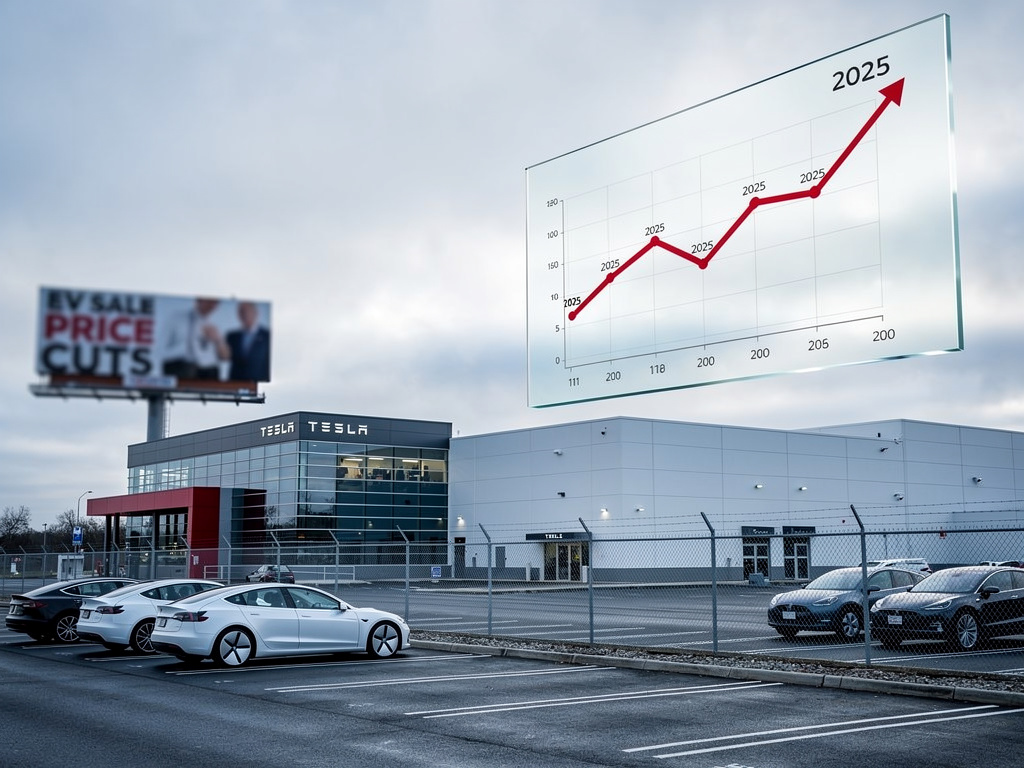
Tesla Inc. has long stood as the bellwether of electric vehicle success, transforming from a Silicon Valley upstart into the world’s most valuable automaker. Yet 2025 marked an unprecedented turning point: for the first time in its history as a publicly traded company, Tesla reported an annual revenue decline, signaling potential headwinds for both the company and the broader electric vehicle industry.
According to Ars Technica, Tesla’s annual revenue fell in 2025, representing a historic shift for a company that has consistently posted growth figures that made traditional automakers envious. The decline comes amid mounting competition from established manufacturers, pricing pressures, and questions about the company’s strategic direction under CEO Elon Musk’s increasingly divided attention.
The revenue contraction represents more than just a statistical anomaly—it reflects fundamental challenges facing Tesla as it transitions from a growth-stage disruptor to a mature automotive manufacturer operating in an increasingly crowded market. Industry analysts point to multiple factors contributing to this downturn, including aggressive price cuts that eroded margins, delivery shortfalls relative to production capacity, and growing consumer hesitancy in key markets.
Delivery Numbers Tell a Sobering Story
Tesla’s delivery figures, long the metric by which Wall Street measured the company’s health, revealed troubling trends throughout 2025. The company struggled to meet its own projections, with quarterly delivery reports consistently falling short of analyst expectations. This marked a departure from previous years when Tesla regularly exceeded forecasts, often by substantial margins.
The delivery challenges stemmed partly from production issues at Tesla’s newer facilities, particularly the Berlin Gigafactory, which faced regulatory hurdles and supply chain complications. Meanwhile, the Shanghai factory, once Tesla’s most reliable production hub, experienced disruptions related to intensifying competition from domestic Chinese manufacturers like BYD, which has aggressively expanded its market share in the world’s largest electric vehicle market.
Price Wars Erode Profit Margins
Tesla initiated multiple rounds of price reductions throughout 2024 and into 2025, attempting to stimulate demand and maintain market share. While these cuts temporarily boosted order volumes, they came at a significant cost to the company’s historically robust profit margins. The automotive gross margin, once Tesla’s crown jewel that distinguished it from traditional automakers, compressed substantially as the price war intensified.
The pricing strategy reflected a difficult calculus: maintain premium positioning and risk losing volume to cheaper competitors, or slash prices to defend market share while sacrificing profitability. Tesla chose the latter, but the gambit failed to prevent the revenue decline, suggesting that the company faces deeper demand challenges than price alone can solve. Industry observers note that this approach may have also damaged Tesla’s brand perception, transforming it from an aspirational luxury product to a more commoditized offering.
Competition Intensifies Across All Markets
The electric vehicle sector has evolved dramatically since Tesla’s early days of near-monopolistic dominance. Legacy automakers including Ford, General Motors, Volkswagen, and Mercedes-Benz have launched competitive electric vehicles with sophisticated technology, established dealer networks, and substantial marketing budgets. These companies have learned from Tesla’s playbook while leveraging their own manufacturing expertise and brand equity.
In China, Tesla faces particularly fierce competition from domestic manufacturers that benefit from government support, lower production costs, and deep understanding of local consumer preferences. BYD surpassed Tesla in global electric vehicle sales, marking a symbolic shift in industry leadership. Chinese manufacturers have also begun exporting vehicles to Europe and other markets, pressuring Tesla’s international operations.
The Musk Factor and Strategic Distraction
Elon Musk’s leadership style and divided attention have become increasingly contentious topics among investors and industry watchers. His acquisition and management of X (formerly Twitter), involvement in political activities, and numerous other business ventures have raised questions about his focus on Tesla’s core automotive business. Some analysts suggest that this distraction contributed to strategic missteps and slower decision-making at critical junctures.
The CEO’s controversial public statements and political positioning have also affected Tesla’s brand appeal, particularly among environmentally conscious consumers who traditionally formed the company’s core customer base. Survey data indicates declining purchase intent among certain demographic groups who previously favored Tesla vehicles, suggesting that Musk’s personal brand has become increasingly intertwined—and potentially problematic—for the company’s commercial success.
Product Pipeline Concerns and Delayed Innovation
Tesla’s product lineup has remained relatively static, with the Model 3 and Model Y continuing to generate the vast majority of sales. The long-promised Cybertruck, finally delivered in limited numbers, has faced production challenges, quality concerns, and mixed market reception. The vehicle’s unconventional design, once seen as bold innovation, has proven polarizing, limiting its mass-market appeal.
Meanwhile, competitors have rapidly expanded their electric vehicle portfolios with diverse offerings spanning multiple price points, body styles, and feature sets. Tesla’s promised next-generation platform and more affordable models have been repeatedly delayed, leaving the company vulnerable to competitors who have filled market gaps that Tesla identified but failed to address promptly. The robotaxi initiative, heavily promoted by Musk, remains years away from meaningful commercial deployment despite consuming significant engineering resources.
Energy Storage Business Provides Partial Offset
While automotive revenue declined, Tesla’s energy generation and storage business showed continued growth, providing a partial offset to the automotive downturn. The Megapack utility-scale battery storage system has gained traction with utilities and commercial customers seeking grid-scale energy storage solutions. However, this segment remains a fraction of overall revenue and cannot compensate for automotive challenges.
The energy business demonstrates Tesla’s broader ambitions beyond vehicle manufacturing, but it also highlights the company’s struggle to execute simultaneously across multiple complex industries. Resource allocation between automotive, energy, and other initiatives like artificial intelligence and robotics has become increasingly fraught as growth pressures mount.
Financial Markets React with Caution
Tesla’s stock price, which reached extraordinary valuations based on growth expectations, has faced increased volatility as the revenue decline became apparent. The company’s market capitalization, once exceeding the combined value of multiple traditional automakers, has come under pressure as investors reassess growth assumptions and profitability trajectories. The valuation debate has intensified, with bears arguing that Tesla should be valued as a mature automotive company rather than a high-growth technology firm.
Institutional investors have begun reducing positions or demanding clearer strategic direction from management. The revenue decline has emboldened critics who long argued that Tesla’s valuation was unsustainable and disconnected from automotive industry fundamentals. Meanwhile, supporters maintain that Tesla’s technological advantages, manufacturing capabilities, and potential in autonomous driving justify premium valuations despite near-term challenges.
Regulatory Headwinds and Subsidy Changes
Changes in government incentive programs have also impacted Tesla’s sales performance. In the United States, modifications to federal tax credit eligibility criteria affected Tesla’s competitive positioning relative to domestic manufacturers. European markets have seen subsidy reductions as governments reassess electric vehicle support programs amid budget pressures. These policy shifts have disproportionately affected Tesla, which built its business model partly around incentive structures that are now evolving.
The company also faces ongoing regulatory scrutiny regarding its Autopilot and Full Self-Driving features, with investigations into accidents involving these systems continuing across multiple jurisdictions. These regulatory challenges create uncertainty around one of Tesla’s key differentiators and potential future revenue streams, further complicating the company’s growth narrative.
The Path Forward Remains Uncertain
Tesla’s first annual revenue decline forces a reckoning with questions the company has long deferred. Can it maintain technological leadership as competitors close the gap? Will the promised autonomous vehicle revolution materialize on a timeline that matters for current business performance? Can the company expand its addressable market with new products while defending existing positions?
The answers will determine whether 2025 represents a temporary setback or the beginning of a more fundamental transformation in Tesla’s trajectory. For an industry watching closely, Tesla’s challenges offer lessons about the difficulties of sustaining hypergrowth, the risks of depending too heavily on a single charismatic leader, and the inevitable maturation that comes with success. The electric vehicle revolution continues, but Tesla’s role as its undisputed leader now faces legitimate questions that revenue growth once obscured.


 WebProNews is an iEntry Publication