
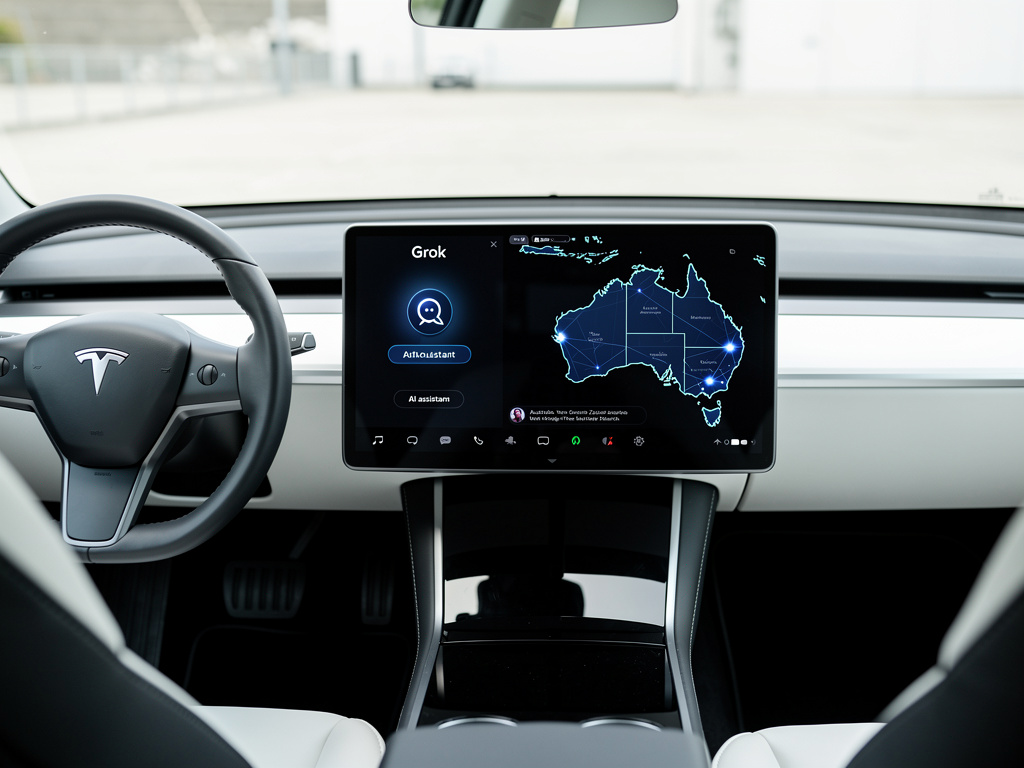
Tesla has officially begun deploying Grok, the artificial intelligence assistant developed by Elon Musk’s xAI, in vehicles across Australia and New Zealand — marking the latest step in the automaker’s aggressive push to embed conversational AI directly into the driving experience. The rollout, confirmed in recent days through Tesla’s software update channels, extends the Grok integration beyond its initial North American footprint and raises pointed questions about how AI assistants will reshape the relationship between drivers, their vehicles, and the broader data economy.
The feature, which arrives via an over-the-air software update, allows Tesla owners in both countries to interact with Grok through the vehicle’s central touchscreen. Drivers and passengers can ask questions, request information, and engage in general conversation with the AI model — similar to how one might interact with ChatGPT or Google’s Gemini, but housed natively within the car’s infotainment system. As reported by MSN, the integration brings Grok’s capabilities to right-hand-drive markets for the first time at scale, a notable expansion given Tesla’s relatively smaller but growing presence in the Asia-Pacific region.
From Novelty to Standard Equipment: The Strategic Logic Behind In-Car AI
Tesla first introduced Grok to its vehicles in late 2024, initially limiting access to owners in the United States and parts of Europe. The expansion to Australia and New Zealand follows a pattern that has become familiar with Tesla’s software features: a phased geographic rollout that uses early adopters as a real-world testing ground before broader deployment. The approach mirrors how Tesla has handled Full Self-Driving beta releases, where regulatory environments and user feedback in initial markets inform subsequent launches.
The timing of the southern hemisphere expansion is not accidental. Tesla has been working to strengthen its competitive position in Australia, where it faces growing pressure from Chinese EV manufacturers like BYD, which have made significant inroads in recent months. Adding Grok as a differentiating software feature — one that competitors cannot easily replicate without their own large language model partnerships — gives Tesla a talking point that extends beyond range, price, and charging infrastructure. It is, in effect, a bid to make the ownership experience stickier through software rather than hardware alone.
What Grok Can and Cannot Do Behind the Wheel
In its current automotive implementation, Grok operates primarily as an information and entertainment tool. Drivers can ask it factual questions, request weather updates, get explanations of Tesla vehicle features, or simply engage in casual conversation during long drives. The AI can also process queries related to navigation and points of interest, though it does not directly control the vehicle’s driving systems or interface with Autopilot or Full Self-Driving functions.
This distinction matters. While the marketing appeal of an AI copilot is considerable, Tesla has been careful — at least for now — to keep Grok’s role separate from safety-critical vehicle operations. The assistant lives within the infotainment layer, not the autonomous driving stack. Industry analysts have noted that this separation is likely both a regulatory necessity and a liability management strategy. Integrating a large language model, which can hallucinate or produce incorrect information, into systems that control steering, braking, or acceleration would introduce an entirely different category of risk.
Data Privacy Concerns Follow the Feature Across Borders
The arrival of Grok in Australian and New Zealand Teslas has prompted fresh scrutiny from privacy advocates in both countries. Australia’s Privacy Act, which is currently undergoing a significant reform process, imposes obligations on companies collecting and processing personal data. Conversations with an AI assistant inside a vehicle could potentially capture sensitive information — from voice patterns to the substance of spoken queries — raising questions about what data is transmitted to xAI’s servers, how long it is retained, and whether it is used to train future versions of the model.
Tesla’s privacy policy for Grok states that voice interactions may be collected and used to improve the service, though the company says data is anonymized. Privacy researchers have pointed out that the definition of “anonymized” varies considerably across jurisdictions and that voice data, in particular, is notoriously difficult to fully de-identify. The Australian Information Commissioner’s office has not issued specific guidance on in-vehicle AI assistants, but the broader regulatory trend in Australia has been toward stricter data handling requirements, particularly after a series of high-profile data breaches at Optus, Medibank, and other major companies in recent years.
The Competitive Pressure: How Other Automakers Are Responding
Tesla is not operating in a vacuum. Mercedes-Benz has integrated a ChatGPT-powered voice assistant into select models through its MBUX system. BMW has partnered with Amazon’s Alexa for in-car voice capabilities, while General Motors recently announced an expanded relationship with Google to bring enhanced AI features to its vehicles. Volkswagen demonstrated a ChatGPT integration at CES 2024, and Hyundai has been exploring its own in-car AI offerings.
What distinguishes Tesla’s approach is the vertical integration. Grok is built by xAI, a company founded and controlled by Musk himself. This means Tesla does not need to negotiate licensing terms with a third-party AI provider, share revenue, or worry about a partner pulling access. It also means that the feedback loop between vehicle users and model improvement is entirely within the Musk corporate family. Whether this represents an advantage or a conflict of interest depends largely on one’s perspective — and on how transparently the data pipeline operates.
Australia and New Zealand as a Testing Ground for Broader Asia-Pacific Ambitions
Industry observers see the Australia-New Zealand launch as a precursor to wider Asia-Pacific deployment. Both countries offer English-speaking markets with relatively permissive technology adoption cultures and regulatory frameworks that, while tightening, are less restrictive than those in the European Union or certain Asian markets like Japan and South Korea. If the rollout proceeds without significant technical or regulatory complications, it could pave the way for Grok’s introduction in additional right-hand-drive markets such as the United Kingdom, India, and Southeast Asian countries where Tesla has expressed future sales ambitions.
The Australian market, in particular, serves as a useful bellwether. With approximately 15,000 to 20,000 Tesla vehicles sold annually in recent years, according to data from the Federal Chamber of Automotive Industries, the installed base is large enough to generate meaningful usage data but small enough to manage if issues arise. New Zealand, with its smaller fleet, adds geographic and network diversity to the testing profile without dramatically increasing risk exposure.
The Bigger Picture: AI as the New Battleground for Automotive Brand Loyalty
The integration of Grok into Tesla vehicles reflects a broader industry thesis: that software, not sheet metal, will increasingly determine which automakers retain customers over multiple purchase cycles. The logic runs as follows — if a driver becomes accustomed to a particular AI assistant, relies on it for daily information needs, and builds a history of preferences and interactions within that system, switching to a competitor’s vehicle becomes more costly in terms of convenience and familiarity. It is the same lock-in dynamic that has made Apple’s iOS and Google’s Android so durable in the smartphone market.
For Tesla, which has long positioned itself as a technology company that happens to make cars, the Grok integration reinforces that identity. But it also introduces new dependencies. If Grok underperforms relative to competitors’ AI offerings, or if xAI’s model development falls behind OpenAI, Google, or Anthropic, the feature could become a liability rather than an asset. The AI assistant space is moving extraordinarily fast, and what impresses users today may feel outdated within months.
What Comes Next: Vehicle Control, Commerce, and the Road Ahead
The most consequential question surrounding Grok’s automotive integration is not what it does today, but what it might do tomorrow. Tesla has filed patents and made public statements suggesting a future where AI assistants could manage vehicle charging schedules, optimize route planning based on real-time energy pricing, facilitate in-car purchases, and even coordinate with smart home systems. Musk himself has hinted at deeper integration between Grok and Tesla’s autonomous driving capabilities, though no specific timeline has been provided.
For now, the Australia and New Zealand rollout represents a measured expansion — one that extends Tesla’s AI ambitions to new geographies while keeping the feature’s scope deliberately contained. Whether Grok becomes a defining feature of the Tesla ownership experience or a footnote in the broader AI arms race will depend on execution, regulation, and the speed at which the underlying technology continues to advance. What is already clear is that the car, once a purely mechanical product, has become a platform — and the competition to control what happens on that platform is only intensifying.


 WebProNews is an iEntry Publication